

Reviewed by Beverly H. Moskowitz, DOT MS OTR/L FAOTA, pediatric occupational therapist
For parents of children aged 2 to 5
Strong, dextrous hands help children feed themselves, dress, draw and later write. These fine motor skills are built through everyday practice and play, not through drills. The best way to encourage engagement and ongoing development is to offer enticing, success-ensured, varied and durable materials in kid-friendly environments, like play centers. When working on activities of daily life, allow plenty of time for exploration, mistakes and self-correction. Be generous with your praise of their efforts, but restrained before inserting yourself into their problem-solving experimentation. Always stay with your child, and skip anything with small parts for children who still put things in their mouths.
Here are six simple activities you can try at home.
1. Scooping and pouring
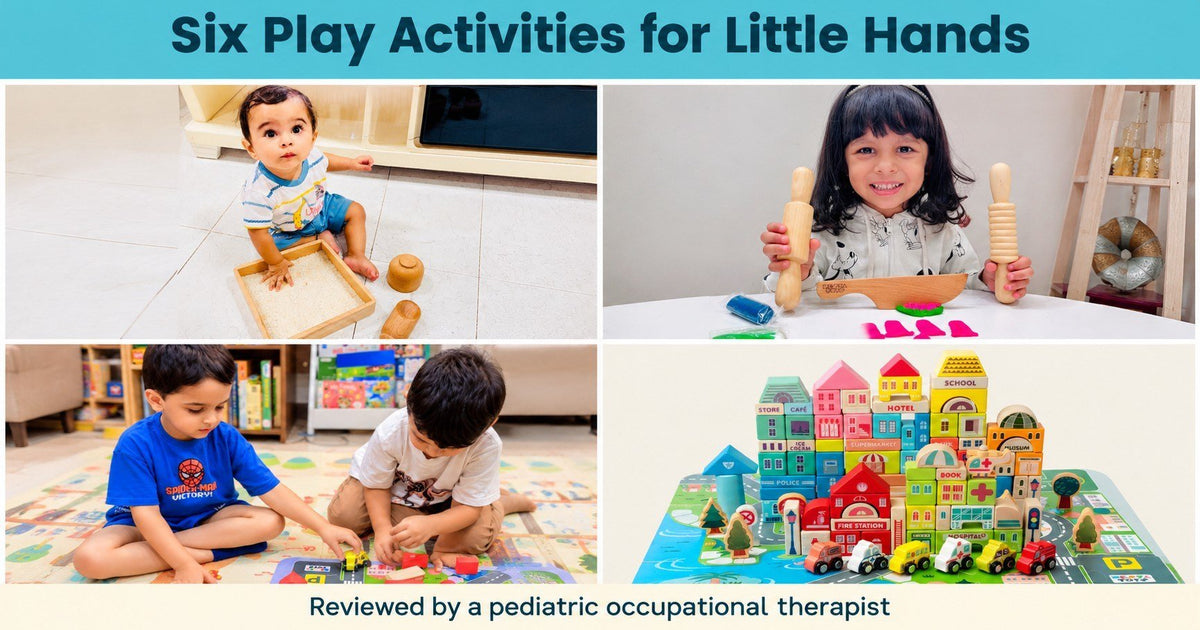
Give your child a bowl of dry rice, dal or sand, a spoon and two cups. Let them scoop from one cup to the other. This builds wrist control and bilateral coordination, the way hands work together. Putting a cookie sheet underneath can catch some spillage. That’s part of learning, too!
2. Squeezing play dough
Soft dough can be squeezed, rolled, pinched and pulled. Ask your child to roll a “snake” or press small pieces into a ball. Squeezing builds the small muscles in the fingers. Store the dough in an airtight container so it can be used again and again.
3. Threading large beads
Use large wooden beads and a thick lace. Start with 3 or 4 assorted round, square or cylindrical beads, and add more over time. Threading the lace through each hole builds finger control and eye-hand coordination. Supervise the assembly. If you knot one end of the lace so the beads accumulate, your child can see the fruit of their labor: 3, 6, 10 beads on top of each other! A great way to promote self-esteem as well.
4. Pegs and clothes pegs
Clip clothes pegs onto the edge of a box or a string. Opening and closing a peg works the thumb and first two fingers, which are the fingers used to hold a pencil. For an additional challenge, suspend the string between two upright cans and pretend it’s a clothesline. Use cardstock cutouts of clothes, or actual fabric, to hang the “clothes”. For even more challenge, make the pictures part of a number or sequence story: what comes first, second, last? A fun way to sneak in a cognitive lesson.
5. Stacking and building
Wooden block towers require careful placing to grow. Start with 3 to 4 blocks. Each additional block is an opportunity to practice graded release, balance, midline crossing, hand preference and visual tracking. Let your child choose what to build. Self-determination fosters creativity and feelings of competence.
6. Moving things with tongs
Use child-safe tongs or tweezers to move soft pom-poms or cotton balls from the floor into a bowl, or from one bowl to another. Experiment with deep and shallow bowls, wide openings and smaller ones, large enough that nothing falls out. Try transferring cotton balls into a tennis-ball-type cylinder: now one hand has to hold the container while the other works the tongs. This builds bilateral coordination, midline crossing, grip strength and visual tracking. Keep small items away from children who mouth things.
Tips for parents
- Keep sessions short, about 5 to 10 minutes.
- Let your child lead. If they’re not interested, try again another day.
- Praise the effort, not the result.
- Rotate activities so play stays fresh.
When to ask for help: Every child develops at their own pace. If you’re worried about your child’s hand skills or development, speak with your pediatrician or an occupational therapist.
This guide offers general play ideas and is not medical advice.
For more ideas by age, see our guide to Montessori toys by age in India.
About the reviewer
Beverly H. Moskowitz, DOT MS OTR/L FAOTA, is a pediatric occupational therapist with 50+ years of practice, a Fellow of the American Occupational Therapy Association, President and CEO of Real OT Solutions, and author of the Size Matters Handwriting Program.


