

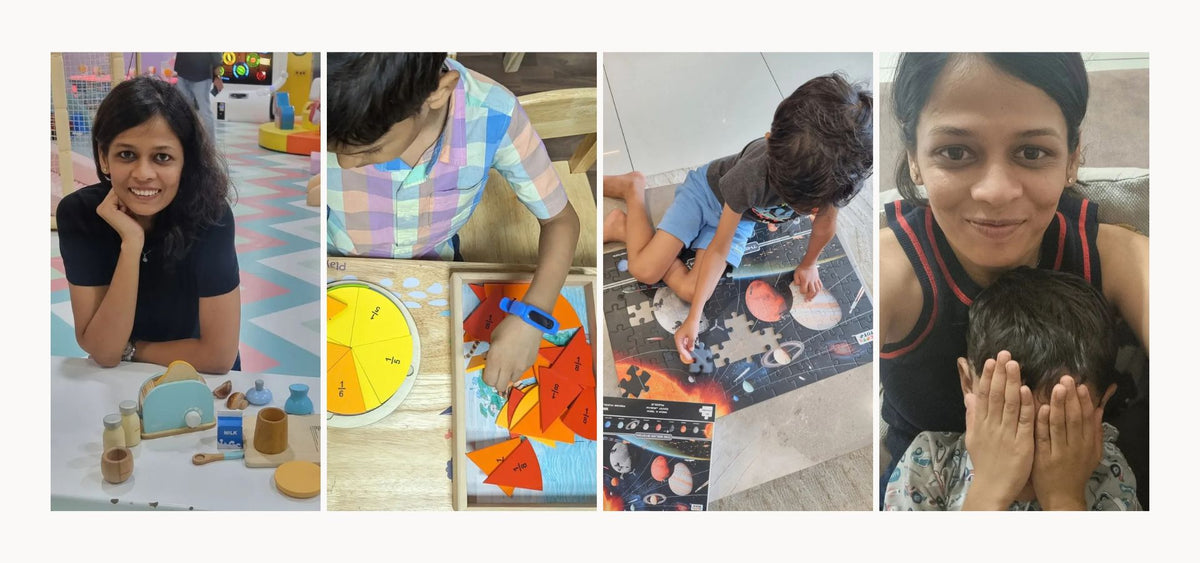
I’m Neha Makdey, Founder & CEO of NESTA TOYS. Over the years, I’ve had the opportunity to design and develop hundreds of research-backed toy concepts, drawing on my background in consulting and my understanding of how children learn through play.
But my most important learning has come from being a mother to a 6-year-old. Watching my own son play, explore, get curious, lose interest, try again and figure things out has taught me things that no textbook could. It has also shaped the way I think about what makes a toy truly meaningful for a child.
My son's journey with toys actually started during COVID. Like many parents, I suddenly had a lot more time at home with my child. I started reading extensively about parenting, child development and early learning. I read more than 20 parenting books, explored Montessori principles, and spent a lot of time understanding one particular question:
How do you help a child become independent in the first few years of life?
That question eventually became one of the foundations behind NESTA TOYS.
But before I designed toys for other children, I experimented with them with my own son.
I observed what he picked up.
What he ignored.
What kept him engaged for five minutes versus thirty minutes.
What challenged him.
What frustrated him.
And what he kept coming back to on his own.
I also bought toys from several other brands - not just for him to play with, but because I wanted to understand what worked, what didn't, how different toys were designed and what made one toy more engaging than another.
My son, of course, did not follow my carefully planned timeline!
He moved much faster than I expected. His interests changed. His abilities changed. Something that fascinated him one month could become completely irrelevant the next.
And that experience taught me something important:
There is no single “best toy” for every child.
The right toy depends on the child - their age, their developmental stage, their interests, their temperament and even the environment in which they play.
After years of observing my son, here are five things I have learned about choosing toys for children from 0 to 6 years.
1. Follow Your Child's Interests
This is probably the biggest lesson I learned as a parent.
If your child is interested in something, use that interest as your starting point.
When my son was very young, he was fascinated by dinosaurs.
So, for a while, everything became dinosaurs.
Books about dinosaurs.
Stories about dinosaurs.
Flashcards.
Puzzles.
Pictures.
Toys.
Anything I could find that allowed him to explore that interest further.
Then, at around two and a half, his interest changed.
Suddenly, it was cars.
And I followed him there.
Instead of trying to constantly introduce completely new subjects, I started looking for different ways for him to explore cars.
We had books about cars, stories about cars, flashcards, puzzles and toys involving wheels. I even looked for toys where he could understand how wheels work and experiment with them.
Something interesting happened.
He was willing to spend much more time learning when the subject already interested him.
A puzzle may be difficult. But if it is a puzzle about something he loves, he is more willing to keep trying.
A book may require patience. But if it is about something he wants to know more about, he wants to turn the next page.
This is something I now keep in mind whenever I design toys.
Sometimes parents ask:
“What toy should I buy for a two-year-old?”
I think a better question is:
“What is my two-year-old interested in right now?”
If your child loves animals, explore animals.
If they love vehicles, explore vehicles.
If they love cooking, explore cooking.
If they are fascinated by water, find ways to explore water.
You don't need ten completely unrelated toys.
One strong interest can become the gateway to many different kinds of learning.

2. Always Keep the Next Challenge Ready
The second thing I learned is that children need room to grow into their toys.
One mistake we can make as parents is buying a toy that is exactly at the child's current ability level and then replacing it as soon as they master it.
Instead, I prefer having the next level of challenge ready.
For example, if my son is comfortable solving a simple puzzle, I don't necessarily need to immediately put that puzzle away.
I can keep a slightly more challenging puzzle available.
Then another.
And another.
At home, we have puzzles with different levels of difficulty - something he can comfortably complete, something that requires a little more thought, and something that is currently a stretch for him.
This creates a natural progression.
The child has something they can do, something they are learning to do, and something they can eventually master.
That progression is important because a toy should not only entertain a child today.
Ideally, it should also give them an opportunity to develop a new skill tomorrow.
When I evaluate toys, I therefore ask:
-
What can my child do with this today?
-
What could they learn to do with it in a few months?
-
Does the toy offer different levels of difficulty?
-
Can the child use it independently as their abilities grow?
A good toy doesn't always have to be easy.
Sometimes the best toy is the one that makes a child think:
“I can't do this yet. Let me try again.”
3. The Environment Around the Toy Matters as Much as the Toy
This is something I understood more deeply after becoming a parent.
You can buy a fantastic toy, but the way you create the environment around it can determine how much the child actually gets out of it.
At home, we try to make playtime a space where my son can focus.
That means fewer distractions.
No screen running in the background.
No phone being constantly handed to him.
And, as much as possible, no electronic toy that does all the work for him.
Why?
Because I want him to be the active participant.
If a toy lights up, makes sounds, moves automatically and essentially performs the activity for the child, there may be very little left for the child to figure out.
But when a child has to physically manipulate something, assemble it, sort it, build it, thread it, balance it, solve it or pretend with it, they have to participate.
Their hands are working.
Their mind is working.
They are making decisions.
They are figuring out what happens next.
That is the kind of play environment I try to create for my son.
It doesn't have to be elaborate.
You don't need a dedicated playroom.
Even a small corner with a few thoughtfully chosen toys can work.
The important thing is to give the child time, space and freedom to explore without constant distraction.

4. Choose Toys That Make the Child Do the Work
This is closely connected to the previous point, but it deserves to be said separately.
I look for toys where my child has to do the work.
This has become one of my strongest principles as a toy designer.
When choosing a toy, I ask:
“What is the child actually doing?”
Are they pressing a button?
Or are they figuring something out?
Is the toy performing the activity?
Or is the child performing it?
Does the toy give the child an answer immediately?
Or does it allow them to experiment and discover the answer?
For me, the second option is usually much more valuable.
A simple building toy can require a child to plan, connect pieces, balance structures and solve problems.
A puzzle requires them to observe, remember, rotate pieces and persist.
A pretend-play set allows them to create their own stories.
A threading activity works their hands while requiring concentration.
These toys may not look as flashy as an electronic toy, but they can demand much more from the child.
And that's exactly what I want.
I don't want the toy to replace the child's imagination. I want it to give their imagination something to work with.
5. Don't Forget Real People and Real-World Play
There is one more thing I have become increasingly conscious of as a parent:
Toys are only one part of a child's development.
Children also need people.
They need conversation.
They need physical activity.
They need outdoor play.
They need to interact with other children.
They need to watch adults doing everyday things.
They need opportunities to imitate, negotiate, communicate and solve little problems together.
Sometimes, as parents, we can become so focused on buying the “right” developmental toy that we forget the most powerful learning opportunities are already around us.
Cooking together.
Going to the park.
Sorting laundry.
Talking about what you see on a walk.
Building something together.
Playing a simple game.
Reading a book together.
Having another child over to play.
These experiences teach things that no toy can completely replicate.
And when children play with other children, there is another layer of learning.
They have to share.
Wait.
Communicate.
Negotiate.
Improvise.
Sometimes they disagree.
Sometimes they solve the disagreement themselves.
All of this is part of growing up.
So when I think about creating the right play environment for my son, I don't think only about which toys are on the shelf.
I think about the entire environment around him.
What is he seeing? Who is he interacting with? What is he allowed to explore? How much independence does he have? And how much time does he have to simply play?
So, How Do I Choose Toys for My Son?

If I had to simplify everything I have learned as a toy founder and a mother, my approach would be this:
1. Follow his interests.
If he loves dinosaurs, explore dinosaurs. If he moves on to cars, follow the cars.
2. Give him the next challenge.
Don't buy only what he can already do. Keep something slightly ahead of his current ability.
3. Create a focused play environment.
Reduce distractions and give him uninterrupted time to explore.
4. Choose toys that make him work.
I look for toys that require his hands, imagination, problem-solving and creativity - rather than toys that do everything for him.
5. Give him opportunities beyond toys.
Books, outdoor play, everyday activities, conversations and playing with other children are just as important.
Most importantly, I've learned that choosing toys isn't about finding the most expensive, most popular or most “educational” toy.
It's about finding something that is right for your child, at that particular stage of their development.
And that can change surprisingly quickly.
The dinosaur phase may become the car phase.
The simple puzzle may become the 25-piece puzzle.
Parallel play may become cooperative play.
And the toy that once sat untouched may suddenly become their favourite six months later.
As parents, our job isn't to perfectly predict what our children need next.
It is to observe them, follow their interests, give them the right level of challenge, and create an environment where they can explore independently.
That is how I have chosen toys for my son from 0 to 6 years.
And, in many ways, he has taught me as much about designing toys as all the books I have read and all the toys I have studied.


