

What Are Montessori Racks and Tubes and How Do They Help Children Learn Division?
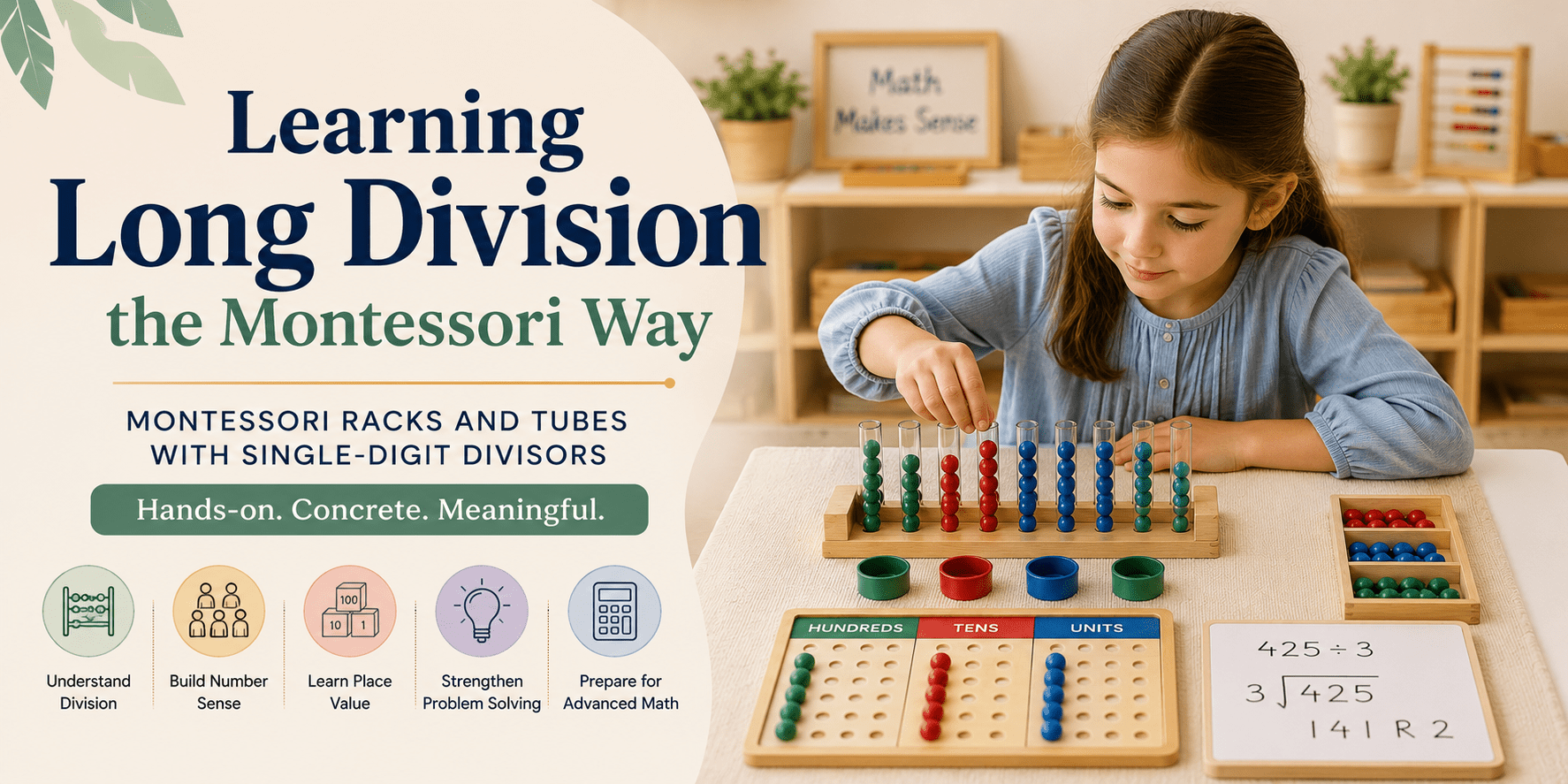
The Montessori Racks and Tubes material is used in elementary classrooms to teach long division in a concrete and hands-on way. It helps children understand the distribution of quantities, the relationship between division and multiplication, and the process of dividing numbers across place values. By working with racks, tubes, and beads, children can visualize how division works, record quotients, carry remainders, and build a strong foundation for more advanced mathematical operations. In addition to supporting conceptual understanding, the material encourages logical thinking, problem-solving, and practical applications of division in everyday life.
Understanding the Montessori Racks and Tubes Material
The Racks and Tubes material is used in Montessori elementary classrooms to teach long division. It helps children understand division concepts, including the distribution of quantities and the relationship between division and multiplication.
The material consists of a series of racks holding beads and tubes for carrying out the division process.
How the Racks and Tubes Presentation Works
1. Introduction to the Material
-
Show the child the racks and tubes.
-
Explain that each tube will hold a certain quantity of beads representing numbers in the division process.
2. Setting Up the Problem
-
Write a division problem on a board (e.g., 425 ÷ 3).
-
Place the dividend (425) in the appropriate place value columns (hundreds, tens, units) using the beads.
3. Dividing the Hundreds
-
Take the beads from the hundreds place and divide them into three groups (since the divisor is 3).
-
Place the beads back into the tubes representing each group.
4. Recording the Quotient
-
Write the number of beads in each group under the hundreds place in the quotient area.
-
If there are remaining beads that cannot be evenly divided, carry them over to the tens place.
5. Dividing the Tens and Units
-
Repeat the process with the tens and units.
-
Ensure the child understands how to carry over remainders to the next place value.
6. Final Steps
-
Once all place values are divided, write down the final quotient and remainder if any.
-
Review the process with the child, ensuring they understand each step.

Why Montessori Racks and Tubes Are Effective
Conceptual Understanding
-
Helps children grasp the concept of division and its relationship with multiplication.
-
Provides a visual and hands-on approach to understanding how numbers are distributed.
Practical Applications
-
Enhances problem-solving skills and logical thinking.
-
Prepares children for more advanced mathematical concepts and operations.
Connecting Mathematics to Daily Life
-
Encourages the use of division in practical scenarios, such as dividing items equally among friends or family members.
Follow-Up Activities to Reinforce Division Concepts
The following activities help children apply division skills beyond the classroom and strengthen mathematical understanding through real-life experiences.
Real-Life Division
-
Engage your child in dividing household items (e.g., sharing snacks equally among family members).
-
Use real objects like buttons or coins to set up simple division problems.
Word Problems
-
Create word problems that involve division and solve them together.
-
Encourage your child to come up with their own division problems and solutions.
Division Games
-
Play board games that involve division or use apps that focus on division skills.
-
Create flashcards with division problems for quick and fun practice sessions.
Cooking and Baking
-
Use recipes to illustrate division by adjusting ingredient quantities.
-
Have your child measure and divide ingredients, reinforcing practical math skills.
Nature and Exploration
-
During nature walks, collect items (like stones or leaves) and divide them into groups.
-
Discuss how division is used in nature, such as how animals share food or space.
Supporting Mathematical Confidence Through Hands-On Learning
The Montessori Racks and Tubes material provides children with a concrete representation of division before moving to abstract calculations. By physically distributing quantities and recording results, children develop a deeper understanding of mathematical processes and gain confidence in solving increasingly complex problems.
Key Takeaways
-
Introduces long division through hands-on learning.
-
Demonstrates the relationship between division and multiplication.
-
Reinforces place value understanding.
-
Builds logical thinking and problem-solving skills.
-
Encourages real-world application of mathematical concepts.
-
Creates a strong foundation for advanced mathematics.
The Montessori Racks and Tubes material transforms division from a procedural exercise into a meaningful learning experience, helping children understand not only how division works but also why it works.
About the Author
Neha Makdey is the Founder & CEO of NESTA TOYS - India’s homegrown educational toy brand loved by over 1 lakh curious kids. NESTA Toys designs research-backed, hands-on learning toys for children aged 1–10, available on Amazon, Blinkit, Swiggy Instamart, and nestatoys.in. Follow NESTA TOYS on WhatsApp and Pinterest for free parenting resources and activity ideas.


