

Preschool Resources

Montessori Math: Visual Decimal Addition Activities
Understanding decimal operations, especially addition, is a key concept in elementary mathematics. It's essential to provide children with hands-on experiences that make abstract ideas more tangible and relatable. This post explores how you can use bead materials for a Montessori math approach to introduce and reinforce the concept of decimal addition in an engaging and interactive way, perfect for Montessori at home learning. Material Components To effectively demonstrate decimal addition with a Montessori focus, you'll typically need the following materials: Bead Material: Various containers with bead material, including: Golden Beads: Representing units Ten Bars: Representing tens Hundred Squares: Representing hundreds Thousand Cubes: Representing thousands Number Cards: Decimal cards up to 9000 and additional sets of cards up to 3000. Trays and Bowls: Wooden trays with small green bowls and a larger green bowl. Objectives (Aligned with Montessori Math Principles) This activity aims to: Provide the child with a sensorial impression of addition. Show the function of the decimal system. Facilitate understanding of the role of changing from one category to the next (e.g., exchanging ten units for one ten). Help the child experience the ordering effect of the laws of the decimal system. Enable familiarity with the mechanism of changing one hierarchy to the next, thus experiencing the dynamism within the decimal system of numeration. Activity: Decimal Addition with Beads (Montessori at Home Edition) Here’s how to facilitate a decimal addition activity with beads at home: Presentation: If possible, divide children into 3 to 4 group or individually Material Preparation: Have the students spread their set of cards out in front of them. Retrieve Corresponding Quantities: Each student retrieves a number on their tray and also retrieve the corresponding quantity of the numbers. Combining and Sharing After each student is given enough time to collect, the kerchief is lifted by one corner to give the impression of combining the four quantities into one large amount. Separating and Classifying Set the kerchief down and have the students separate the quantities into their respective categories. Counting invite the students to count the categories and then select the corresponding cards in front of the quantity. The children arrange the material and formed a number using the small cards, fetching the corresponding amount as before. The process was conducted similarly to static addition. When a child counted ten of a particular category, they were informed that for every ten, one should be exchanged for the next higher category. The cards were laid out in the same manner as static addition at the end. About the Author Neha Makdey is the Founder & CEO of NESTA TOYS - India’s homegrown educational toy brand loved by over 1 lakh curious kids. NESTA Toys designs research-backed, hands-on learning toys for children aged 1–10, available on Amazon, Blinkit, Swiggy Instamart, and nestatoys.in. Follow NESTA TOYS on WhatsApp and Pinterest for free parenting resources and activity ideas.
Learn more
Bead Bars for Multiplication: Montessori-Inspired Math Activities
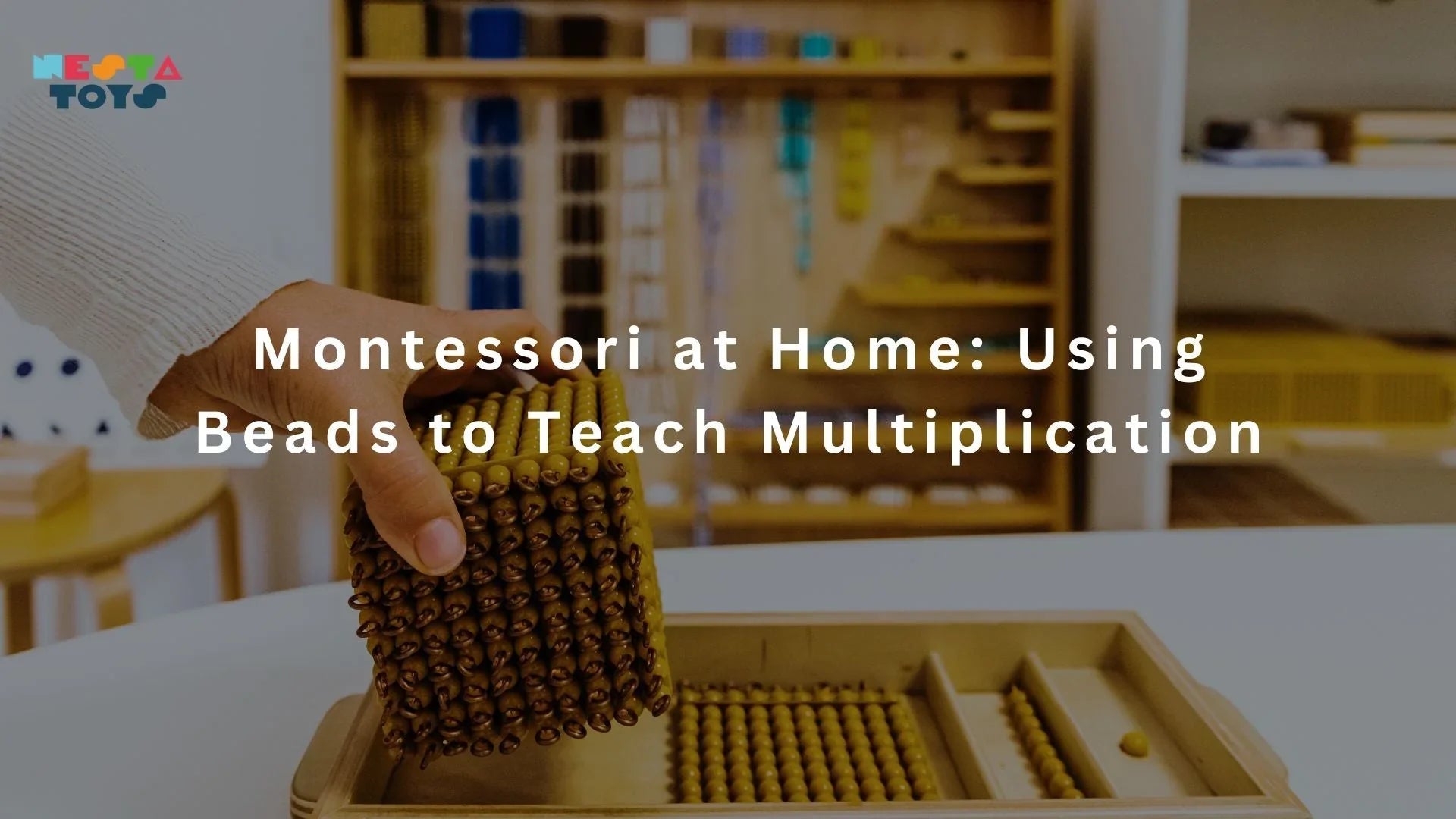
Multiplication can be an abstract concept for young children. One effective way to make it more concrete and understandable is through hands-on activities. This post explores how to use colored bead bars to introduce the concept of multiplication in a visually engaging and interactive way. The Multiplication Bead Bar Material The material consists of a box containing a variety of colored bead bars representing numbers one through nine. Additionally, there may be a separate box with bars of ten and a felt mat to work on. Number cards are also included, featuring the numbers one through nine. The box holds multiple bars for each number, ensuring ample quantity for various activities. Introducing Multiplication Through Steps During the presentation, the child is introduced to the concept of multiplication through a series of steps: Visual Representation: Begin by taking one bar representing a chosen number (for example, the number 4) from the material and placing it horizontally. Display the quantity on the left side. Connecting Quantity and Product: Prompt the child to count along and observe as a colored bead bar is positioned vertically below, representing the product. Explain that when 4 is taken once, the result is 4. Introducing "Times": Direct the child's attention to taking the same quantity but this time, two times. Remove two bars and place them horizontally, creating a gap between them. Count together with the child, demonstrating the process using colored bars or a combination of 10 and colored bars, if necessary. Visualizing the Concept: Explain that when 4 is taken twice, the product becomes 8. Repetition and Progression: Guide the child to remove the same quantity, increasing the number of times in each iteration. This process is repeated until the quantity has been taken nine times. Throughout the activity, encourage the child's active participation, gradually involving them in the steps. After completing a round of multiplication, clear the mat, giving the child the opportunity to select another number to work with. Encourage them to explore independently, allowing them to deepen their understanding of multiplication concepts at their own pace. Direct Aims: Memorization of Multiplication Tables. To reinforce the concept of Multiplication. To reinforce the idea that the multiplier is not the quantity but an indication of a number of times a quantity has to be taken. Indirect Aims: Preparation for Division. Showing the geometrical form of Multiplication. Preparation for work with factors. Suggested At-Home Activities: Multiplication Arrays: Provide the child with a set of small objects, such as buttons or coins. Ask them to create arrays to represent different multiplication equations. For example, for the equation 3 x 4, they can arrange 3 rows with 4 objects in each row. Encourage them to explore various multiplication facts using arrays. Multiplication Story Problems: Create story problems related to real-life scenarios and have the child solve them using multiplication. For example, "If each bag of apples contains 6 apples, and there are 4 bags, how many apples are there in total?" Encourage the child to draw pictures or use manipulatives to help visualize the problem. By using concrete materials like bead bars and encouraging active participation, children can develop a solid understanding of multiplication concepts that goes beyond rote memorization. This approach makes learning math more engaging, interactive, and meaningful. About the Author Neha Makdey is the Founder & CEO of NESTA TOYS - India’s homegrown educational toy brand loved by over 1 lakh curious kids. NESTA Toys designs research-backed, hands-on learning toys for children aged 1–10, available on Amazon, Blinkit, Swiggy Instamart, and nestatoys.in. Follow NESTA TOYS on WhatsApp and Pinterest for free parenting resources and activity ideas.
Learn more
Learn Fractions at Home: Hands-On Activities for Kids
Struggling to teach fractions? We've got you covered! Learn how to make fractions fun and engaging with these hands-on, Montessori-based activities for kids.
Learn more
Preschool Education vs Daycare – What Every Parent Needs to Know
Deciding between preschool education and daycare is one of the most crucial choices parents face during their child’s early years. Both options offer essential care and developmental benefits, yet they serve distinct purposes and address different needs. Although both preschool and daycare focus on early education, they have key differences. Let’s explore the main distinctions to help you decide the best option for your child. What is a Preschool? A Preschool is an educational institution for young children between three and five. Here, children are prepared for formal schooling by developing foundational skills through exploration, play, and various activities. Preschools can be run privately or publicly and typically follow a pre-kindergarten curriculum. The primary goal of preschool is to help children become familiar with the concept of school at an early age. What is a Daycare? A Daycare is a facility that provides supervised childcare and activities. The kids at daycare facilities are mostly infants to preschool age. The primary purpose of a daycare facility is to ensure your child's safety while you're at work. An added benefit of daycare is that it also provides playtime and social opportunities for your child. A daycare is a great option for working parents of infants who do not have anyone else to take care of their child for the entire day while they are away. Preschools vs Daycares: What’s the Difference? The main difference between these two childcare facilities is that a preschool is meant to prepare your child for formal schooling. Think of it as a foundational school that follows a curriculum designed to enhance your child’s social and cognitive development. In contrast, daycare focuses primarily on play and care. While there is no formal curriculum, daycare centers often organize activities that promote the development of your child's social skills. Let’s delve deeper into the main differences between the two: 1. Age Group - The main difference between preschools and daycares is the age group. Preschools: Preschools typically accept children aged two to six, with those older than six usually moving up to kindergarten. Daycares: While daycares have varying groups of kids in the facility. They range from infants to six-year-olds. 2. Timing Flexibility Preschools: A preschool has a fixed schedule to prepare your child for the formal educational setting. The hours are not flexible, however, there are breaks and holidays for both students and educators just like how formal schools have. Daycares: A daycare has a more flexible schedule where some offer options between part-time and full-time. 3. Location Preschool: The difference in location and settings between a preschool and daycare only lies based on centres. Some preschools are public while some are private. The area will be based on the funding a preschool has. Daycares: When you look for a daycare, make sure to look for supreme security. Analyse the locality of the centre, ensure there’s a security service at the gate, and the daycare facility is in a gated building. 4. Curriculum Preschools: A preschool follows a structured curriculum that is designed for a specific age group. As preschools aim to prepare children for formal education, they follow a structured routine that teaches essential skills, including fine motor skills and gross motor skills. Daycares: On the other hand, daycares do not follow a set curriculum. The focus in daycare is primarily on play-based activities. While they may include educational activities to keep children engaged, the approach is less formal compared to preschools. 5. Services Preschools: They offer services that are catered towards preparing your child for the formal school setting. This encompasses early childhood education, social skill development, creative activities, communication growth, parental involvement, and much more. Daycares: While daycares are focused on providing routine care services like meals, toilet training, collaborative activities for social interaction, nap time, and more. 6. Socialisation - While both preschools and daycares are great for your kids to evolve their socialisation skills, they both cater to different age groups of interaction. Preschools: In preschools, your child will interact with other children of the same age, which helps them develop collaboration skills and learn how to communicate effectively with their peers. Daycares: In daycares, children interact with mixed-age groups, which is also valuable for developing communication skills as they learn to engage with both older and younger peers. Which One to Choose - Preschool vs Daycare? While both serve different purposes, today, even daycares run preschool programs and even preschools offer daycare facilities. Ultimately, choosing the right option for your child depends on your goals. Are you seeking an educational setting that prepares your child for formal schooling, or are you simply looking for a childcare facility where your child can play, learn, and safely spend the day while you're at work? Also, Consider the following Factors before Choosing a Preschool: Curriculum: Make sure the preschool offers a structured, age-appropriate curriculum that supports your child's cognitive, social, and emotional development. Operational Hours: Check if the preschool’s hours align with your schedule and provide flexibility if needed. Costs: Consider the tuition fees and additional expenses to ensure the preschool fits within your budget. Age Range: Check the age group the preschool serves and ensure it aligns with your child's developmental stage. Teacher’s Qualifications: Look for well-trained and certified educators who have experience in early childhood education. Parental Communication: Ensure the preschool maintains regular updates and open communication about your child’s progress. Class Size: Smaller class sizes often result in more individualized attention, creating a better learning environment for children. Teacher-to-Student Ratio: A low teacher-to-student ratio ensures that your child receives adequate care and guidance. Security and Safety: Ensure the preschool has strict safety protocols, secure facilities, and trained staff to manage emergencies effectively.
Learn more
Plaiting for Kids: Montessori Activity to Develop Coordination, Concentration, and Independence
Explore the Montessori activity of plaiting for kids, which helps develop coordination, concentration, and independence. Learn how children master braiding and decision-making skills with hands-on activities and at-home suggestions for further practice.
Learn more
Montessori Spindle Box Activity for Kids: Enhancing Numeracy and Counting Skills
Discover the Montessori spindle box activity for children aged 3-6. This hands-on learning experience helps kids understand numeration, counting, and the concept of zero, while fostering fine motor skills. Learn how to replicate the activity at home with simple materials.
Learn more
Stereognostic Sense Activity for Kids: Enhancing Touch and Object Identification Skills
Explore a Montessori-inspired activity designed to enhance a child's stereognostic sense. Using blindfolds and a variety of objects, children refine their ability to identify items based on touch. Discover fun at-home activities like mystery boxes and sensory trays to support this learning process.
Learn more
Multiplication Board Activity for Kids: Learn and Memorize Tables | Montessori Method
Help your child master multiplication tables with this engaging Montessori activity. Using a multiplication board and beads, children will practice counting and memorizing basic tables from 1 to 10. Explore fun at-home activities to reinforce multiplication skills and enhance learning.
Learn more


