

Many toys promise to be educational, but do they help children learn, or is that mostly a label on the box? It's a fair question, especially when nearly every product claims some developmental benefit.
Understanding what educational toys actually do makes it easier to buy well instead of guessing. This article covers twelve observable benefits, along with practical examples parents will likely recognize from their own homes.
Why Educational Toys Matter
Play is one of the primary ways young children learn, particularly before they're ready for anything more formal. A child doesn't need a lesson to understand that a wider base makes a tower more stable. They learn it by stacking, watching it fall, and adjusting on the next attempt.
Many child development educators describe this as the core mechanism of early learning: repeated, hands-on trial and error, rather than direct instruction. Toys that ask something of a child, attention, effort, some trial and error, tend to build skills that toys performing the activity for the child do not.
12 Benefits of Educational Toys
1. Encourages Learning Through Play
A toddler stacking cups isn't thinking about balance or cause and effect in any formal sense. But they're testing both with every attempt, and adjusting based on what happens.
This is why "learning through play" isn't just something toy brands say. Child development researchers have long pointed to hands-on exploration as more effective for young children than direct explanation.
2. Supports Cognitive Development and Problem-Solving
Take a five-piece puzzle. A child notices which shapes fit where, tests a few options, and adjusts when something doesn't work.
Do this often enough and a pattern emerges: children start trying fewer wrong pieces before finding the right one. That shift is early reasoning, built through repetition.
3. Improves Fine Motor Skills
Threading beads, stacking rings, picking up small wooden pieces, all of it strengthens the small muscles in a child's hands. Those same muscles are used later for holding a pencil.
This is part of why toy quality matters specifically here. Smooth, well-finished pieces matter for children who handle everything closely with their hands and often their mouths.
4. Builds Creativity and Imagination
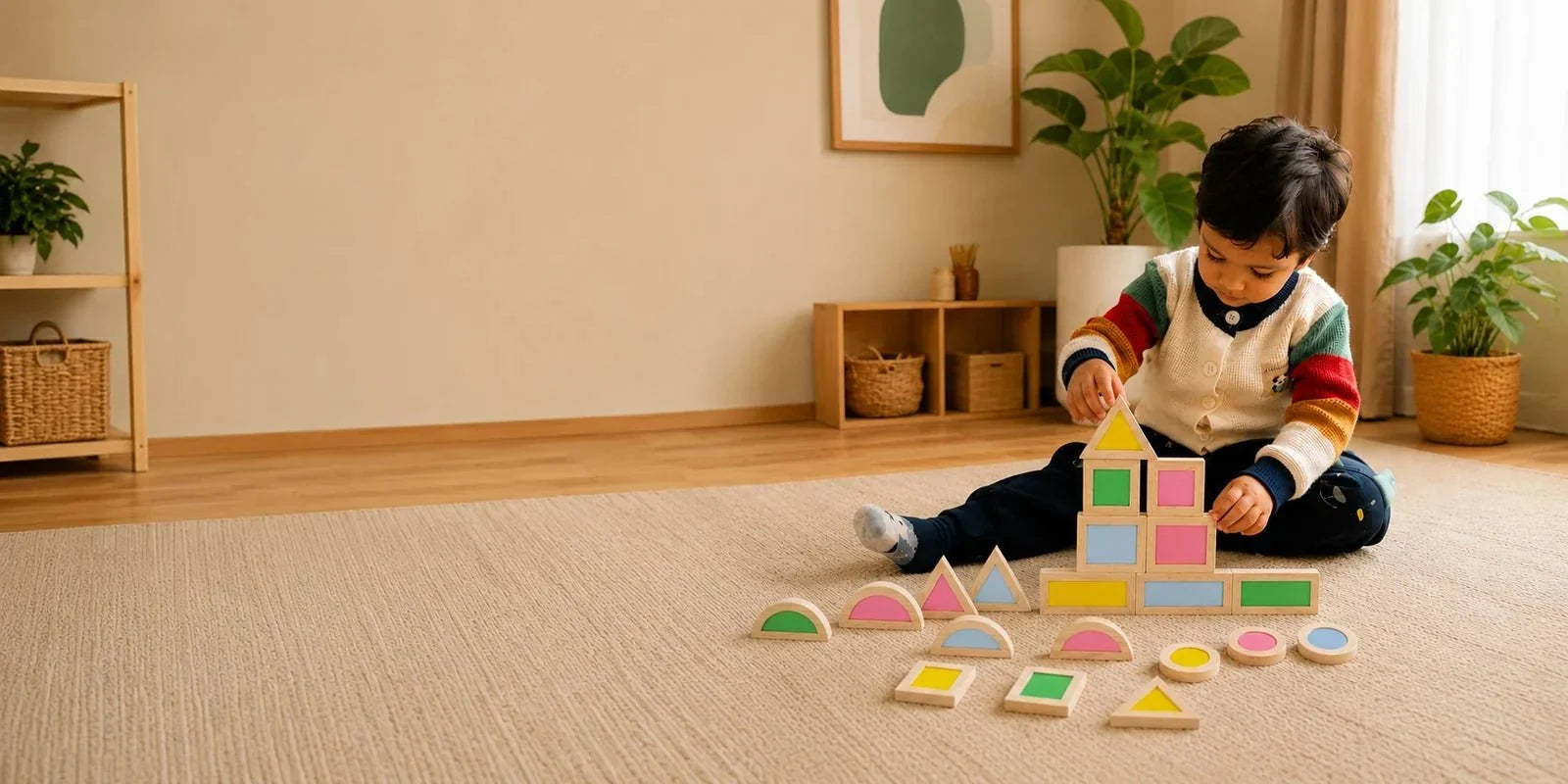
A toy with one function teaches one thing. A toy that can be rebuilt or rearranged, like a set of wooden blocks, asks the child to generate their own ideas instead.
A toy that leaves room for imagination tends to stay interesting for years. One that performs all the actions itself, lights, sounds, pre-set movements, often loses a child's interest within weeks, simply because there's less left for the child to bring to it.
5. Supports Language Development
Pretend play is a language exercise disguised as fun. A child cooking a "meal" in a play kitchen narrates what they're doing and invents dialogue. With a sibling or friend involved, they're also negotiating roles and taking turns speaking.
None of this feels like a lesson to the child, but the vocabulary and sentence structure being practiced is real.
6. Improves Focus and Concentration
A toy that's challenging but achievable, not too easy, not overwhelming, can hold a child's attention for an extended stretch. Over time, this supports the ability to concentrate on one task without frequent redirection.
If a child abandons a toy within a minute every time, it's often a sign the toy is either too simple to hold interest or too advanced to feel achievable.
7. Encourages Independent Play
Independent play doesn't mean leaving a child alone in a room. It means giving them space to explore something on their own, with a parent nearby rather than directing every step.
This can be one of the harder habits to build, since it can feel like not doing enough. A few minutes of quiet, unguided play with the right toy often supports a child's confidence more than a fully parent-led activity in the same window of time.
8. Develops Social and Emotional Skills
Board games, cooperative building, and pretend play with siblings or friends all involve waiting, sharing, occasionally losing, and working with someone else's ideas, particularly relevant in many Indian households where children often grow up playing alongside cousins or extended family. These are social skills, practiced in a low-stakes setting.
A child working through frustration when a game doesn't go their way is also getting practice at emotional regulation.
9. Builds Confidence Through Small Achievements
There's a specific look on a child's face the moment they finish a puzzle alone, or get a tower to stand taller than the last one.
These small moments of solving something independently tend to encourage children to keep trying after future mistakes, rather than giving up at the first difficulty. It's a pattern that starts early and tends to persist.
10. Reduces Screen Time Naturally
A genuinely engaging toy doesn't need a rule attached to compete with a screen. A child absorbed in building or pretend play simply isn't reaching for the screen in that moment.
This tends to work better than restricting screen time alone, since it replaces the activity instead of only removing one. For many urban Indian families managing smaller living spaces, compact, screen-free toys that pack away easily can make this easier to sustain day to day.
11. Grows With Your Child Through Open-Ended Play
A well-designed open-ended toy resists the usual outgrowing pattern. A set of wooden blocks serves a two-year-old learning to stack and a seven-year-old building something considerably more complex, using the same pieces.
Children often return to simple, open-ended toys repeatedly as they grow, because the toy adapts to whatever stage the child is at, rather than staying fixed at one level.
12. Provides Better Long-Term Value When They Are Well Made
Quality matters more than many parents initially assume. A toy with smooth, splinter-free edges, sturdy joints, and safe, non-toxic materials is not only safer, it's more likely to survive years of everyday play, including being handed down to a younger sibling.
Fewer, well-made toys tend to get more genuine engagement than a shelf crowded with cheaper ones. Partly because they hold up physically, and partly because a child has room to actually explore each one instead of skimming across dozens.
Which Toy Type Delivers Which Benefit
Not every toy offers every benefit above, most lean into two or three at a time. This is a useful reference when you know what you're trying to support:
| Toy Type | Primary Benefits |
|---|---|
| Wooden building blocks | Creativity, problem-solving, fine motor skills |
| Puzzles and shape sorters | Cognitive development, focus, confidence |
| Pretend play sets (kitchen, doctor, tools) | Language development, social-emotional skills, imagination |
| Board and matching games | Social skills, focus, turn-taking |
| Open-ended sensory toys | Independent play, fine motor skills, screen-time reduction |
A practical way to use this: if a specific skill is a current focus for your child, focus, patience, sharing, this table is a faster way to pick a toy than browsing by age alone.
Conclusion
Educational toys aren't magic, but the right ones do the work described above: building problem-solving skills, motor coordination, language, creativity, and confidence, through ordinary play. These twelve benefits aren't abstract; they're patterns visible in how children actually play, given the right toy and a bit of space to explore it.
NESTA TOYS was founded on a similar belief, that children are naturally curious, and a parent's role is to support that curiosity rather than manage it, which is why every toy in the collection goes through child development research and safety testing before it's handcrafted by local Indian artisans. For anyone building out a shelf at home, the Educational Toys Collection, Montessori Toys Collection, Wooden Building Blocks Collection, and Wooden Kitchen Toys Collection are reasonable places to start.
About the Author
Neha Makdey is the Co-Founder & CEO of NESTA TOYS - India’s homegrown educational toy brand loved by over 3 lakh curious kids. NESTA Toys designs research-backed, hands-on learning toys for children aged 1–10, available on Amazon, Blinkit, Swiggy Instamart, and nestatoys.in. Follow NESTA TOYS on WhatsApp and Pinterest for free parenting resources and activity ideas.
FAQs
Do educational toys really make a measurable difference, or is it mostly marketing?
The difference isn't something measured by a test score, but it shows up in everyday behavior: longer attention spans, more persistent problem-solving attempts, and more independent play.
Is it better to buy a few expensive educational toys or several cheaper ones?
Neither price point guarantees quality on its own. A smaller number of well-made, open-ended toys generally offers more developmental value than a large collection of cheaper, single-use ones.
How do I know if a toy is genuinely educational or just labeled that way?
Watch what the toy asks the child to do. Building, solving, or creating usually points to real developmental value. A toy that performs most of the activity itself is closer to entertainment.
Can educational toys help a child who struggles with focus?
Often, particularly toys that are challenging but achievable. Short, successful bursts of concentration can gradually support a longer attention span over time.
Should educational toys match my child's age exactly?
Age ranges are a useful starting point, but children develop at different paces. Watching a child's current interests and skills is often more reliable than buying strictly by the number on the box.
Do educational toys replace the need for parent involvement?
No. Independent play has real value, but toys work best alongside regular time playing together, not as a substitute for it.
How can I tell if my child has outgrown a toy?
If a toy no longer holds attention even after time away from it, or offers no new challenge, it's usually a sign to rotate it out or introduce a more advanced version of the same type of play.
Are wooden educational toys worth the extra cost compared to plastic ones?
Often, mainly due to durability and long-term value. A well-made wooden toy can survive years of regular use and frequently gets passed down to a younger sibling.
What's a simple way to start introducing more educational toys at home?
Starting small tends to work better than a large purchase. A few open-ended toys, chosen based on what the child already enjoys, generally do more than a sudden, large collection.
Do educational toys help reduce tantrums or emotional outbursts?
Not directly, but toys involving turn-taking or mild frustration, like a puzzle that takes a few tries, give children low-stakes practice managing exactly those emotions.


