

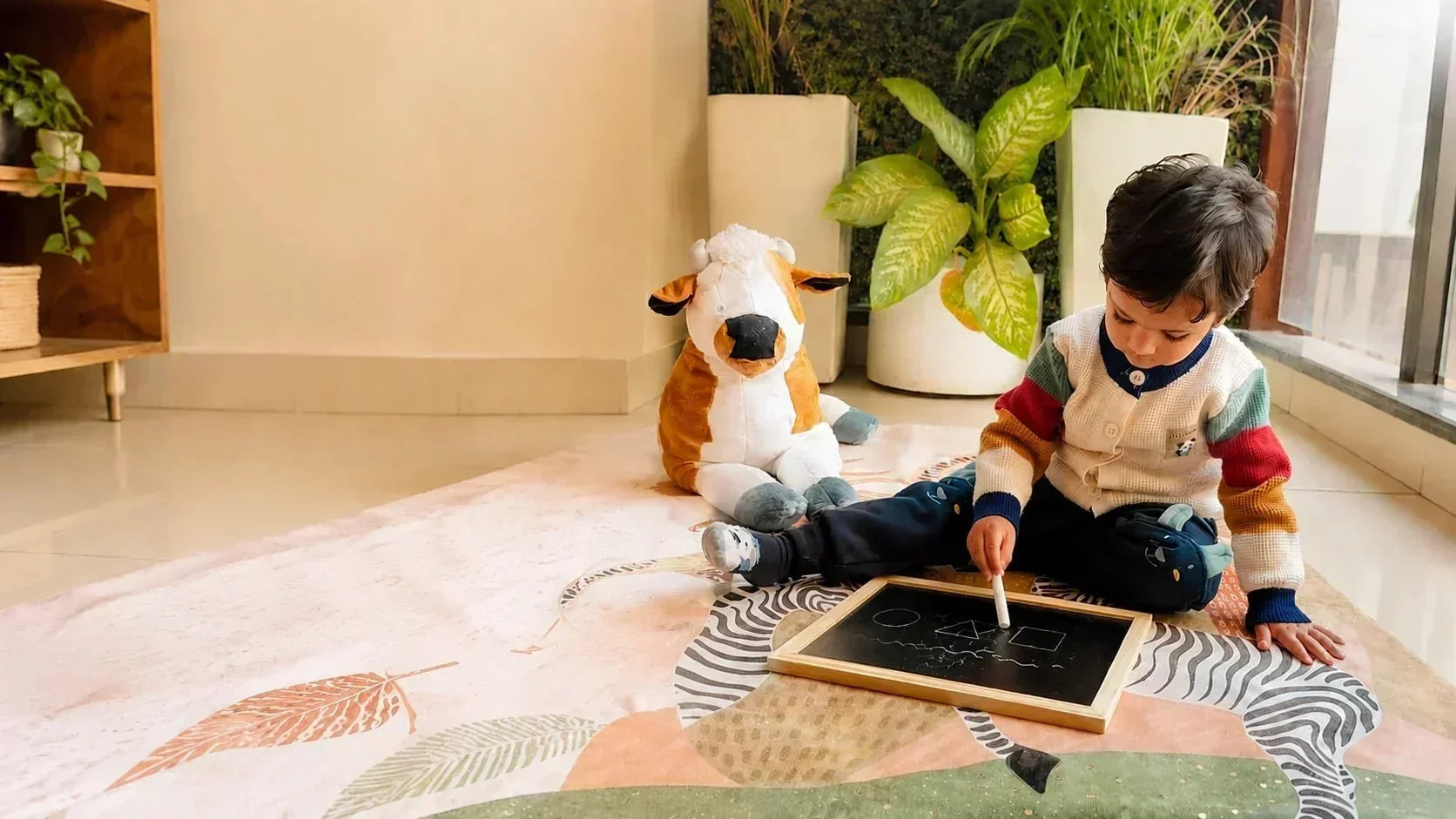
Open any toy website or walk down any toy aisle and you'll notice the same word stamped on almost everything: educational. Puzzles have it. Tablets have it. Even some stuffed animals claim to build "cognitive skills." At some point this stops being useful information and starts being just another word on the packaging.
That's really the problem most parents run into. Not a lack of options, there are too many, but a lack of any real way to tell which ones are worth buying. This guide is meant to fix that. We'll go through what educational toys actually are, why they matter for a child's development, and how you can tell a toy that genuinely helps your child learn from one that's simply using the label to sell better.
What Are Educational Toys?
At its core, an educational toy is one that gets a child actively doing something while they play, rather than just watching or pressing buttons. That could mean solving a small problem, practicing a movement, building vocabulary, or just working through trial and error until something clicks.
Here's a simple test that works better than reading the box: watch what your child is actually doing with the toy. If they're building, sorting, adjusting, trying again, that's a strong sign it's genuinely educational. If the toy is mostly doing things on its own, lights, sounds, pre-recorded phrases, while your child sits and watches, it's not offering much more than any other toy on the shelf, whatever the packaging says.
A basic set of wooden blocks illustrates this well. There's no motor, no screen, nothing automated about it. And yet it asks more of a child, in terms of thinking, planning, and problem solving, than most toys that carry the "educational" label loudly on the front.
Why Are Educational Toys Important?
The years between roughly one and ten are when a huge amount of brain development happens. This is when kids are building the skills they'll rely on for basically everything later, problem solving, communication, managing their own emotions, working with other people.
Toys are one of the main ways children practice these skills, long before they're ready for anything more formal. A three year old doesn't learn to adjust their approach because someone explains the concept to them. They learn it by building a tower, watching it fall over, and trying something different the next time. Do this enough times, across enough different toys, and you end up with a child who's genuinely comfortable trying, failing, and adjusting, which honestly is a skill a lot of adults still struggle with.
This is really why the toys available to a child during these years matter more than most parents assume going in.
Learning Through Play: Why It Matters
You'll hear the phrase "learning through play" a lot in early childhood circles, and it's not just something toy brands say to sound credible. Many educators genuinely treat play as the main way young kids learn, not a break from learning, the actual mechanism of it.
Take block stacking again as an example, since it's such a common one. A toddler isn't consciously thinking about balance or weight distribution when they stack blocks. But they're testing both, over and over, with every attempt. When the tower falls, they adjust, without anyone teaching them the physics behind it. Repeat that dozens of times in one play session and a child builds a working sense of these ideas well before they could ever put it into words.
There's also something play offers that structured lessons usually can't: the child is actually in charge. They decide how to build it, sort it, or rearrange it. That sense of control matters. It means they're practicing decision making at the same time as whatever specific skill the toy is targeting.
How Educational Toys Support Child Development
Most educational toys touch more than one area of development at once, though individual toys usually lean harder into one or two.
- Problem solving and early reasoning: Puzzles, shape sorters, and building sets all ask a child to notice patterns and test out different approaches. That repeated process, try, fail, adjust, try again, is essentially early logical thinking, even if no one would call it that at the time.
- Fine motor skills: Picking up small pieces, threading beads, stacking rings, all of it strengthens the small muscles in a child's hands. Those same muscles get used later for holding a pencil, so this isn't a coincidence, it's practical groundwork.
-
Language and social skills: Pretend play toys, like a toy kitchen or a set of play figures, get kids narrating what they're doing and inventing dialogue on the spot. Add another child into the mix and now they're also negotiating roles and waiting their turn, both closely tied to early language development.
-
Creativity: Toys that can be used many different ways, rather than one fixed function, tend to push kids to generate their own ideas instead of following a script. This is a big reason open-ended toys like blocks or basic craft materials get recommended so consistently by early childhood educators. There's no single correct way to use them.
- Focus and independent play: A toy that's challenging without being frustrating can hold a child's attention for a genuinely long stretch, which slowly builds the ability to concentrate on one task without needing constant redirection from an adult.
Types of Educational Toys
A few categories come up again and again in early childhood education, and each one leans toward slightly different skills.
-
Wooden building blocks. Good for spatial reasoning, planning, and fine motor skills. Since there's no single way to use them, they tend to stay relevant across a wide age range instead of getting outgrown in a few months.
-
Montessori-inspired toys. Built around independent exploration, usually with simple, natural materials and one clear purpose, so a child's own curiosity is what drives the play rather than the toy itself.
-
Pretend play toys, like a wooden kitchen set. Support language, sequencing, and social skills through role play and made-up scenarios.
-
Educational games. Introduce rules and turn taking, and depending on the specific game, some early counting, memory, or basic strategy too.
- Screen-free construction and sensory toys. Ask for real hands-on effort and sustained attention, which is exactly what a lot of screen-based activity doesn't require.
Educational Toys vs Traditional Toys
The real difference between the two isn't always about the category of toy. It usually comes down to how much the toy actually asks of the child.
| Feature | Educational Toys | Traditional or Passive Toys |
|---|---|---|
| Child's Role | Active participant | Often just watching |
| Play Pattern | Open-ended, different each time | Usually one fixed function |
| Skill Development | Problem solving, motor skills, creativity | Mostly entertainment |
| How Long It Lasts | Often stays relevant for years | Frequently outgrown quickly |
| Learning Style | Hands-on, self-directed | Often automated or adult-led |
None of this means traditional toys are bad, or that your child shouldn't have any purely-for-fun toys. They still offer real enjoyment. But if the goal is supporting development specifically, toys that require the child to actually do something tend to deliver more consistent value over time.
How to Choose Educational Toys for Kids
- Go by your child's current stage, not the age printed on the box. Age ranges are a rough guide at best. A toy slightly above where your child is right now can offer a good stretch. One too far ahead usually just leads to frustration and gets pushed to the back of a shelf.
-
Pay attention to what they're already drawn to. A kid who's constantly stacking things will get more out of building sets. A kid who copies you in the kitchen will love a play kitchen. Following actual interest beats guessing based on trends.
-
Lean toward open-ended toys over single-function ones. They support more skills and stay interesting for longer, since the child decides how to use them each time.
-
Choose toys that need the child to participate, not ones that mostly perform on their own while the child watches.
- Think about how it fits your routine. Some toys are great for solo, independent play. Others work best as something you do together. Both have value, just for different reasons.
Common Mistakes Parents Make
Even well-meaning purchases can miss the point. A few mistakes come up often:
- Trusting the packaging more than watching what the toy actually asks the child to do.
- Buying too many toys at once, which can actually make it harder for a child to focus deeply on any one of them. A lot of educators point out that rotating a smaller number of toys, keeping some put away and swapping them in later, tends to hold a child's interest better than leaving everything out all the time.
- Choosing toys that are heavily automated, so the child ends up mostly watching instead of doing.
- Skipping over build quality, which affects both safety and how long the toy actually stays usable.
- Assuming a higher price automatically means a more educational toy. It doesn't always work out that way.
Why Quality Matters More Than Quantity
There's decent support in early childhood education for the idea that fewer, better toys lead to deeper engagement than a large pile of options. A smaller set of well-made, open-ended toys gives a child room to actually explore each one properly, instead of skimming across dozens of toys without really engaging with any of them.
Quality also matters for straightforward safety reasons. A toy should have smooth edges, no splinters, be made with non-toxic materials and finishes, and have joints that stay solid instead of loosening after a few weeks of normal use. A toy built to that standard can often be passed down to a younger sibling and still work perfectly fine, which is real, practical value beyond the original purchase.
Are Expensive Educational Toys Worth Buying?
Not necessarily. Price really isn't a reliable signal of educational value on its own. Some of the toys with the most genuine developmental benefit, a basic set of wooden blocks being the obvious example, are also some of the cheapest, precisely because their value comes from being open-ended rather than from built-in features.
When you're deciding whether a pricier toy is worth it, look at the material and construction quality, and how long it's likely to hold your child's interest, rather than the price tag by itself. A moderately priced toy that's well built and open-ended will usually offer more long-term value than an expensive one that only does one thing.
Conclusion
You don't need to track down the single "best" educational toy on the market. What actually matters is understanding what a toy asks of your child, and choosing ones that encourage real participation, problem solving, and independent thinking rather than passive watching. A smaller collection of well-made, open-ended toys will generally do more for your child's development than a large pile of toys that do most of the work themselves.
At NESTA TOYS, this is the same thinking behind how we build our own collection, safe, non-toxic materials, construction meant to survive years of real, hands-on play. The goal isn't to replace the thoughtful choices you're already making as a parent, just to make it a little easier to choose well.
About the Author
Neha Makdey is the Co-Founder & CEO of NESTA TOYS - India’s homegrown educational toy brand loved by over 3 lakh curious kids. NESTA Toys designs research-backed, hands-on learning toys for children aged 1–10, available on Amazon, Blinkit, Swiggy Instamart, and nestatoys.in. Follow NESTA TOYS on WhatsApp and Pinterest for free parenting resources and activity ideas.
FAQs
What are educational toys?
Toys designed to actively involve a child in learning while they play, whether that's problem solving, motor skills, language, or creativity.
Why are educational toys important?
They give kids repeated, low-pressure chances to practice foundational skills during a period when their brains are developing fast, and those skills carry well beyond childhood.
At what age should children start using educational toys?
Around six months is fine for something simple, like soft blocks or a basic shape sorter, with more complex toys introduced as your child grows.
Are educational toys worth buying?
Toys that need real participation and can be used many ways tend to offer strong value. Toys that mostly entertain without involving the child offer a lot less.
Do expensive educational toys help children learn more?
Not really. Price doesn't reliably predict educational value. Some of the simplest toys, like basic wooden blocks, are among the most useful.
Are wooden educational toys better?
Well-made wooden toys tend to be more durable and more open-ended than battery-powered toys with one fixed function, though the material alone isn't a guarantee.
Can educational toys reduce screen time?
Toys that need real, hands-on engagement can work as a genuine alternative to screens, especially if you play alongside your child at first to help the switch feel natural.
How many educational toys should a child have?
Fewer than most people assume. Rotating a smaller set tends to hold a child's attention better than leaving a huge collection out all at once.
What skills do educational toys develop?
Depending on the toy, problem solving, fine motor skills, language, creativity, focus, and independent thinking.
How do I choose the right educational toy?
Match it to your child's current stage and actual interests, favor open-ended designs, and pick toys that ask your child to participate rather than just watch.


