

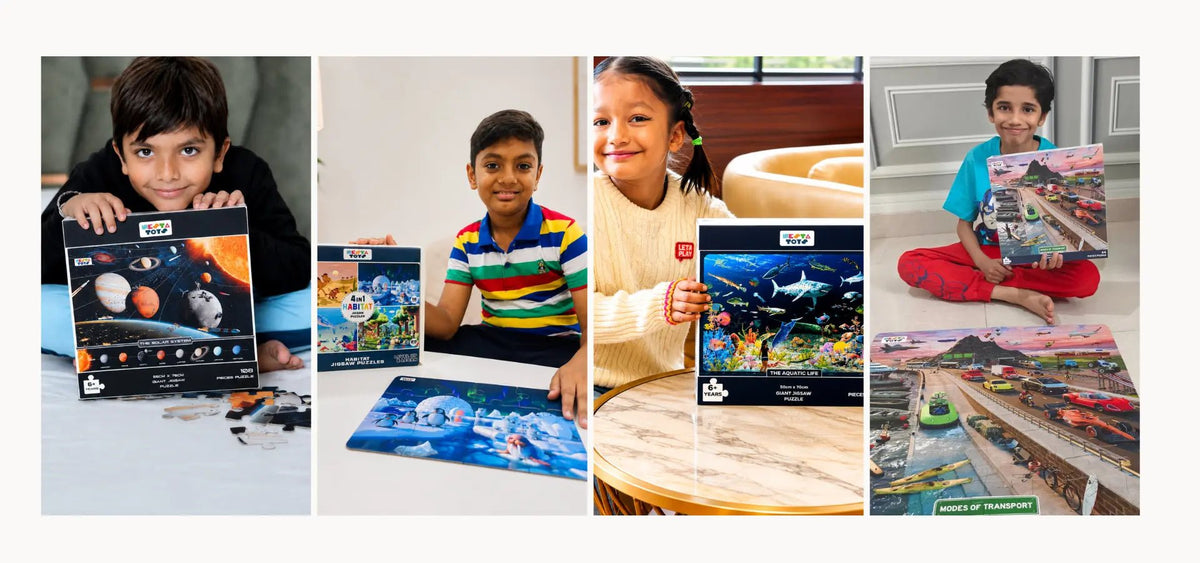
A jigsaw puzzle starts as a pile of pieces that don't mean much on their own, and ends as one complete picture. For a child, the interesting part is everything in between: looking closely, trying a piece, being wrong, trying again, and slowly watching something take shape.
Choosing the right puzzle matters more than it seems. Too difficult, and a child gets frustrated before they've had a real chance to enjoy it. Too easy, and it gets set aside after one try. Here's what actually helps when you're standing in front of a shelf, or scrolling through one online, trying to decide.
The right puzzle isn't necessarily the one with the highest piece count. It's the one your child actually wants to pick up again, on their own.
What Children Practise Through Jigsaw Puzzles
Puzzle play gives children opportunities to practise several skills at once, without it feeling like a lesson.
- Comparing shapes, colours and details to work out where a piece belongs
- Fine-motor coordination while picking up and placing small pieces
- Focus and attention, especially once a puzzle takes a few minutes to finish
- Persistence, since a piece rarely fits on the first try
- Pattern recognition, matching, and simple visual problem-solving
A child who tries an incorrect placement, notices it doesn't work, and tries again is practising persistence in a fairly low-stakes way. It's a small moment, but it repeats every time the puzzle comes out again.
How to Choose a Jigsaw Puzzle by Age
Age is a useful starting point, but a child's actual puzzle experience matters just as much. Two five-year-olds can be at very different stages depending on how many puzzles they've already worked through.
Around 3 years
Look for larger pieces, clear and recognisable images, and construction that's easy for small hands. A first-time solver usually does better starting simple, even if a bigger, more detailed puzzle looks tempting on the shelf.
Around 4 to 5 years
Children already comfortable with basic puzzles may be ready for more pieces and themed subjects, like NESTA's India Map Jigsaw Puzzle (64 Pcs) or Prehistoric Park Jigsaw Puzzle (64 Pcs).
Around 6 to 7 years
Children who already enjoy puzzles may be ready for higher piece counts and more detailed educational themes. The World Map Jigsaw Puzzle (108 Jumbo Pieces) and Solar System Jigsaw Puzzle (108 Jumbo Pieces) both work well here for a child who's ready for a bigger challenge.
None of this is a rigid rule. A 64-piece puzzle may suit a child who's already comfortable with simpler ones, regardless of the exact age on the box.
How Many Pieces Should a Child Start With?
Piece count is useful, but it's only one measure of difficulty. The real challenge also comes down to piece size, how similar the shapes are to each other, and how much visual detail is packed into the picture.
- Beginner puzzles, like NESTA's 4-in-1 Level Up & Learn puzzles, move a child gradually from 9 up to 20 pieces within one theme, which works well for a first puzzle experience.
- 64-piece puzzles may suit a child who already has some puzzle experience and is ready for a bigger picture.
- 108-piece puzzles may suit a child comfortable with larger counts and more visual detail.
Two 64-piece puzzles from the same shelf can feel completely different to the same child, purely because of how the image and pieces were designed.
Different Types of Jigsaw Puzzles for Kids
Not every puzzle is trying to do the same thing.
- Classic picture puzzles suit children who simply enjoy working toward one recognisable scene.
- Educational jigsaw puzzles combine puzzle-solving with a subject like animals, science or geography, though the value comes from what the child does with it, not the word on the box.
- Map puzzles, like an India or world map jigsaw, make geography visual without automatically teaching it on their own.
- Science puzzles, such as NESTA's Periodic Table of Elements Jigsaw Puzzle (108 Jumbo Pieces), offer a visual way into a subject a child is already curious about.
- 4-in-1 puzzles such as Habitat - 4 in 1 Level Up & Learn Jigsaw Puzzle pack several images or difficulty levels into one set, letting a child progress without switching themes.
- Wooden puzzles tend to offer durability and a tactile feel suited to repeated handling.
The type matters less than whether it matches what your child actually gravitates toward.
How to Choose an Educational Jigsaw Puzzle
The best theme is usually one that connects to something the child already likes, not the one that sounds most impressive on a listing.
- Space, for a child drawn to planets and stars
- Animals or habitats, for a child always asking about creatures
- Maps, for one curious about countries or where things are
A puzzle doesn't need an academic-sounding theme to hold value. Even a simple picture puzzle gives real practice at observing, matching and solving.
Wooden Jigsaw Puzzles vs Other Materials
Material is one part of the decision, not the whole thing.
- Wooden puzzles tend to offer sturdier construction, thicker pieces, and a tactile feel suited to repeated use.
- Other materials, like cardboard, can be lighter, easier to store, and available at different price points.
Wooden isn't automatically the better choice for every child or budget. Construction, finish and fit for your child's current stage matter more than the material alone. Parents wanting a wooden format specifically can browse NESTA's Wooden Puzzles collection alongside the picture jigsaws here.
Myth: Wooden puzzles are always better. Fact: Not automatically. Construction, finish and fit for your child's current stage matter more than the material alone.
A Few Puzzle-Buying Mistakes Worth Avoiding
Most parents make at least one of these at some point, and none of them are disastrous, but knowing them in advance can save a puzzle from ending up untouched in a cupboard.
- Buying the highest piece count available, assuming it means more value for money
- Judging difficulty by age alone, without factoring in how many puzzles the child has already completed
- Choosing a theme the parent finds impressive rather than one the child is actually curious about
- Assuming a simpler-looking picture automatically means an easier puzzle, even when the pieces are small and similarly shaped
- Buying several puzzles at once before finding out which type actually holds the child's attention
The fix is usually simple: start with one, watch how your child responds, and let that guide the next purchase.
Practical Jigsaw Puzzle Buying Guide
Experience and confidence should shape your choice as much as this table does.
| Age / Experience | Suggested Difficulty | What to Look For | Good Puzzle Style |
|---|---|---|---|
| Beginning puzzle solver | Simple | Large pieces, clear image, easy matching | 4-in-1 puzzle or simple picture puzzle |
| Around 3-4 years | Simple to moderate | Manageable pieces, recognisable images | Picture or themed 64-piece puzzle |
| Around 4-5 years | Moderate | More detail, slightly higher piece count | Themed or educational puzzle |
| Around 5-6 years | Moderate to challenging | Detailed scenes, stronger visual complexity | Science, map or themed puzzle |
| Around 6-7+ years | Challenging | Higher piece count, detailed imagery | 108-piece educational or picture puzzle |
Treat this as a starting point to narrow the shelf down, not a final answer.
How Parents Can Make Puzzle Time More Engaging
A puzzle doesn't need much from a parent to become a shared activity rather than a solo one.
-
Start with the border, if the puzzle suits it, to give a simple structure to build from.
-
Sort by colour or pattern before starting, so the task feels more manageable.
-
Talk about the picture. "What do you notice?" or "where do you think this goes?" keeps the child thinking out loud.
-
Let the child try first, even when the fix looks obvious to you.
-
Increase difficulty gradually, once the current puzzle feels comfortable.
- Extend the theme afterward, without turning it into a lesson.
None of this needs to happen every time. Some days, sitting nearby without saying much is enough.
Choosing the Right Puzzle for Your Child
Before buying, it helps to run through a short checklist.
- Age and puzzle experience
- Piece count and piece size
- Image complexity
- Your child's current interests
- Material and construction quality
- Whether the puzzle offers a challenge without tipping into frustration
The right puzzle isn't necessarily the one with the highest piece count. It's the one your child actually wants to pick up again on their own.
NESTA TOYS' jigsaw puzzle collection spans different formats, piece counts and themes, from 4-in-1 sets for first-time solvers to 64- and 108-piece educational jigsaws, so you can choose based on your child's age, experience and interests rather than the label on the box. For hands-on learning beyond puzzles, the Educational Toys and Montessori Toys collections are worth browsing alongside this one.
Conclusion:
A jigsaw puzzle isn't really about the finished picture. It's about a child sitting with a problem that doesn't solve itself right away, and staying with it anyway. Some children get there in ten minutes. Others walk away and come back to the same puzzle three times over a week, and that's not a sign anything went wrong.
The right puzzle for your child is simply the one that gets picked up again without being asked. Piece count, theme, material, all of it is just a way of getting closer to that.
About the Author
Neha Makdey is the Founder & CEO of NESTA TOYS - India’s homegrown educational toy brand loved by over 3 lakh curious kids. NESTA Toys designs research-backed, hands-on learning toys for children aged 1–10, available on Amazon, Blinkit, Swiggy Instamart, and nestatoys.in. Follow NESTA TOYS on WhatsApp and Pinterest for free parenting resources and activity ideas.
Frequently Asked Questions
What age should a child start jigsaw puzzles?
Most children can start with very simple puzzles, four to six large pieces, from around age 2. There's no fixed starting age that applies to every child; readiness usually shows up as interest in fitting, stacking or matching things before a puzzle is even involved.
How many pieces should a puzzle have for a 3-year-old, 4-year-old, or 5-year-old?
This depends more on experience than exact age. A first-time 3-year-old solver often does better with a beginner set like a 4-in-1 puzzle, while a 4- or 5-year-old already comfortable with basics may be ready for a 64-piece puzzle. Treat piece count as a guide to try, not a rule to follow strictly.
Are wooden jigsaw puzzles better than cardboard ones for kids?
Not automatically. Wooden puzzles tend to be sturdier and hold up better to repeated handling, which matters if the same puzzle gets played with often. Cardboard puzzles can still be well made, lighter, and easier to store. Construction quality matters more than the material itself.
How do I know if a puzzle is too difficult for my child?
Watch for frustration that shows up quickly and doesn't ease, or a child abandoning the puzzle without wanting to return to it. Some struggle is normal and part of how puzzles build persistence; it's the total loss of interest that usually signals the puzzle is a poor fit for now, not that the child isn't capable.
What's a good first jigsaw puzzle for a toddler who's never done one?
A puzzle with large, easy-to-grip pieces and a simple, familiar image works best as a starting point. NESTA's 4-in-1 Level Up & Learn puzzles are built around this kind of gradual start, moving from 9 pieces upward within one theme.
Should I choose an educational puzzle or a regular picture puzzle?
Either can work well. An educational theme, like a map or the solar system, can add a layer of subject interest, but a plain picture puzzle still gives a child the same core practice at observing, matching and problem-solving. The theme your child is actually drawn to usually matters more than whether it's labelled educational.
How can I help my child with a puzzle without just doing it for them?
Ask questions instead of pointing out where a piece goes. "What do you notice about that shape?" or "where else could you try?" keeps the child working through it themselves, with you nearby rather than taking over.


