

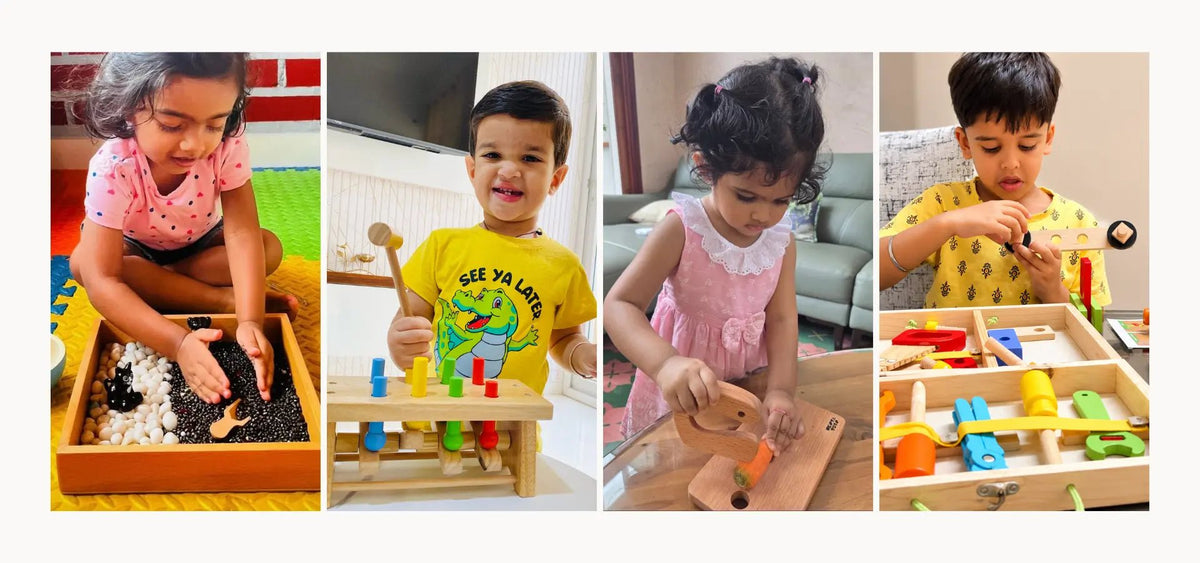
Walk into a toy store, or scroll one online for five minutes, and you'll find dozens of products calling themselves Montessori. Finding one isn't the hard part anymore. Figuring out which one actually makes sense for your child is.
Our earlier guide covered what Montessori toys actually are, and the one after that looked at age and readiness. This one's about the moment that actually matters most, standing in front of a shelf or a product listing, trying to decide if this specific toy is worth buying. Here's the short version: the best Montessori-inspired toy rarely wins on label or feature count. It wins by giving your particular child something real to do, repeat, and eventually manage without you.
Start With the Child, Not the Label
Before anything else, it helps to notice what your child is already doing, not what the packaging promises they'll do.
- What do they keep coming back to on their own, without being asked?
- Sorting, building, pouring, matching, something else entirely, what's the actual pattern?
- Which activity holds their attention past the first minute or two?
The word "Montessori" on a box tells you less than five minutes of watching your child play.
A beautifully designed sorting toy can sit untouched if a child is genuinely more interested in kitchen play. A child who keeps trying to help in the kitchen is telling you something a shelf label never will.
Every child gravitates toward something different, and none of it needs to match some ideal Montessori profile you've read about elsewhere. It's noticing the one they've already started building for themselves.
What This Actually Looks Like at Home
Take a fairly ordinary example. A three-year-old ignores an expensive, beautifully finished sorting tray after the first afternoon, but keeps dragging a stool over to "help" wash vegetables at the sink. The sorting tray wasn't a bad toy. It just landed on the wrong week, for a kid who'd rather be at the sink.
The parent in this situation has two options. Buy a second, fancier sorting toy hoping the next one lands better, or notice what's actually happening and pick up something built around washing, pouring, or basic kitchen participation instead. The second option usually costs less and gets used more, simply because it's chasing an interest that already exists rather than trying to manufacture one.
This is really the whole argument for watching before buying. A child's actual behavior, repeated, unprompted, over a few days, is a far better signal than anything printed on a box.
The 8 Things Actually Worth Checking
- A clear purpose. A child should look at a toy and know what to do with it, without five features competing for attention at once. A simple threading activity hands a child exactly one thing to practice, and that narrowness does the work.
- The right level of challenge. Too easy and interest fades fast. Too hard and frustration takes over before curiosity gets a chance. The toy that actually works is the one that makes a child want to try again, not the one that matches a number on a chart. Age is a reasonable starting point, but what your child can currently do matters more.
- Hands-on interaction. Watch what the child's hands are doing, not just what the toy claims to teach. Sorting, threading, pouring, building, arranging, pretending, all of it counts. This isn't a case against toys with lights or sound, it's just that Montessori-style play tends to lean toward active participation over passive watching.
- Room for independent exploration. A parent might show a child how something works once. After that, the child should have real room to practice on their own. Independent doesn't mean unsupervised though, younger children and anything involving small parts still need an adult nearby.
- Open-ended potential. Some materials are built for one specific outcome, and that's fine, not everything needs to be endlessly reinventable. But toys that can be approached differently each time, blocks, pretend play pieces, loose construction materials, tend to stay interesting longer because the child decides what happens, not the toy.
- A connection to real life. This part of Montessori philosophy shows up constantly once you start noticing it, pouring, fastening, sorting, preparing pretend food, using child-sized tools. It doesn't mean every toy has to mimic a household chore, just that real-world relevance tends to make an activity feel meaningful rather than arbitrary.
- Quality and construction. This is worth checking with your actual hands, not just reading about. Sturdy joints, smooth surfaces, consistent pieces, no rough edges, materials that won't loosen or degrade after a few weeks of handling. Montessori-style materials get used repeatedly, so a toy that starts feeling rough or unreliable after a month has already lost most of its value.
-
Whether it'll actually remain useful. Not every toy needs to last for years, some genuinely serve one developmental purpose and that's enough. But it's worth asking whether a child's interaction with it could get more sophisticated over time, or whether a sibling might eventually use it too.
| What to Check | What to Look For |
|---|---|
| Purpose | Clear, meaningful activity |
| Challenge | Appropriate for the child's current ability |
| Hands-on Play | Child actively manipulates or explores the material |
| Independence | Can gradually be used with less adult help |
| Open-Ended Potential | Allows meaningful exploration or different outcomes where appropriate |
| Quality | Sturdy construction and smooth, appropriate finishing |
| Long-Term Use | Likely to remain useful beyond the first few sessions |
Is It Actually Montessori-Inspired, or Just Labeled That Way?
Skip the packaging for a second and ask what the child actually does with it. Is it hands-on? Does the child have real control over the activity? Can they repeat it and get better at it? Is the design simple enough to make sense on its own? Can they eventually manage it with less help?
A toy can be wooden, simple, educational, and open-ended without being Montessori in any meaningful sense. And a lot of what's sold as "Montessori" is more accurately Montessori-inspired, built around the principles without coming from an actual Montessori classroom or certified source. Most of what you'll find in a shop falls into that second category, which is fine, just worth knowing the label's doing less work than it looks like.
Myth: If it's wooden, it's Montessori.
Fact: Wood is a material. Montessori is a philosophy. A wooden building block set is fantastic for open-ended construction, but the wood itself doesn't make it Montessori, the purposeful, hands-on, repeatable design behind it does.
Should Montessori Toys Be Simple?
Often, yes, but simple doesn't mean boring. Cutting unnecessary features gives a child more room to actually concentrate on what they're doing, rather than getting pulled in ten directions by a toy trying to do everything at once.
Color and complexity aren't the issue on their own. Ten unrelated functions genuinely distracts more than one focused activity does, but several connected elements can work fine if they all serve the same thing a child's actually trying to do. Feature count was never really the right question. It's whether those features actually add to what the child is doing.
How Many Does a Child Actually Need?
There's no fixed number, and you don't need to build a dedicated Montessori shelf to do this well. A handful of well-chosen activities, genuinely used, beats a large collection that mostly sits untouched.
A few things worth trying: keep fewer toys accessible at any one time, rotate what's available every so often, and actually watch what gets picked up repeatedly versus what gets ignored. A shelf full of "educational" toys doesn't automatically create better play.
Sometimes fewer choices make it easier for a child to actually settle into something. There's a practical test for this too. If you can't remember the last time your child picked up a particular toy without being reminded it exists, that's usually your answer. It doesn't need to be donated immediately, but it also doesn't need to stay on the accessible shelf, competing for attention with things that are actually getting used.
Wood, Plastic, or Something Else, What Actually Matters
Material alone shouldn't decide this. Wood tends to offer a sturdy, tactile feel and straightforward construction. Well-made plastic can be lighter, easier to clean, and just as durable, depending on the design.
What actually matters is construction, finish, safety, and how the specific toy fits your child's current interests, not which material it happens to be made from. Neither material has a built-in advantage, and it's worth being skeptical of any claim that says otherwise.
A 60-Second Buying Test
Before You Buy, Ask:
☐ Does my child actually show interest in this kind of activity?
☐ Is the challenge level right for where they are now?
☐ Will they actively do something with it, not just watch?
☐ Can they eventually use it with less help from me?
☐ Is the purpose actually clear?
☐ Is there room to repeat the activity, not just do it once?
☐ Does the construction feel solid enough for repeated use?
☐ Will I still find this useful once the novelty wears off?
Where NESTA TOYS Fits Into This
NESTA TOYS builds its Montessori-inspired collection around the same criteria laid out here, hands-on participation, purposeful activities suited to a child's current stage, sturdy construction, and real room for independent exploration. Not every product is a fit for every child, that's really the whole point of this guide, but the Montessori-inspired toy collection is worth browsing with these eight criteria in hand rather than just the label on the page. A piece like the Montessori Chopping Board & Knife is a decent example of what "clear purpose plus real-life connection" actually looks like in practice, not because it's the best option out there, but because it illustrates the principle well.
A Few Mistakes Worth Avoiding
Buying because the box says Montessori, rather than checking what the child actually does with it. Assuming every wooden toy automatically qualifies. Choosing something too advanced because it looks impressive. Buying several toys at once instead of watching how one gets used first. Ignoring your child's actual current interests in favor of what seems educationally correct. Prioritizing how a toy looks over how it's actually built. Expecting immediate independent play the first time it's introduced. Assuming a higher price tag guarantees better quality.
None of these are catastrophic mistakes, most parents make at least one of them at some point. The fix is usually just slowing down for a minute before checkout and running through the criteria above.
Choosing a Montessori-inspired toy was never really about finding the perfect labeled product. It comes down to understanding your child, what genuinely interests them, what challenges them without frustrating them, and matching that to a toy built well enough to actually hold up. Get that part right, and the label on the box stops mattering nearly as much as you'd think.
About the Author
Neha Makdey is the Co-Founder & CEO of NESTA TOYS - India’s homegrown educational toy brand loved by over 3 lakh curious kids. NESTA Toys designs research-backed, hands-on learning toys for children aged 1–10, available on Amazon, Blinkit, Swiggy Instamart, and nestatoys.in. Follow NESTA TOYS on WhatsApp and Pinterest for free parenting resources and activity ideas.
FAQs
What should I look for when choosing Montessori toys?
Look for a clear purpose, an appropriate level of challenge, hands-on interaction, room for independent use, and sturdy construction. The Montessori label matters less than what the child actually does with the toy.
How do I know if a toy is Montessori-inspired?
Check whether it's hands-on, gives the child real control, allows repetition, and has a simple, clear purpose. A toy can meet all of this without being officially certified Montessori, most commercial products are more accurately Montessori-inspired.
Are all wooden toys Montessori toys?
No. Wood is a material, Montessori is a philosophy. A wooden toy can be open-ended, educational, or great for construction without necessarily being Montessori in any meaningful sense.
Should Montessori toys be simple?
Often, yes, simplicity helps a child focus on one activity rather than getting pulled toward competing features. But simple doesn't mean boring, and a toy with several connected elements can still work well if those elements support the same activity.
Are Montessori toys suitable for toddlers?
Many are, particularly simple, hands-on materials matched to what a toddler can currently do. Readiness and interest matter more than a specific age printed on the box.
How many Montessori toys does a child need?
There's no fixed number. A smaller, well-chosen, rotated selection generally works better than a large collection that mostly goes untouched.
Are expensive Montessori toys better?
Not necessarily. Price tracks the brand and the marketing more often than it tracks construction or fit. Construction, purpose, and how well it matches your child's current interests matter far more than the number on the price tag.
What makes a Montessori toy high quality?
Sturdy construction, smooth and consistent finishing, secure joints, and materials that hold up to repeated, hands-on handling without loosening or degrading.


