

A lot of parents see "Montessori" printed on a box and assume that settles the question, either it's Montessori or it isn't. But even once a toy genuinely fits the philosophy, a second question matters just as much: is this the right moment for this particular child?
We've covered what actually makes a toy Montessori elsewhere, child-led, hands-on, one clear purpose. This guide picks up from there and looks at something slightly different, how age, readiness, and interest work together when you're actually standing in front of a shelf trying to decide. The short version: the same toy can mean something completely different to a child at eighteen months versus five years old.
What to Actually Look For, Regardless of Age
A Montessori-inspired toy should give a child something to genuinely do, explore, adjust, repeat, rather than something to simply watch happen.
A few things matter more than the label:
- One clear purpose, not five features competing for attention
- Enough challenge to be interesting, not so much that it's frustrating
- Room to repeat the activity as many times as the child wants
- A real chance at independent use once it's been shown once
- Some connection to an actual, everyday task where possible
- Safe, sturdy construction that can survive being handled constantly
Keep this list in your head as you go through the ages below. It matters more than any number does.
Around the First Year
Babies at this stage are mostly working with their hands and eyes, grasping, reaching, watching something happen and trying to make it happen again. Simple sensory materials and cause-and-effect toys tend to fit well here, things a baby can grab, mouth safely, and trigger on their own.
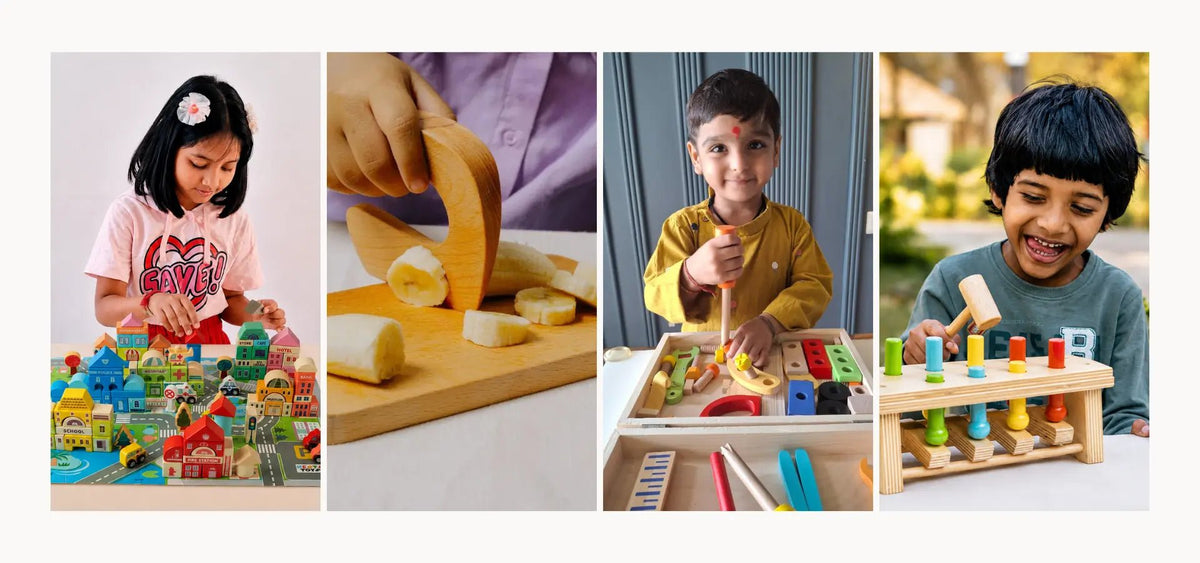
Safety carries extra weight at this age. Pieces need to be too large to swallow, construction needs to hold up to being dropped and gnawed on, and supervision matters more than independence right now. A sensory bin set with a Montessori tray is a reasonable example of the category, simple movement and touch, nothing that needs explaining twice.
One to Two Years
This is usually when stacking, sorting, and posting things into holes becomes genuinely fascinating. Simple puzzles and basic practical-life activities, like pouring water between two small cups, often click into place here too.
What tends to hold attention: repetition, small choices, and tasks that reward a bit of hand-eye coordination without demanding too much of it. Something like a circle seriation puzzle, sized correctly for small hands, fits the pattern well. Not every child at this age is ready for the same complexity, some are still deep in stacking mode, others are already sorting by size on their own.
Two to Three Years
Puzzles get a bit more involved. Matching and sorting start to feel purposeful rather than random. Building blocks show up more seriously, and simple practical-life play, like pretend food preparation, often becomes a daily fixture.
A pounding bench works well around here too, cause and effect, repetition, and a satisfying bit of physical effort all in one activity. Children at this stage tend to gravitate toward the same handful of activities over and over, which is normal, not a sign anything's wrong. Repetition is often the whole point.
Three to Four Years
Puzzles get genuinely more challenging. Building starts turning into actual construction rather than stacking. Counting and simple manipulation activities enter the picture, alongside classification tasks, sorting by more than one property at once, for instance.
A chopping board and knife set fits naturally here, real practical-life skill, safely scaled down, that many kids this age are genuinely eager to try. Independence tends to expand quickly around this stage. A child who needed help with everything six months ago may suddenly want to do most of it alone.
Four to Five Years
More complex construction. Pattern and sequencing activities. Early number concepts woven into hands-on play rather than worksheets. Practical-life tasks often get more elaborate too, closer to genuinely helping than pretending to.
A wooden shape-sorting clock is a decent example of where this stage tends to head, sequencing, early number sense, still entirely hands-on. This isn't about starting school early. It's just that hands stay busier and more capable as they get older, and materials can keep pace with that.
Five and Up
Building gets more ambitious. Strategy and problem-solving games start to genuinely interest kids at this stage, alongside advanced puzzles and creative construction projects that might take more than one sitting to finish.
Independent projects become realistic here too, something a child can pick up, work on for a while, set aside, and return to later without needing an adult to restart it. The core Montessori principles, hands-on, independent, appropriately challenging, don't change. What changes is how much complexity a child can genuinely handle inside that framework.
The Same Toy Can Mean Something Completely Different Later
Here's a genuinely useful thing to know before buying anything: a good Montessori-inspired toy doesn't necessarily need replacing as a child grows. It just gets used differently.
Take wooden building blocks. A younger child mostly grasps, carries, and stacks them, simple exploration, nothing more complicated. An older child using the exact same set starts planning structures, testing balance, solving small problems when something falls over. The blocks never changed. Only the child's way of using them did.
This is really the strongest argument for buying fewer, better pieces rather than replacing toys every few months. If you're building out a collection with this in mind, wooden building blocks are a solid place to start, since they genuinely stretch across several years rather than one narrow window.
A Quick Way to Check If a Toy Actually Fits
Before buying, run through this:
- Does it match what my child can currently do, not just their age?
- Is there enough challenge here to stay interesting for a while?
- Can my child use it on their own after being shown once?
- Does it invite hands-on exploration, not passive watching?
- Can it be repeated as many times as the child wants?
- Does it match something they're already drawn to?
- Is it sturdy enough to survive being handled constantly?
- Will it still make sense to them in six months, just used differently?
If most of these come back yes, it's very likely a good fit, regardless of what the box says about age.
Does Age Even Matter Here?
It's a useful starting point, but it shouldn't be the only thing deciding your choice.
Two children can share a birthday and be in completely different places. One might find a puzzle far too easy. Another might just be starting to work it out. Age gets you into the right neighborhood. It doesn't tell you which house to knock on.
A better question than "what age is this for" is usually "does this offer the next reasonable step for this specific child." That single shift in framing solves more gifting and buying dilemmas than any age chart ever will.
Why Build Quality Still Matters Here
Montessori materials get handled constantly, picked up, carried, dropped, repeated dozens of times in a single sitting. That kind of use puts real demands on construction. Smooth finishing, sturdy joints, and consistent pieces matter more here than they might for a toy that only comes out occasionally.
We've covered the full quality checklist in detail in our buying guide, worth a look since everything there applies just as much to Montessori-inspired pieces. NESTA TOYS follows these same principles across its Montessori-inspired toys and educational toys collections, sturdy construction meant to survive years of exactly this kind of repeated, hands-on use.
Choosing well was never really about matching a number on a box. It's about noticing what your child can already do, what still challenges them a little, and picking something that meets them right there. Do that consistently, and the same handful of well-made pieces can carry a child through several genuinely different stages, without needing to be replaced along the way.
About the Author
Neha Makdey is the Co-Founder & CEO of NESTA TOYS - India’s homegrown educational toy brand loved by over 3 lakh curious kids. NESTA Toys designs research-backed, hands-on learning toys for children aged 1–10, available on Amazon, Blinkit, Swiggy Instamart, and nestatoys.in. Follow NESTA TOYS on WhatsApp and Pinterest for free parenting resources and activity ideas.
FAQs
What are the best Montessori toys by age?
It depends less on age alone and more on the child's current abilities and interests. Younger children tend to do well with simple sensory and cause-and-effect toys, while older kids often move toward puzzles, construction, and practical-life activities with more steps.
What Montessori toys are good for toddlers?
Simple stacking, sorting, and posting activities tend to work well, alongside basic practical-life tasks like pouring. The goal is repetition and independence, not complexity.
What Montessori toys are suitable for a 2-year-old?
Many two-year-olds enjoy building activities, simple puzzles, and pretend practical-life play, though the right level of challenge varies a lot between individual children.
What Montessori toys are suitable for a 3-year-old?
More involved puzzles, early construction, and classification activities often fit well here, alongside practical-life tasks that give a child a real, safely scaled-down task to complete.
How do I choose a Montessori-inspired toy?
Start with what the child can currently do rather than their age on paper. Look for one clear purpose, room for independent use, and enough challenge to stay engaging without becoming frustrating.
Do Montessori toys need to be made of wood?
No. Wood is common in Montessori design because it's simple and durable, but it's the philosophy behind a toy, child-led, purposeful, independent, that actually makes it Montessori.
Can the same Montessori toy be used at different ages?
Often, yes. Open-ended materials like building blocks tend to get used very differently as a child grows, simple stacking early on, more complex construction later, without needing to be replaced.
What is the difference between Montessori and Montessori-inspired toys?
"Montessori-inspired" is generally the more accurate term for toys sold commercially, since they draw on Montessori principles without necessarily coming from a certified Montessori source or classroom.


