

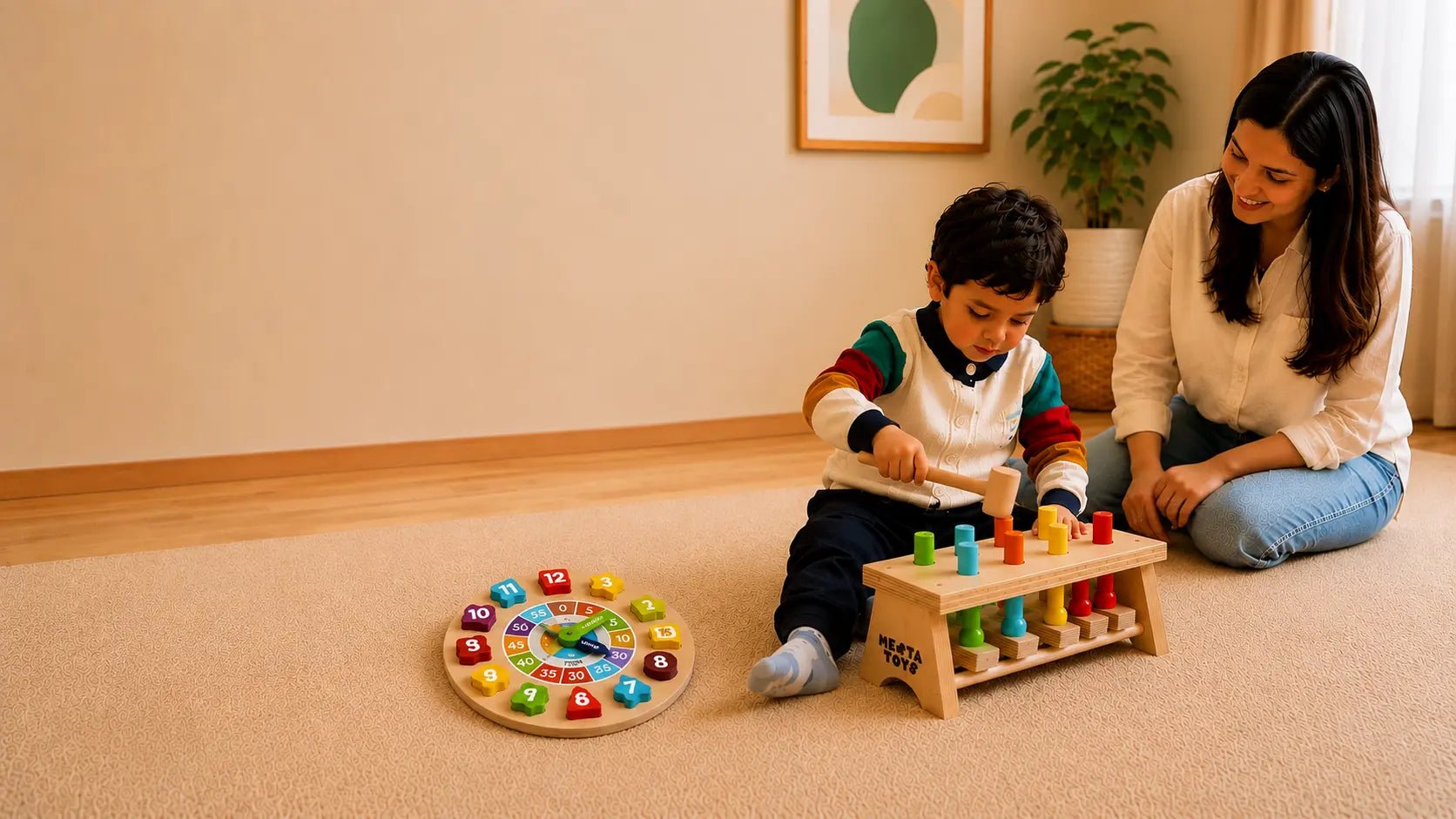
A lot of parents hear "Montessori toys" thrown around long before they actually know what it means. Some assume every wooden toy on a shelf qualifies. Others figure it's something that only matters inside an actual Montessori classroom, not at home.
The reality is a lot more practical than either of those. This guide walks through what Montessori toys actually are, what makes a toy count as one, and how much of this you genuinely need to adopt at home. Spoiler: not as much as you'd think.
So, What Exactly Is a Montessori Toy?
A Montessori toy is one built around child-led exploration, usually with a single, clear purpose, designed to let a child learn something through their own hands rather than being shown or told.
That's it. No certification, no official stamp, no particular brand. Just a toy that steps back and lets the child do the figuring out.
What Actually Makes a Toy Montessori
A few things separate a genuinely Montessori toy from something that just looks the part.
- Child-led. The child decides how and when to use it, not an adult guiding every step.
- Hands-on. Learning happens through touch and doing, not watching.
- Open-ended, but purposeful. Most have one clear task, pouring, sorting, buttoning, rather than dozens of features competing for attention.
- Encourages independence. A child can usually use it without needing help every time.
- Tied to real life. Practical skills like pouring water or fastening buttons show up a lot, since Montessori leans heavily on real-world tasks.
- Simple by design. Fewer parts, fewer distractions, more room for actual focus.
A wooden object-permanence box, where a child drops a ball through a hole and retrieves it themselves, checks every one of these boxes. A colorful shape sorter with lights and sound effects usually doesn't, even in wood.
What Montessori Toys Are Not (And the Myths Worth Clearing Up)
This is where most of the confusion actually lives, so worth getting straight early.
Montessori toys don't have to be wooden. Wood shows up a lot because it's simple and natural, but the philosophy behind a toy is what defines it, not the material it's carved from.
They don't have to be expensive either. Some of the best Montessori materials are about as basic as it gets, a simple sorting tray costs a fraction of most mainstream toys.
They're not exclusive to Montessori schools. Plenty of Montessori-style play happens in ordinary homes with zero formal training involved.
They don't kill imagination. This one comes up a lot, and it's backwards if anything. Open-ended, simple materials tend to leave more room for a child's own imagination, not less, precisely because they're not doing all the entertaining themselves.
And no, you don't have to follow Montessori perfectly for any of it to count. Loosely applying the core idea, stepping back and letting a child explore, still offers real value even without the full setup.
A Quick Word on Where This All Comes From
Dr. Maria Montessori developed this approach over a century ago, built around one core idea: respect the child as a capable, curious person, and give them real opportunities to explore on their own terms rather than being constantly directed.
That's genuinely most of what you need to know for practical purposes. The philosophy runs deep if you want to go further into it, but everyday application doesn't require a history lesson, just the basic respect-and-independence idea underneath it all.
What Montessori Toys Actually Do for Kids
-
Independent play. A child engaged with a purposeful, single-task toy tends to stick with it longer than one bouncing between flashy, multi-function options.
-
Concentration. Repetition is part of the design. A child pouring water from one jug to another, over and over, is building focus, not just passing time.
-
Fine motor skills. Buttoning, pouring, threading, sorting small objects, all of it strengthens the small muscles used later for writing.
-
Confidence. There's a specific kind of pride on a child's face the moment they manage a task entirely on their own. Montessori materials are built to create that moment often.
-
Practical life skills. Real tasks, real tools, sized for small hands. A child pouring their own water isn't just playing, they're practicing something genuinely useful.
Many children spend longer with toys they can fully control than with toys that constantly entertain them on their own terms.
Bringing Montessori Home Without Overhauling Everything
You don't need a dedicated Montessori room. You don't need special furniture, and you definitely don't need a picture-perfect setup that looks like it belongs in a magazine.
A few small shifts go a long way.
- A low shelf where a child can reach their own toys without asking
- A smaller number of toys out at once, rotated rather than all available together
- A few extra minutes of patience while a child works something out themselves
- Encouraging a child to try first, before immediately stepping in to help
A Montessori-inspired home doesn't need to look perfect. A couple of thoughtfully chosen toys on a low shelf, genuinely accessible to the child, does more than an entire room redone to match a Pinterest board.
Montessori Toys at a Glance vs General Educational Toys
| Characteristic | Montessori Toy | General Educational Toy |
|---|---|---|
| Learning approach | Child-led, self-paced | Can be either open-ended or guided |
| Purpose per toy | Usually one clear task | Often broader, multi-purpose |
| Adult involvement | Introduced once, then independent | Often benefits from shared play |
| Materials | Frequently natural, like wood | Wide range, including quality plastic |
This is a shortened snapshot. For the fuller breakdown, our Educational Toys vs Montessori Toys guide covers this comparison in more depth.
How to Actually Choose Montessori Toys
Start with what your child is ready for developmentally, not just their age on paper. A toy slightly ahead of where they are offers a healthy stretch. One too far ahead usually just frustrates.
- Notice what your child already gravitates toward before buying something new
- Favor simplicity, one clear purpose beats five competing features
- Check that it genuinely invites independent use, not constant adult help
- Think about whether it'll still hold interest in six months, not just this week
Observe your child's actual play before adding more toys to the shelf. What they're already drawn to usually tells you more than any buying guide, this one included.
Build quality matters here too, smooth finishes, safe materials, sturdy construction, the same basics that apply to any toy. We've gone into full detail on exactly what to check for in our buying guide, worth a look since it applies here as much as anywhere else. NESTA TOYS follows these same principles across its Montessori-inspired collection.
Can Montessori Toys Mix With Everything Else?
Yes, and honestly, most families are already doing it without thinking about it that way. A single afternoon might involve a Montessori pouring activity, a set of building blocks, a picture book, and a completely unrelated pretend-play session, all within a couple of hours.
Children don't divide their play into categories. Adults do. There's no rule that says a Montessori toy has to sit apart from everything else in the toy box.
A Simple Checklist Before You Buy
- Genuinely child-led, not adult-directed
- Encourages independent use
- Simple, with one clear purpose
- Age and stage appropriate
- Safe materials and sturdy construction
- Likely to hold interest for more than a few weeks
You don't need to replace every toy overnight. Start with one or two simple Montessori-inspired pieces and see how your child responds before going any further.
Montessori toys were never really about buying anything expensive or perfect. They're about creating small, genuine opportunities for a child to explore, practice, and grow more independent through ordinary play. The philosophy matters far more than the label ever will. If you're curious where to start, the Montessori Toys Collection and Educational Toys Collection are worth browsing side by side, since the overlap between them is bigger than most people expect.
About the Author
Neha Makdey is the Co-Founder & CEO of NESTA TOYS - India’s homegrown educational toy brand loved by over 3 lakh curious kids. NESTA Toys designs research-backed, hands-on learning toys for children aged 1–10, available on Amazon, Blinkit, Swiggy Instamart, and nestatoys.in. Follow NESTA TOYS on WhatsApp and Pinterest for free parenting resources and activity ideas.
FAQs
Do I need to replace all my child's current toys to try Montessori?
No. Most families ease in with one or two Montessori-inspired pieces alongside whatever's already in the toy box, rather than starting over completely.
Can I follow Montessori principles without any formal training?
Yes. The core ideas, stepping back, letting a child explore, observing before helping, can be applied at home without any certification or classroom experience.
Are all wooden toys automatically Montessori toys?
No. Wood is a common material in Montessori design, but it's the philosophy behind the toy, child-led, purposeful, simple, that actually defines it.
Are Montessori toys more expensive than regular educational toys?
Not necessarily. Many Montessori materials are intentionally simple, which tends to keep the cost down rather than up.
Can Montessori toys be combined with regular educational toys?
Absolutely, most children naturally experience both within the same day without any conflict between the two.
Is Montessori all or nothing? Do I have to do it perfectly?
No. Even loosely applying the basic ideas, independence, patience, simplicity, offers genuine benefit without needing a fully Montessori-styled home.
Do Montessori toys limit a child's imagination?
Generally the opposite. Simple, open-ended materials tend to leave more room for imaginative play, not less, since they're not doing the entertaining themselves.
What age should a child start with Montessori toys?
Montessori-style materials can start from infancy with simple sensory items, and the complexity naturally increases as a child grows.
Can Montessori toys work in a small living space?
Yes. A single low shelf with a few thoughtfully chosen toys is often more effective than a large collection spread across a bigger room.
How do I know if my child is responding well to a Montessori toy?
Watch for sustained, independent focus and a willingness to return to the toy repeatedly. That kind of engagement is usually a strong sign it's working.


