

A NESTA TOYS Research report on how young children in India are growing up with screens, and what parents can genuinely learn from the evidence
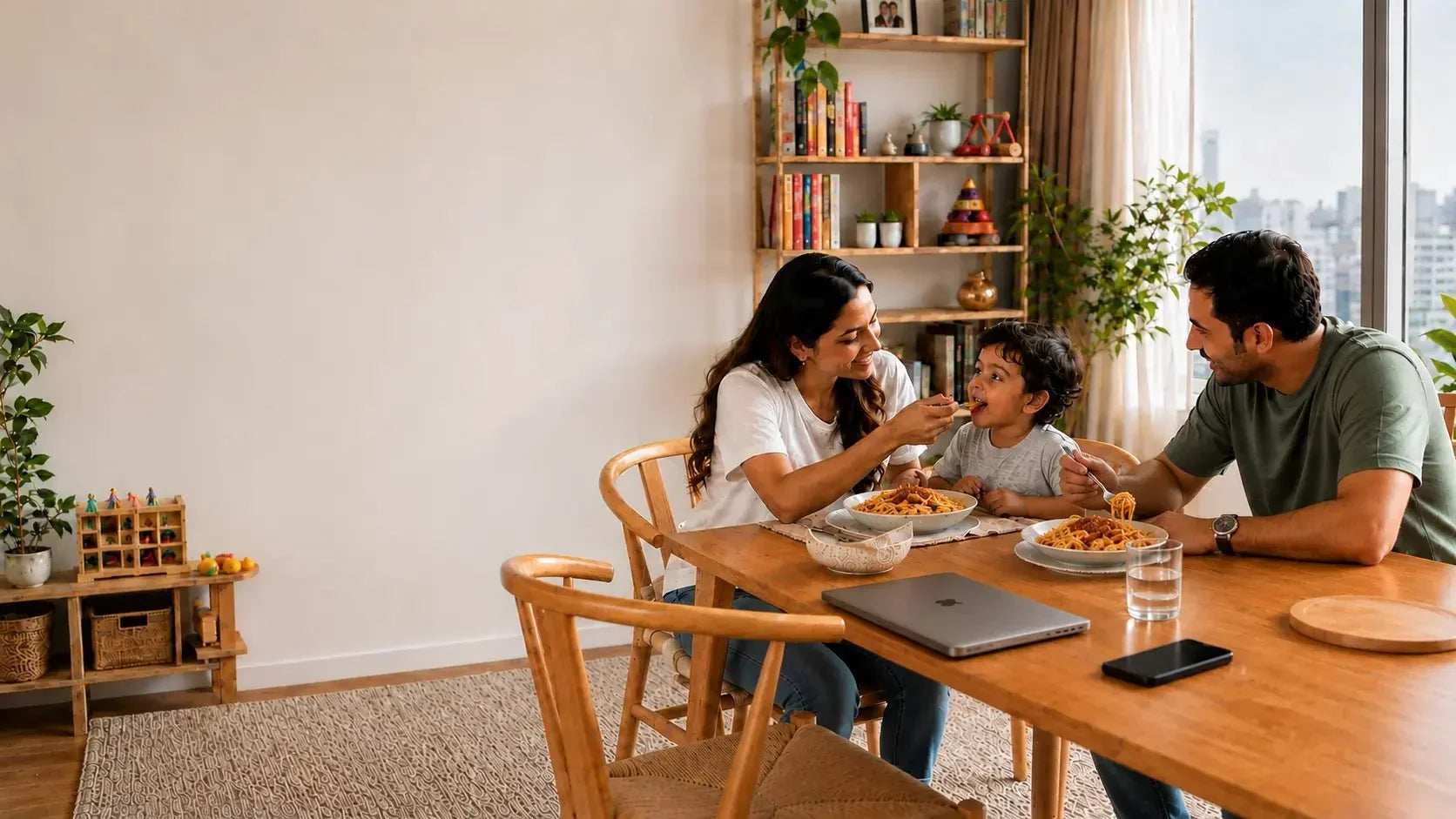
It's dinner time. A toddler is refusing to sit still, a parent is trying to get one more spoon of dal into them before the food gets cold, and a phone comes out, mostly to buy five quiet minutes. Almost every parent has done some version of this. It isn't a failure. It's Tuesday.
What's harder to find is a straight answer to the question that usually follows: was that okay? How much is too much? Does it matter what's on the screen, or just how long it's on for?
This report doesn't try to settle that with fear or with false certainty. Instead, it pulls together what the World Health Organization, the American Academy of Pediatrics, the Indian Academy of Pediatrics, UNICEF, and peer-reviewed journals like JAMA Pediatrics actually say, where they agree, where they genuinely disagree, and what's still unknown. It also looks honestly at where the popular narrative around "screen time is bad" gets ahead of what the science supports, and where the concern is well-earned.
The goal is simple: give Indian parents of young children a clear, honest, non-judgmental map of the evidence, so decisions come from understanding, not guilt.
What this report covers
- What the major health bodies actually recommend, and why they don't all agree
- What's genuinely proven about screens and speech, sleep, attention, and behaviour
- Where popular claims outrun the evidence
- Devices, content types, and what the research says actually matters
- Why parents reach for screens, and what that says about the real problem
- Practical, age-by-age recommendations
- Common myths, checked against the evidence
- Frequently asked questions
How This Report Was Built
Not as a lab study, and not as a survey with a clean set of percentages to quote. This is a synthesis, a careful reading of current science, cross-checked across multiple independent bodies and journals, translated into plain language for parents.
A few ground rules shaped how it was written.
-
Correlation is labelled as correlation. Most screen-time research compares children who happen to get more or less screen exposure, it can't always prove screens caused an outcome versus simply being associated with it. This report says so explicitly wherever that distinction matters.
-
Not all "screen time" is the same thing. A toddler half-watching a fast-cut cartoon alone, a child on a video call with a grandparent, and a preschooler using a well-designed app with a parent nearby are different experiences that happen to share a unit of measurement.
-
Disagreement is reported, not hidden. Where major bodies genuinely differ, for instance on whether a fixed hour-limit still makes sense, this report says who disagrees with whom, and why.
-
Indian context matters. Much of the underlying research comes from the US, UK, and Europe. Where that changes how findings should be read for Indian families, smaller homes, denser cities, joint families, air quality limiting outdoor play, this report says so.
What Do Health Authorities Actually Recommend?
There isn't one number everyone agrees on, and pretending otherwise would be the first dishonest thing in this report. WHO and the Indian Academy of Pediatrics still use hour-based limits. The American Academy of Pediatrics, in a major update, has moved away from a fixed number entirely.
Here's how the major guidelines actually compare.
| Body | Under 18-24 months | 2-5 years | Approach |
|---|---|---|---|
| WHO | None | ≤1 hour/day (2-4 yrs) | Fixed hour limit |
| Indian Academy of Pediatrics | None under 2 | ≤1 hour supervised (2-5 yrs) | Fixed hour limit |
| American Academy of Pediatrics (2016) | Avoid, except video calls | ≤1 hour high-quality content | Fixed hour limit |
| American Academy of Pediatrics (2026 update) | No set number | No set number | Content quality, family media plans, replacing hour-limits with a systems approach |
This shift matters. The AAP's newer framework, released in early 2026, moves away from counting hours toward asking different questions entirely: what is the child watching, who's watching with them, and what is the screen replacing. A co-author involved in the update put it plainly, the earlier two-hour rule had become nearly impossible for most modern families to follow, not because parents weren't trying, but because the guidance itself hadn't kept pace with how screens are actually used now, video calls, shared family devices, apps that weren't imagined in 2016.
UNICEF, notably, doesn't set an hour figure at all. Its position leans more toward equity, arguing that digital access can help or harm depending entirely on context, rather than treating all screen time as a uniform risk.
Something worth sitting with: nearly every recommendation body agrees on three things regardless of their exact numbers. Children under two shouldn't get unsupervised solitary screen time. Content quality and whether an adult is engaged alongside the child both matter a great deal. And screens shouldn't push out sleep, movement, or real conversation. Where they disagree is mostly about whether a clock-based rule is even the right tool anymore, not about whether screens deserve thoughtful limits.

Devices, Content, and Why Screens Get Introduced
Smartphones dominate early screen exposure in most urban households, more than television, tablets, or laptops, largely because they're always in a parent's pocket, always charged, and can be handed over in seconds. That immediacy is exactly what makes them the default reach in a stressful moment, not a considered choice about the best device for a child.
What's actually being watched matters more than which device it's on. Nursery rhymes and short-form videos dominate the youngest age group. As children get closer to preschool age, that shifts toward cartoons, algorithm-chosen YouTube content, and occasionally genuine educational apps.
The honest research on why screens get introduced isn't flattering, but it isn't shameful either. It maps closely onto real pressure points in a family's day.
- Mealtimes, to get food into a reluctant eater
- A parent working from home or managing office messages
- Household chores that need both hands free
- Long commutes or travel, where a screen genuinely does make a journey easier
- Managing a tantrum or meltdown in the moment
- Grandparents or other caregivers who use screens differently than parents might
- Straightforward exhaustion, especially in the evening
None of these reasons are unique to India or to any income bracket. What is somewhat distinct in dense Indian cities is the added layer of limited outdoor space, air quality concerns on many days, and multigenerational households where more than one adult's habits shape a child's day. A grandparent handing over a tablet isn't the same decision, made under the same pressures, as a parent doing it, and current research genuinely doesn't have much to say about that dynamic. It's a real gap, not a settled question either way.

What the Evidence Actually Says About Speech and Language
This is one of the more consistently studied areas, and also one of the more misunderstood.
A widely cited JAMA Pediatrics analysis by Madigan and colleagues found a modest association between screen use and weaker expressive and receptive language skills in young children, but the effect was strongest for solitary, non-educational, background viewing, and much weaker or absent when content was co-viewed or genuinely high quality. The mechanism researchers point to isn't mysterious. Children learn language best from live, responsive back-and-forth exchange, what linguists call conversational turns, and pre-recorded video simply cannot replicate that, no matter how well designed.
There's a well-replicated finding behind this called the video deficit effect. In controlled studies, toddlers reliably learned a new word from a live, responsive speaker, but not from an unresponsive recording, even when the content looked identical. Video calling narrows this gap considerably, because it's still live and responsive, which is part of why most guidelines treat video chat with a distant relative differently from a pre-recorded show.
Background television carries its own quieter cost. Even when a child isn't actively watching, having the TV on in the background has been shown, in controlled observation, to reduce both how much parents talk to their children and the variety of words they use, while high-quality parent-child interaction time drops noticeably.
What isn't well supported: the idea that labelling an app or show "educational" guarantees any benefit at all. Most such claims come from marketing, not independent research. And while the association between screens and language delay is real, the effect sizes in the underlying studies are modest and appear reversible for most children once richer conversational interaction resumes, this isn't a permanent-damage story.
Attention, Behaviour, and Emotional Regulation: A More Contested Picture
If speech and language is one of the better-established areas, this is one of the murkier ones, and it's worth being honest about that rather than borrowing certainty the research doesn't have.
There is a real, replicated link between heavy exposure to fast-paced, non-child-directed content and weaker self-regulation and attention measures later on. One well-known experiment found that four-year-olds performed measurably worse on executive-function tasks immediately after watching a fast-paced cartoon, compared with children who watched a slower, educational show or no television at all, a genuine short-term effect, not just a correlation.
But the bigger, more headline-grabbing claim, that screens cause ADHD or attention disorders, is considerably weaker than popular parenting content usually suggests. One longitudinal study specifically designed to test this found no association between screen time at age two and inattention or hyperactivity symptoms measured years later, even though a same-time snapshot did show a correlation, suggesting the earlier link may have been more about which children were already harder to redirect, and therefore given more screen time, rather than screens causing the difficulty. A separate large cohort using brain-activity measurements did find a connection between screen exposure at 12 months and attention-related brain activity at age nine. These two credible, recent findings genuinely point in different directions. That's not a contradiction to paper over, it's an accurate description of where the science currently stands.
Sleep: The Strongest Evidence in This Entire Report
If there's one section where the science is unusually solid, it's this one.
A large meta-analysis published in JAMA Pediatrics, covering over 125,000 children, found that having screen access in a child's sleeping environment was linked to significantly higher odds of inadequate sleep duration (odds ratio 1.79) and poorer sleep quality (odds ratio 1.53), along with more than double the odds of daytime sleepiness. The mechanism is well understood, blue-wavelength light from device screens suppresses melatonin production, delaying the body's natural signal that it's time to sleep, and interactive apps or games tend to cause more physiological arousal than passive TV viewing, which can further disrupt sleep architecture.
WHO, the AAP, and the IAP are unanimous here in a way they aren't elsewhere, recommending screen-free periods before bed and no devices in the bedroom itself, even when the device is switched off. Reduced sleep in early childhood has also been linked to worse next-day emotional regulation, which is part of why this particular recommendation carries such consistent weight across every major guideline.
Eyes, Outdoor Play, and the Physical Side of Screen Time
Two separate but related concerns show up repeatedly in parent conversations: eyesight and outdoor time.
On eyesight, the evidence is fairly clear. A large 2021 meta-analysis in The Lancet Digital Health, covering over 150,000 children, found high smartphone use was associated with roughly a 26% increased risk of myopia, rising to a 77% increased risk when combined screen and computer use was considered. Part of the reason is simple physics, handheld devices are typically held 20-25 centimetres from a child's face, compared to roughly 30-35 centimetres for a book and well over two metres for a television, placing real strain on developing eyes. Blink rate also drops by roughly half during active screen use, contributing to dryness and irritation. Outdoor light exposure, separately, appears to help protect against myopia progression, which is one reason paediatric eye guidance so consistently pairs "less screen time" with "more time outdoors" rather than treating them as unrelated pieces of advice.
The link between screen time and physical activity is less straightforward than it might seem. It's tempting to assume that removing a screen automatically frees up that time for active play, but the research doesn't support that as a guarantee. Several studies have found that screen time and physical activity operate somewhat independently, children who lose access to a screen don't reliably go outside instead, especially when the real barrier is something else entirely: no safe playground nearby, poor air quality on a given day, or simply no adult available to supervise outdoor play. This is especially relevant in dense Indian cities, where space constraints often matter more than screen availability itself in explaining why a child isn't playing outside.
Mealtimes: What "Distraction Feeding" Actually Does
Handing over a phone at the dinner table is one of the most common uses of screens in early childhood, and it's also one of the better-studied.
A systematic review covering 22 studies found that screen viewing during meals interferes with a child's satiety responsiveness, essentially, their ability to notice their own body telling them they're full. Children fed in front of screens tend to eat more high-calorie, processed snack foods and show lower acceptance of varied, healthy textures like vegetables. The same review found mealtime screen use was linked to a 42% higher risk of childhood overweight, and that parent verbal engagement during meals dropped by more than 65% when a screen was present. Perhaps most interesting for parents dealing with a fussy eater, children fed in front of screens showed more food resistance and fussiness during screen-free meals too, suggesting the pattern doesn't stay contained to the moments a screen is actually on.
None of this means one screen-assisted meal during a hard week undoes anything. But as a routine pattern, mealtime screens appear to work against exactly the eating habits most parents are trying to build.
Parents' Own Screens, and a Genuine Research Gap Worth Naming
Here's something that gets far less attention than it probably deserves: a parent's own device use during caregiving moments, sometimes called technoference, appears to matter at least as much as a child's direct screen exposure. The AAP's 2026 update makes this explicit, framing family media habits as a shared responsibility rather than a child-only restriction, with one contributor noting plainly that children learn behaviour by watching what the adults around them actually do, not just what they're told.
There's a genuine, citable gap in this research worth being upfront about. Almost all existing studies are conducted in Western, single-caregiver households. Very little peer-reviewed research exists on how grandparents or extended family, who provide significant daytime childcare in many Indian households, shape a child's screen habits differently than parents do. It's not that the answer is known and inconvenient, it's that the question mostly hasn't been asked yet in a context like this.
Working Parents and Stay-at-Home Parents Face Different Pressure Points
The specific daily pressures around screens don't look identical across households, even when the underlying evidence applies to everyone. A parent managing a full-time job from home is often weighing a work call against a toddler's attention in real time, several times a day, in a way that makes a screen feel like the only workable bridge. A parent at home full-time faces a different kind of pressure, long unstructured stretches of the day to fill, fewer built-in breaks, and often more of the guilt that comes from having, in theory, "more time" and still reaching for a screen anyway.
Neither situation is a research finding so much as a pattern most parents will recognise immediately. What the evidence above does offer both groups is a slightly different question to ask than "how many hours." A more useful one might be: when a screen goes on, is there any way, even briefly, to sit alongside the child rather than stepping fully away. That single shift, co-use rather than solo use, has more supporting evidence behind it than almost any other single lever discussed in this report.
What Actually Helps Reduce Screen Time
Reducing screen time on the ground floor is far harder than any list of tips suggests, but a few approaches do have real evidence behind them rather than being generic advice repeated everywhere.
-
Co-use over removal. Sitting with a child during screen time, narrating what's happening, asking questions, has the best evidence of any single intervention for turning screen time from a likely negative into something closer to neutral or even positive.
-
Protecting specific windows, not the whole day. Screen-free meals and a screen-free hour before bed are both backed by strong, consistent evidence, more so than trying to police every minute across the day.
-
Replacement activities that involve an adult. Guided block play, shared reading, and pretend play all show solid evidence for language and cognitive gains, but the common thread across the research isn't the toy itself, it's an adult narrating and engaging alongside the child.
-
A family media plan, not just a child rule. Because parental self-modelling appears to matter so much, agreements that include adults ("phones away during dinner" for everyone, not just the child) tend to hold up better than rules aimed only at kids.
-
Outdoor time on its own terms. Since removing screens doesn't automatically produce outdoor play, actively planning outdoor time, rather than hoping it fills the gap, tends to work better in practice.
Practical Recommendations by Age
Avoid solo screen use entirely. Video calls with family are a reasonable exception, since they're live and responsive rather than passive. Background TV should be off during play and feeding, since even unwatched TV reduces how much parents naturally talk to their child.
If screens are used, keep sessions short and co-viewed where possible. Favour slower-paced, child-directed content over fast-cut shows. Keep mealtimes and the hour before bed screen-free. Balance any screen time with guided play, blocks, books, pretend play, ideally with an adult narrating alongside.
Some independent, well-chosen content is reasonable at this age, but the same principles hold: content quality over quantity, screens out of bedrooms, and protected outdoor and unstructured play time built into the day rather than left to chance.
Myth vs Fact
Fact: Most such claims come from app-store marketing, not independent research. Very few educational apps have been rigorously tested against a real learning outcome.
Fact: This isn't supported by the strongest available evidence. One well-designed longitudinal study found no causal link between early screen time and later attention symptoms, even though a same-time snapshot showed a correlation.
Fact: Several studies show screen time and physical activity operate somewhat independently. Outdoor play usually needs to be planned for directly, not assumed as a byproduct of less screen time.
Fact: Even unwatched background television has been shown to measurably reduce how much parents talk to their children in the room.
Fact: Video chat is treated differently by every major guideline, because it's live and responsive, which is exactly what makes screen-based language learning work.
Fact: The AAP moved away from a fixed hour limit in its 2026 update, shifting toward content quality and family media habits instead. WHO and IAP still use hour-based limits, so guidance genuinely varies by source.
Parent Action Checklist
Ten Key Takeaways
- No major health body recommends any screen time for children under 12 months, apart from live video calls.
- The AAP's 2026 update dropped fixed hour limits in favour of content quality and family media habits, a significant, recent shift.
- Sleep is the area with the strongest evidence, a large JAMA Pediatrics meta-analysis found screen access at bedtime nearly doubles the odds of inadequate sleep.
- Co-viewing with a child converts screen time from a likely negative into something closer to neutral, more reliably than any specific app choice.
- Background TV reduces parent talk even when a child isn't actively watching it.
- The claim that screens cause ADHD is weaker than popular parenting content suggests, the science here is genuinely mixed.
- Removing screens doesn't automatically create more outdoor play, that usually has to be planned for separately.
- Screen use during meals measurably affects a child's ability to recognise fullness and accept varied foods.
- A parent's own screen habits during caregiving moments matter nearly as much as a child's direct exposure.
- There's almost no research yet on grandparent and extended-family screen habits in India, a real, open gap rather than a settled question.
About the Author
Neha Makdey is the Co-Founder & CEO of NESTA TOYS - India’s homegrown educational toy brand loved by over 3 lakh curious kids. NESTA Toys designs research-backed, hands-on learning toys for children aged 1–10, available on Amazon, Blinkit, Swiggy Instamart, and nestatoys.in. Follow NESTA TOYS on WhatsApp and Pinterest for free parenting resources and activity ideas.
Frequently Asked Questions
What is the ideal screen time for a 2-year-old in India?
IAP recommends no screen time at all under age 2, apart from live video calls. From 2-5 years, IAP and WHO both suggest up to one hour a day of supervised, high-quality content. The AAP's 2026 update dropped a fixed number for this age group in favour of content quality and parental engagement, so treat one hour as a reasonable ceiling, not a strict rule.
Is TV bad for a 1-year-old?
Every major health body recommends avoiding screen media under 18-24 months, apart from live video calls. Even background TV a child isn't directly watching has been shown to reduce how much parents naturally talk to them, which matters for language development at this age.
Can screen time cause ADHD in toddlers?
The evidence is genuinely mixed. One longitudinal study found no causal link between early screen time and later attention symptoms, while a separate study using brain-activity measurements did find an association. Popular claims that screens cause ADHD outrun what the strongest evidence currently supports.
Does video calling count as screen time?
Technically yes, but every major guideline treats it differently from passive viewing because it's live and responsive. Research on the video deficit effect shows children learn far better from interactive video than pre-recorded content, so a call with a grandparent isn't the same exposure as a cartoon.
How does screen time affect a child's sleep?
A large JAMA Pediatrics meta-analysis of over 125,000 children found screen access in a child's sleep environment nearly doubled the odds of inadequate sleep duration. Blue light suppresses melatonin and delays the body's natural sleep signal, which is why every major body recommends keeping screens out of bedrooms.
Does screen time cause eyesight problems in children?
A 2021 meta-analysis in The Lancet Digital Health, covering over 150,000 children, found high smartphone use meaningfully increased myopia risk. Handheld devices are held much closer to a child's face than books or TV, straining developing eyes, while outdoor light exposure appears to help protect against it.
Is it okay to let a child watch TV during meals?
Occasionally is fine. As a routine pattern, though, research shows it interferes with a child's sense of fullness, increases processed snack intake, and sharply cuts parent-child conversation during meals, one review even found more food fussiness on screen-free days among children used to screen meals.
Does it matter if parents are on their own phones around their kids?
Research suggests parental device use, sometimes called technoference, matters at least as much as a child's own screen exposure. The AAP's 2026 update frames family media habits as a shared responsibility, since children largely learn behaviour by watching the adults around them.
What can I give my toddler instead of a phone during a tantrum or meal?
No object fully replaces a screen, but the research points to adult engagement, not the item, as the real factor. Guided block play, shared books, and pretend play all show solid evidence for language and cognitive development when an adult is narrating and interacting alongside the child.
Do grandparents use screens differently with children, and does it matter?
Almost certainly in practice, but there's very little peer-reviewed research on this specific question, since most existing studies come from Western, single-caregiver households rather than the multigenerational households common across urban India. It's a real, open gap worth naming rather than glossing over.
References
- World Health Organization. Guidelines on Physical Activity, Sedentary Behaviour and Sleep for Children Under 5 Years of Age. who.int
- American Academy of Pediatrics. Media and Young Minds (2016 policy statement). DOI: 10.1542/peds.2016-2591
- Madigan, S. et al. Association Between Screen Time and Children's Language Outcomes. JAMA Pediatrics. DOI: 10.1001/jamapediatrics.2019.3869
- Carter, B. et al. Association Between Portable Screen-Based Media Device Access and Sleep Outcomes: A Systematic Review and Meta-Analysis. JAMA Pediatrics. jamanetwork.com
- Foreman, J., Salim, A. T., Praveen, A., Fonseka, D. et al. Association Between Digital Smart Device Use and Myopia: A Systematic Review and Meta-Analysis. The Lancet Digital Health, 2021. thelancet.com
- Emond, J. A., Tovar, A., Li, R., Karagas, M. R., & Madigan, S. Screen Time During Meals and Child Nutritional and Behavioral Outcomes: A Systematic Review. Appetite. DOI: 10.1016/j.appet.2021.105431
- Indian Academy of Pediatrics. Screen time guidelines for children. iapindia.org


