

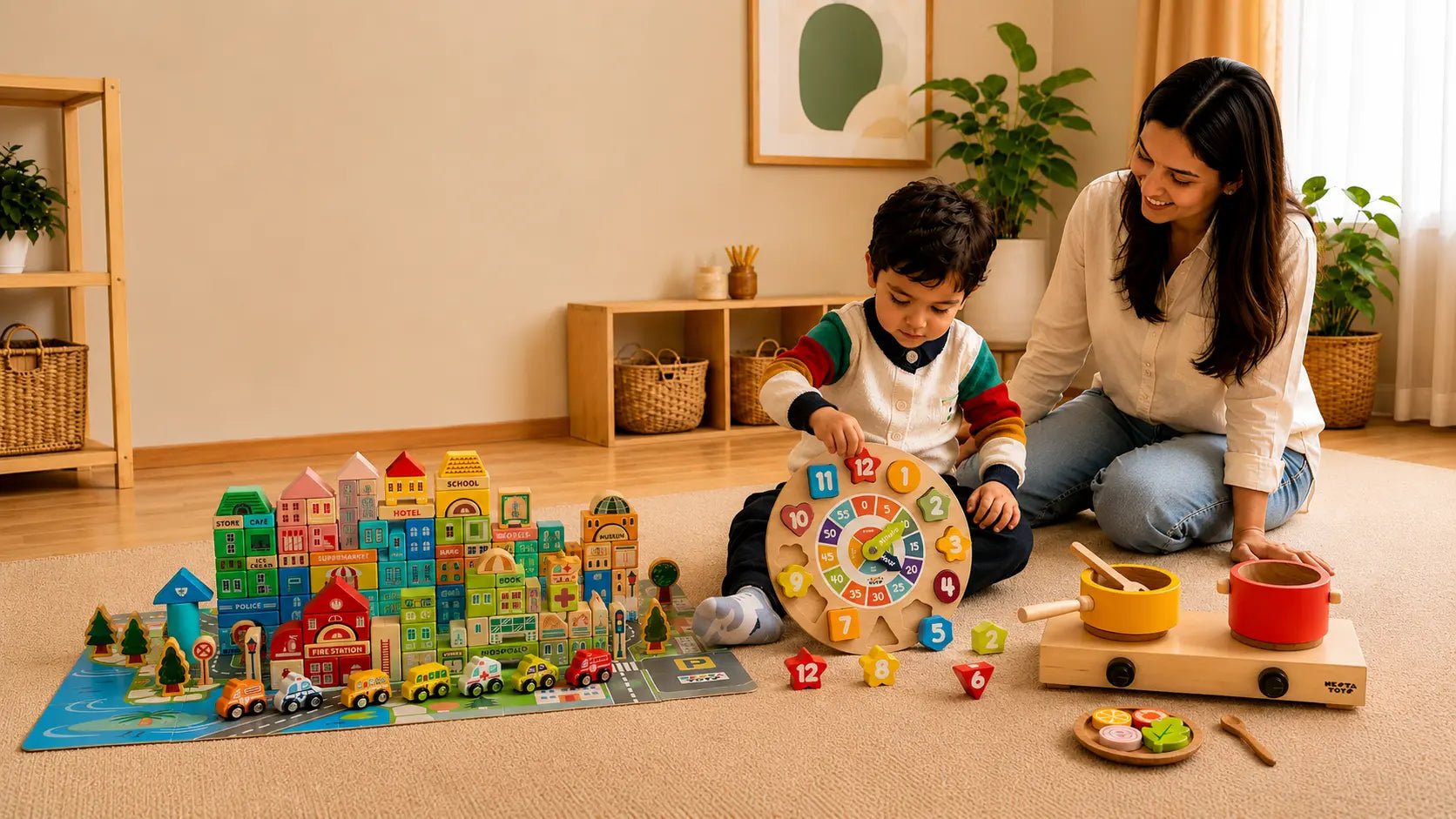
By now, this series has covered what educational toys are, why they matter, how to choose them, and how they relate to Montessori toys. One question still comes up constantly. What's actually right for my child's age?
Here's the honest answer. Developmental readiness matters more than the number printed on a box. Every child grows at their own pace, and a toy that's perfect for one three-year-old might be too simple, or too advanced, for another entirely. This guide walks through what kids are typically exploring at each stage, birth through age eight, and what tends to genuinely fit.
Age Is a Starting Point, Not a Rule
Interest predicts engagement better than age ever does. A toy that matches what a child is curious about right now usually gets played with far more than a pricier one bought because it's trending this season.
The number on the box still counts for something, worth using as a rough guide. But watching what your child actually reaches for tells you more than any birthday ever will.
- A toy slightly ahead of a child's current stage offers a good stretch
- One too far ahead just creates frustration, not learning
- The same toy can land completely differently in two households with same-aged kids
0-1 Years: Learning Through the Senses
A baby explores almost entirely through touch, sound, and sight. Poke it, shake it, squeeze it, something happens. That's the whole lesson at this stage, and it's a bigger one than it sounds.
Sensory exploration, visual tracking, grasping, tummy time, all of it fills up the day without needing a schedule attached.
- Different textures matter more than most parents expect
- High-contrast colors are easier for very young eyes to focus on
- Simple mechanisms a baby can trigger themselves, a shake, a squeeze, teach real cause and effect
- Good categories: soft sensory toys, high-contrast cards, simple rattles, grasping toys
Babies tend to circle back to the same few favorites again and again here. A smaller rotation usually beats a large pile.
1-2 Years: Stacking, Sorting, and First Words
Toddlers this age are working on walking, stacking, sorting, and early hand-eye coordination, often all in the same afternoon. Their first real words start showing up somewhere in the middle of all that motion.
Balance and movement take up a lot of a toddler's attention. So does cause and effect, mostly discovered by knocking things over on purpose.
- Look for toys sturdy enough to survive repeated stacking and dropping
- Pieces should be big enough to be safe, small enough for developing hands
- Good categories: stacking toys, shape sorters, push-and-pull toys, simple wooden puzzles
Watch what your toddler keeps going back to before buying something new. Their own pattern tells you more than a shelf full of options ever could.
2-3 Years: Pretend Play Takes Over
This is usually the year a cardboard box becomes a car and a spoon becomes a microphone. Vocabulary expands fast right alongside it.
Imagination through role play, early matching, basic trial-and-error reasoning, this is the age where all of it clicks into place at once.
- Pretend kitchens and dress-up pieces support storytelling and imitation
- Puzzles and matching games build on fast-growing vocabulary
- Wooden blocks and peg puzzles round things out nicely
A toy that gets your child talking is worth just as much as one that teaches numbers. Language at this age develops through play, not flashcards.
3-4 Years: Building, Creating, Counting
Fine motor control keeps improving, and so does the ambition behind whatever a kid decides to build. Storytelling gets more elaborate. Early number sense starts showing up in ordinary play, usually without anyone teaching it directly.
Open-ended building tends to hold attention longer than toys with one fixed outcome.
- Building blocks and construction sets
- Art materials for drawing, coloring, simple crafts
- Simple board games and role-play toys
A child can outgrow how they use a toy before they outgrow the toy itself. The same blocks a two-year-old stacked might get rebuilt into an entire imaginary town two years later, no new purchase needed.
4-5 Years: Logic Starts to Show Up
Many kids this age start showing real interest in patterns, sequencing, and early letters and sounds. Independent play stretches get noticeably longer too.
What tends to work here is a bit more challenge, but not so much that it tips into frustration.
- Sequencing games and simple reasoning puzzles
- Construction sets and early STEM exploration kits
- Alphabet-based activities that feel like play, not drills
- Continued pretend play, still very much relevant
Don't retire a favorite toy too quickly at this stage. Kids often find entirely new ways to use something familiar once their thinking has moved forward.
5-6 Years: Planning and Working With Others
Basic strategy, planning ahead, cooperative or turn-based play, this is where all three start to matter. Creative projects also start taking longer than a few minutes to finish, which is new.
Games with simple rules involving more than one player tend to land well here.
- Strategy games and larger building projects
- Simple science kits
- Geography or map-based puzzles
Rotating old toys back into the mix often creates more excitement at this age than buying something new does.
6-8 Years: Real Problem-Solving Begins
By now, kids are often ready for genuine critical thinking and longer independent projects. Not just something to occupy time, something to actually work through.
Deeper reasoning, collaboration on shared projects, sustained independent focus, all of it becomes part of daily play.
- Advanced building sets and STEM kits
- Logic-based games
- Multi-step craft kits with real complexity
A child who's outgrown the simplicity of a toy hasn't outgrown the category. A basic building set from age three usually has a far more advanced version that still earns a spot on the shelf at seven.
Quick Reference by Age
| Age | Development Focus | Recommended Toy Types |
|---|---|---|
| 0-1 years | Sensory exploration, cause and effect | Sensory toys, rattles, high-contrast cards |
| 1-2 years | Stacking, sorting, coordination | Stacking toys, shape sorters, simple puzzles |
| 2-3 years | Pretend play, language, matching | Pretend play sets, blocks, peg puzzles |
| 3-4 years | Creativity, storytelling, early counting | Building blocks, art materials, role-play toys |
| 4-5 years | Logic, early literacy, independent play | Construction sets, alphabet activities, STEM basics |
| 5-6 years | Planning, teamwork, creativity | Strategy games, building projects, science kits |
| 6-8 years | Critical thinking, collaboration, independent projects | Advanced building sets, STEM kits, logic games |
Some Toys Just Grow With the Child
Open-ended blocks are the clearest case. A two-year-old stacks them into a wobbly tower. A five-year-old builds a house with rooms. An eight-year-old uses the exact same set to build something with real structural logic behind it.
Pretend play sets and basic art supplies work the same way. Nothing about the toy changes. What changes is the child using it.
- Fewer, higher-quality open-ended toys often beat a large age-specific collection
- The same set can genuinely serve more than one child in a household
- A toy outgrowing its box doesn't mean it's done being useful
Matching a Toy to Where Your Child Actually Is
Construction, materials, and durability are already covered in our buying guide, worth a look if you haven't seen it. This part is about something narrower, matching a toy to this specific child, right now.
- Does it match what my child is genuinely curious about, not just their age?
- Is there enough challenge in it to hold interest for a while?
- Can my child engage with it without needing constant help?
- Could it still be relevant a year from now, just used differently?
- Would a sibling, older or younger, get real use out of it too?
The One Mistake Worth Naming
Buying strictly off the age on the box, rather than what a child is actually ready for, is the single most common misstep here. Two kids can share a birthday and be in completely different developmental places. The packaging has no way of knowing that.
Watching actual play, what they gravitate toward, what holds attention, what frustrates them, beats a printed number every time.
So, choosing by age was never really about matching a birthday to a shelf label. It's about noticing where your child is right now and meeting them there. The best toys usually aren't tied to one age at all. They just grow alongside the kid using them.
For toys built with exactly that in mind, the Educational Toys Collection and Montessori Toys Collection are worth browsing by stage rather than age.
About the Author
Neha Makdey is the Co-Founder & CEO of NESTA TOYS - India’s homegrown educational toy brand loved by over 3 lakh curious kids. NESTA Toys designs research-backed, hands-on learning toys for children aged 1–10, available on Amazon, Blinkit, Swiggy Instamart, and nestatoys.in. Follow NESTA TOYS on WhatsApp and Pinterest for free parenting resources and activity ideas.
FAQs
Is it okay if my child prefers toys meant for a younger or older age group?
Yes, this is common and not a cause for concern. Interest and readiness vary a lot between individual children, and a toy slightly outside the "recommended" range often still fits perfectly well.
How do I know if a toy is too advanced for my child?
Watch for frustration rather than engagement, if a child gives up quickly and doesn't return to the toy, it may be a bit ahead of where they currently are. Setting it aside and reintroducing it later often works better than returning it outright.
Should I buy new toys every time my child has a birthday?
Not necessarily. Many toys, especially open-ended ones like blocks or pretend play sets, simply get used differently as a child grows, without needing to be replaced.
What's the biggest difference between toys for toddlers and toys for school-age children?
Toddler toys tend to focus on sensory exploration and basic cause and effect, while toys for older children shift toward planning, logic, and more complex creative projects.
Can siblings of different ages share the same educational toys?
Often, yes, particularly with open-ended toys like building blocks or art supplies, which naturally scale in complexity based on how each child chooses to use them.
Do children need a completely new set of toys at every age stage?
No. Many toys remain relevant across several years, just used in increasingly complex ways as a child's skills develop.
How many educational toys does a child need at each stage?
Generally fewer than expected. A smaller, well-chosen set that matches a child's current interests tends to get more genuine use than a large collection spread across every possible category.
What should I do if my child loses interest in an age-appropriate toy quickly?
It may simply be too simple for where they currently are, or it may need to be rotated out and reintroduced later rather than replaced outright.
Are STEM toys only appropriate for older children?
Not necessarily, simpler STEM concepts, like basic cause and effect or early building challenges, can be introduced well before formal STEM kits become appropriate around ages five to six.
How do I choose toys for a child whose interests change quickly?
Open-ended toys tend to work best in this situation, since they can be repurposed for whatever a child is currently curious about, rather than being tied to one specific activity.


