

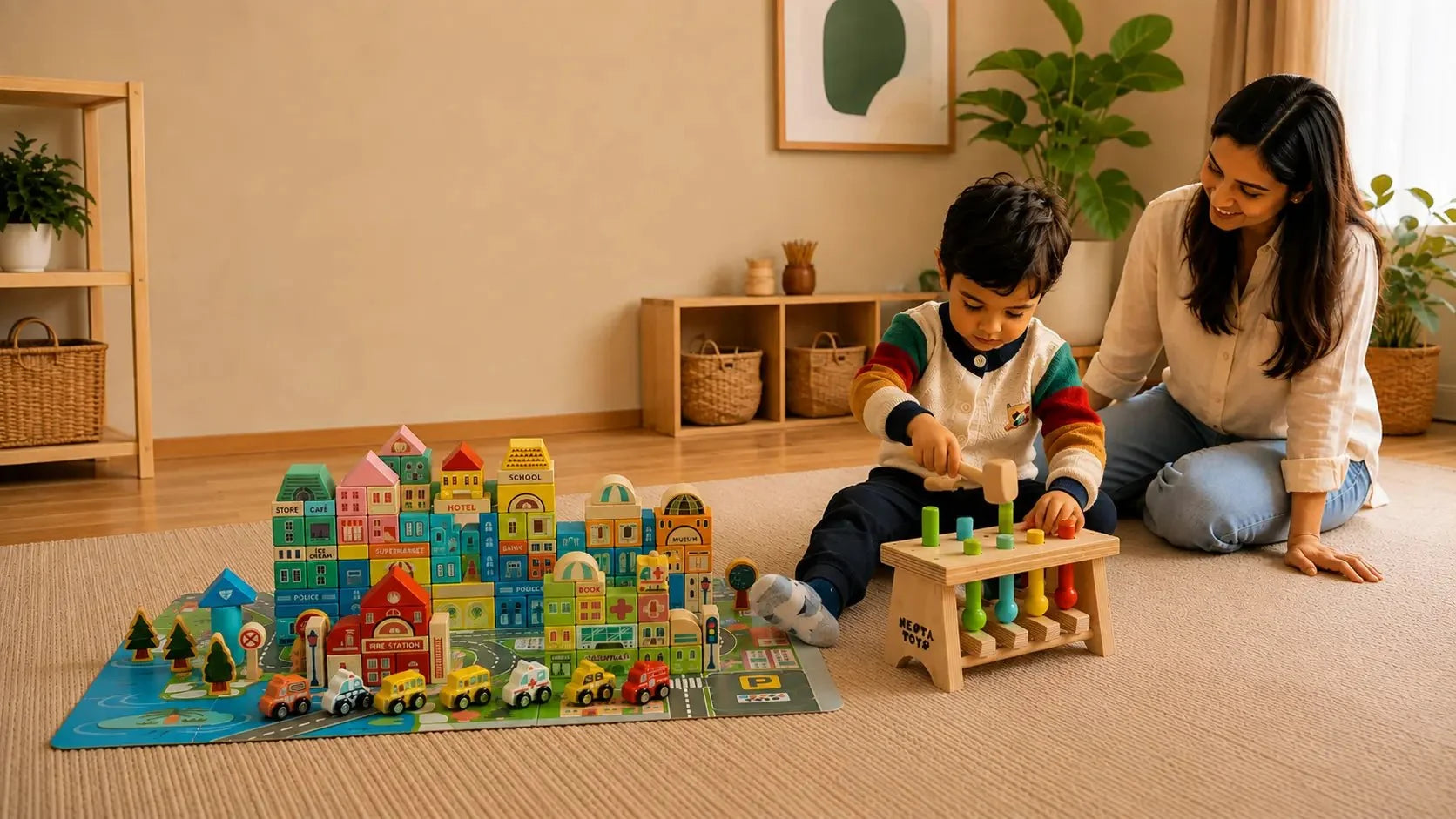
A lot of parents start out searching for educational toys, then stumble onto the term "Montessori toys" somewhere along the way and start wondering if they're the same thing, or if they need to throw out one and switch to the other.
Good news: you don't need to pick a side. Both approaches genuinely support learning through play, they're just not identical. This guide walks through where they overlap, where they differ, and how to actually decide what fits your child, without treating either one as the "right" answer. If you're just getting started, what educational toys are, why they matter, and how to choose them are already covered in earlier posts in this series.
What Are Educational Toys?
In short: educational toys are any toys that get a child actively involved while they play, thinking, building, solving, rather than sitting back and watching something happen.
It's a wide net. Building blocks, puzzles, pretend-play sets, board games, all of it can qualify, as long as the toy actually asks something of the child. There's no single design style behind the category, just the requirement that the child is doing real work, not just observing.
Key takeaway: Educational toys are the big umbrella. Lots of different toys fit under it.
What Are Montessori Toys?
Montessori toys are a bit more specific. They're built around the principles of Montessori education, letting a child explore independently, at their own pace, with the adult stepping back rather than directing.
Dr. Maria Montessori's approach is built on the idea that children learn best through hands-on, self-directed activity. So Montessori toys usually have one clear purpose, they're designed to be mastered through repetition, and a lot of them connect to real-life skills, pouring water, buttoning fabric, sorting objects by size. Wood shows up a lot in Montessori design because it's simple and natural, but wood alone doesn't make something Montessori.
Here's maybe the easiest way to picture it: educational toys are the broad category, anything that helps a child learn through play. Montessori toys live inside that category, they're just built around one specific philosophy rather than a general goal.
A quick example: a colorful shape sorter with lights and different functions is a general educational toy. A plain wooden box where a child drops a ball through a hole and fishes it back out themselves, no lights, one clear task, is Montessori. Same broad idea, learning through play, just a much narrower, more deliberate design behind it.
Key takeaway: Every Montessori toy counts as educational. Not every educational toy is Montessori.
Where the Two Actually Differ
Purpose. Educational toys usually target a general skill, creativity, motor development, problem solving, whatever it is. Montessori toys are built around one specific principle, usually independence or some real-world task. Neither approach is doing "more" here, they're just aimed differently.
How the child learns. Some educational toys are open-ended, some are fixed and single-purpose, it really depends on the toy. Montessori materials are almost always self-paced and child-led, with very little correction from an adult while the child works through it.
How much the parent's involved. A lot of educational toys, board games especially, or pretend kitchens, actually work better with a parent joining in. Montessori materials are usually meant for a child to use on their own once you've shown them how, once, and then stepped back.
What they're made of. Educational toys come in pretty much any material, wood, good-quality plastic, fabric, depending on what the toy needs to do. Montessori toys lean toward natural materials, mostly because simplicity is baked into the philosophy, not because plastic is somehow disqualifying.
How they connect to real life. Educational toys might or might not tie into something practical. Montessori materials usually do on purpose, think tiny pouring jugs, dressing frames with real buttons, kid-sized food prep tools.
Worth remembering through all of this: both are genuinely good options. This isn't really a "pick the winner" situation.
Educational Toys vs Montessori Toys: Side by Side
| Feature | Educational Toys | Montessori Toys |
|---|---|---|
| Purpose | Support general developmental skills | Support specific Montessori principles |
| Learning style | Can be open-ended or fixed-function | Typically child-led and self-paced |
| Adult involvement | Often benefits from shared play | Usually designed for independent use |
| Materials | Wide range, including quality plastic | Often natural materials like wood |
| Open-ended play | Varies by toy | Common, though purpose is usually singular per activity |
| Real-life skills | Sometimes included | Frequently central to the design |
| Creativity | Often encouraged directly | Emerges through independent exploration |
| Typical examples | Building blocks, puzzles, pretend-play sets | Object-permanence boxes, practical life trays, sensory materials |
| Best suited for | Broad developmental play across many skills | Children who thrive with independent, self-paced exploration |
Can You Use Both? (Short Answer: Yes, and You Probably Already Do)
Most families aren't picking one system and sticking to it, they're mixing both without really thinking about it. One afternoon might have a Montessori-style pouring activity, a set of blocks, a board game, and a full pretend-play session, all before dinner.
Kids don't sort their own play into categories like that. We do. In practice the two blend together pretty seamlessly in most homes, and there's no rule saying you need to commit to one philosophy.
A small observation worth mentioning: plenty of kids naturally combine Montessori-style materials with imaginative play and never notice any difference between the two. The category label matters a lot more to how a shelf gets organized than to how a child actually plays.
Key takeaway: If your kid's day already looks like a mix of both, that's normal, not something to fix.
How to Figure Out What Fits Your Child
Instead of starting with a philosophy, it usually works better to start with the kid in front of you.
- Personality. Some kids love mastering one focused task through repetition. Others get more out of open-ended toys they can use ten different ways.
- Attention span. Montessori materials tend to reward sitting with one thing for a while. Kids who bounce between activities quickly might click more with varied educational toys instead.
- Home setup. A calmer, less cluttered play area tends to suit Montessori-style materials well. A busier house with siblings running around often leans naturally toward broader, more flexible educational toys.
-
Budget. Neither approach requires spending a lot. Some of the best Montessori materials are dead simple, and plenty of good educational toys are affordable too.
The biggest wins usually come from matching the toy to the actual kid, not to whichever approach is trending in a parenting group that week. Kids tend to learn best when they feel free to move at their own pace, whichever category that technically falls under.
Common Myths Worth Clearing Up
- "Montessori toys are always expensive." Not really. A lot of the best Montessori materials are intentionally basic, a simple wooden sorting tray costs a fraction of plenty of mainstream toys.
-
"Educational toys have to light up or make noise." Some do, sure, but plenty of the most effective ones, wooden blocks being the obvious example, have zero lights or sound.
- "If it's wood, it's Montessori." Not automatically. Wood shows up a lot in Montessori design, but it's the philosophy behind the toy that actually makes something Montessori, not the material it's carved from.
- "You have to do Montessori perfectly or it doesn't count." Not true at all. Even loosely applying the core idea, stepping back and letting a kid explore on their own sometimes, still offers real benefit.
- "One of these is just better than the other." Both genuinely work. Which one fits better really comes down to the specific kid, not which philosophy has more buzz right now.
A Quick Note on Quality
Whichever direction you lean, the same basic quality checks apply, smooth finishes, safe materials, sturdy construction, they matter just as much for a Montessori sorting tray as for a set of building blocks. We went through exactly what to check for in our buying guide, worth a look since it applies to both categories equally. NESTA TOYS builds both its educational and Montessori-inspired collections around these same basics.
A Quick Way to Decide
- Does my kid like repeating one activity, or hopping between several?
- Do they enjoy figuring things out alone, or do they light up more during shared play?
- Is our home more of a calm, focused space, or a busier, more chaotic one most days?
- Am I after something tied to a real-life skill, or something open to broader imaginative use?
- Would they benefit more right now from mastering one specific task, or from having lots of options?
There's no wrong answer here. Most kids will honestly fit into both categories depending on the day, sometimes depending on the hour.
Conclusion
Educational toys and Montessori toys are really headed toward the same place, helping kids learn through play that actually means something. Every Montessori toy is educational by definition, it's just built around a tighter set of principles. And educational toys don't need to follow Montessori rules to genuinely help a child grow.
The label matters a lot less than how thoughtfully the toy supports your child's curiosity. Browsing the Educational Toys Collection and the Montessori Toys Collection side by side is honestly the easiest way to see just how much overlap there already is.
About the Author
Neha Makdey is the Co-Founder & CEO of NESTA TOYS - India’s homegrown educational toy brand loved by over 3 lakh curious kids. NESTA Toys designs research-backed, hands-on learning toys for children aged 1–10, available on Amazon, Blinkit, Swiggy Instamart, and nestatoys.in. Follow NESTA TOYS on WhatsApp and Pinterest for free parenting resources and activity ideas.
FAQs
Is a Montessori toy always better than a regular educational toy?
No. Both genuinely support learning. Montessori toys follow a specific philosophy, educational toys cover a much wider range, neither one wins outright.
Can a toy be both educational and Montessori at the same time?
Yes, every Montessori toy is a type of educational toy. Montessori is really just one specific approach sitting inside the bigger educational-toy category.
Do Montessori toys have to be made of wood?
No. Wood shows up a lot because it's simple and natural, but it's the philosophy behind the toy, not the material, that actually makes it Montessori.
Do I have to pick just one approach for my child?
Not at all. Most kids naturally get a taste of both in a single day without anyone planning it that way.
How do I know if my kid would do better with Montessori-style toys?
If they enjoy repeating one focused task on their own, they'll probably take to Montessori materials well. If they bounce between activities quickly, varied educational toys might hold their attention better.
Are Montessori toys pricier than regular educational toys?
Not necessarily. A lot of Montessori materials are built to be simple, and that simplicity often keeps the price down rather than up.
Do I need any special training to bring Montessori toys into my home?
No. The core ideas, stepping back, letting your child explore, observing before jumping in to help, can be picked up without any formal training.
What's an example of something educational but not really Montessori?
A colorful, multi-function shape sorter with lights and sounds is educational, sure, but not typically Montessori, since Montessori favors simplicity and one clear purpose per toy.
Should I get rid of my kid's current educational toys and switch to Montessori?
Usually not needed. Most homes do fine with a mix, there's no requirement to replace everything to get real value from either style.
How do I choose between the two when buying a gift?
Think about how the kid usually plays. A child who likes focused, independent tasks might enjoy something Montessori-style. A kid who loves variety might get more out of a broader educational toy.


