

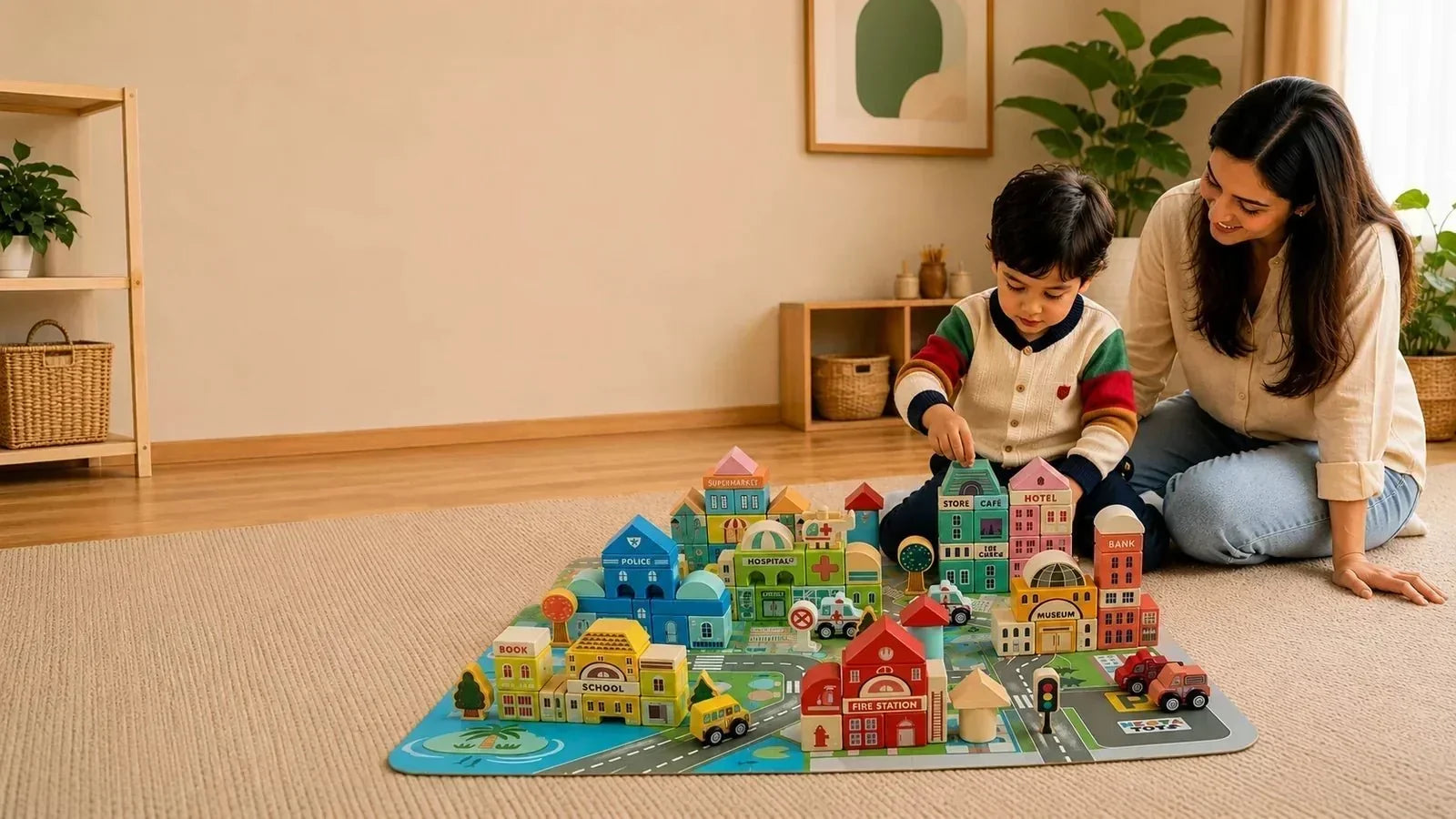
Standing in a toy store, or scrolling through page after page online, can turn overwhelming fast. Hundreds of products claim to build creativity, boost learning, or support development, and after a while it's genuinely hard to tell which ones actually deliver on that.
By now, two questions are probably settled: what educational toys actually are, and why they matter for a child's development. The harder question is the one parents actually face at the point of purchase: which specific toy is worth buying, right now, for this child. This guide is built to answer exactly that, with ten concrete things to check before buying, a store-ready quality checklist, and the questions worth asking yourself before any educational toy goes into the cart.
Why Choosing the Right Educational Toy Matters
Not every toy with "educational" on the box delivers meaningful learning. A toy becomes educational because of what the child actually does with it, not because of what the packaging claims.
This distinction has real, practical consequences. A toy that's well matched to a child's current stage tends to get used often, sometimes daily, for months or years. A toy that misses the mark, too advanced, too simple, or just not genuinely interesting to that child, often ends up untouched within a week, regardless of what it cost or how good it looked online. That gap between "used constantly" and "sits in a bin" is really the whole reason choosing carefully matters more than buying more.
It also isn't about spending more to get it right. Some of the toys that get the most sustained use in a household are also some of the simplest and least expensive, since their value comes from how open-ended they are, not from a long feature list. A toy that's well matched to a child's actual interest and stage will usually get more genuine engagement than a pricier one chosen mainly because it looked impressive in a store. Getting the choice right the first time also tends to save money in the long run, since it means fewer toys bought, barely used, and eventually replaced.
10 Things to Look for When Choosing Educational Toys
1. Start With Your Child's Actual Interests
A toy your child is genuinely drawn to will get used far more than one you think they should like. A child who loves stacking things will engage more with building sets than with a puzzle chosen because it looked educational on the shelf. A child who's constantly "cooking" in the kitchen at home is a strong candidate for a wooden kitchen play set, long before a more generic toy would land.
Before buying, it helps to notice what your child already gravitates toward at home, kitchen utensils, blocks, drawing, sorting objects, and shop from there rather than starting from a bestseller list.
Parent takeaway: Observe first, buy second.
2. Match the Toy to Developmental Stage, Not Just Age
Age ranges on packaging are a rough guide, not a rule. A toy slightly above your child's current stage offers a healthy stretch. One too far ahead usually creates frustration instead of learning.
If your three-year-old is still mastering basic shape sorting, a 100-piece puzzle isn't "advanced," it's just discouraging. Better to look at what your child can currently do, not just their birthday. A full breakdown of what to expect at each age is worth its own guide, but the short version here is simple: watch the child, not the calendar.
Parent takeaway: Buy for where your child is, not where the box says they should be.
3. Choose Toys Where the Child Does the Work
If a toy performs most of the activity itself, lights up, plays sounds, moves on its own, the child's role shrinks to watching. Toys that require the child to build, sort, solve, or figure something out are doing far more developmental work.
A simple test: watch your child use the toy for two minutes. If they're actively doing something the whole time, that's a good sign. If they're mostly observing, it's closer to entertainment.
Parent takeaway: If the toy does the thinking, the child doesn't have to.
4. Look for Open-Ended Play
A toy that can only be used one way teaches one thing. A toy that can be built, rebuilt, and reimagined stays relevant across ages and interests, since it grows with however the child wants to use it that day. This is also one of the clearer ways educational toys differ from Montessori toys specifically designed around independent exploration, worth understanding on its own if you're weighing the two.
Wooden blocks are the clearest example. A tower today, a bridge next week, something entirely imaginary a month later, using the same set of pieces.
Parent takeaway: Fewer fixed functions usually means longer-lasting play.
5. Choose Toys That Encourage Creativity and Problem-Solving
Toys that ask a "what if" question tend to hold attention longer than toys that hand over a single answer. A shape sorter has one correct outcome per piece. A set of building blocks has none, the child decides what "correct" looks like.
Both have value at different stages, but open problem-solving is worth prioritizing once a child has moved past very early toddlerhood.
Parent takeaway: Toys without a single "right answer" tend to age well with the child.
6. Prioritize Quality Over Quantity
A shelf with fewer, better toys usually gets more genuine engagement than one crowded with options. Children often spend longer with toys they've actively chosen and can explore properly, rather than skimming across a large collection without engaging deeply with any of it.
This isn't about spending more. It's about being more selective, and it directly affects how much a toy actually gets used.
Parent takeaway: One well-chosen toy often outperforms five mediocre ones.
7. Check Build Quality and Durability
A toy that cracks, splinters, or falls apart within weeks cuts the learning experience short and creates a safety concern. Sturdy joints, smooth edges, and solid materials matter well beyond how the toy looks on day one.
Before buying, it's worth handling the toy directly where possible, checking for wobble in joints, rough spots on edges, and whether it feels solid rather than flimsy. A few minutes spent checking this before buying can often prevent months of frustration later.
Parent takeaway: If it won't survive a year of real play, it's not worth the shelf space.
8. Choose Safe, Non-Toxic Materials
This matters most for younger children, who explore everything with their hands and mouths. Look for non-toxic paints and finishes, and materials that won't easily break into small, swallowable pieces.
Certifications and material information are usually listed on packaging or the product page, worth a quick check before buying rather than after.
Parent takeaway: Safety checks take thirty seconds and are worth it every time.
9. Think About Long-Term Play Value
Some toys are quickly outgrown. Others, like a good set of blocks, remain interesting for years because the child's use of them changes as their skills grow. Children frequently rediscover familiar toys after learning a new skill, using an old favorite in a completely new way.
A toy priced slightly higher but usable for four years is often better value than a cheaper one outgrown in four months.
Parent takeaway: Ask "will this still be interesting next year?" before checking out.
10. Buy Fewer, Better Toys Instead of Many Low-Quality Ones
Sometimes reducing the number of available toys leads to deeper, more focused play rather than less play overall. A durable toy chosen carefully often becomes more valuable over time, since it keeps supporting new play patterns as a child grows rather than being replaced.
This is less about restriction and more about giving each toy room to actually matter.
Parent takeaway: A smaller, thoughtful collection usually beats a large, random one.
How to Identify a High-Quality Educational Toy
Quality affects safety, how enjoyable the toy actually is to use, and how long it lasts, so it's worth checking directly rather than trusting the listing alone. Here's what to physically look and feel for:
- Smooth finishing, no rough patches or visible splinters
- Rounded edges rather than sharp corners
- Sturdy construction that doesn't flex or creak under normal handling
- Balanced weight, not so light it feels flimsy, not so heavy it's unsafe for the age group
- Splinter-free wood with a properly sealed finish
- Non-toxic paints and finishes
- Secure joints that don't wiggle
- Materials that are easy to clean and maintain
- Overall build that feels like it could survive years, not months
| What to Check | Good Sign | Warning Sign |
|---|---|---|
| Edges | Smooth and rounded | Sharp corners or rough spots |
| Joints | Firm, no movement | Wobbly or loose |
| Finish | Even, no flaking | Peeling paint or visible splinters |
| Weight | Solid but age-appropriate | Feels hollow or overly light |
| Materials | Labeled non-toxic | No material information listed |
| Small parts | Secure, won't detach easily | Loose pieces that pop off with light pressure |
These same principles guide how NESTA TOYS develops its educational toy collection, checked at each of these points before a toy is considered ready.
Wooden vs Plastic Educational Toys
Both materials have a real place in a thoughtful toy collection, and neither is automatically the better choice.
- Wooden toys tend to be more durable over years of use, often feel more substantial in a child's hands, and are frequently designed with open-ended play in mind, since there's less pressure to add battery-powered features to justify the price. They also tend to age well visually, developing a worn, well-loved look rather than looking cheap over time.
- Quality plastic toys can offer things wood generally can't, bright colors for very young children, lighter weight for toddlers still building strength, and sometimes more detailed, realistic designs useful for specific pretend-play scenarios. Well-made plastic toys, properly tested for safety, are not inherently worse, just different.
Many families end up using a mix of both, wooden toys for open-ended building and imaginative play, and quality plastic where a lighter weight or a specific function genuinely suits the activity better.
Material matters less than thoughtful design, safety, durability, and how actively the child engages with the toy. A well-made toy in either material will usually outperform a poorly made one in the "better" material.
Questions to Ask Before Buying Any Educational Toy
A quick self-check before checkout tends to prevent most buying regrets:
- Can my child play with this in more than one way?
- Does it encourage thinking, or does it do the thinking for them?
- Will it still be interesting six months from now?
- Can it grow with my child as their skills develop?
- Will my child actively participate, or mostly watch?
- Is it built to last?
If most of these answers are yes, it's very likely a good buy.
Quick Buying Checklist
- Age and stage appropriate
- Encourages thinking, not just watching
- Open-ended, more than one way to play
- Durable construction
- Safe, non-toxic materials
- Smooth, splinter-free finish
- Easy to clean and maintain
- Long-term play value
- Something your child genuinely enjoys
Conclusion
The best educational toy isn't necessarily the newest or the most expensive one on the shelf. It's the one that keeps inviting your child to think, explore, and imagine, long after the excitement of opening the box has worn off. Choosing well doesn't mean finding a single perfect toy. It means buying fewer, more meaningful ones, prioritizing quality and open-ended design, and paying attention to what actually interests your child rather than what looks impressive in a listing.
For a starting point built around these same principles, the Educational Toys Collection is a reasonable place to browse.
About the Author
Neha Makdey is the Co-Founder & CEO of NESTA TOYS - India’s homegrown educational toy brand loved by over 3 lakh curious kids. NESTA Toys designs research-backed, hands-on learning toys for children aged 1–10, available on Amazon, Blinkit, Swiggy Instamart, and nestatoys.in. Follow NESTA TOYS on WhatsApp and Pinterest for free parenting resources and activity ideas.
FAQs
How do I know if a toy is actually worth buying, not just labeled educational?
Watch what it asks your child to do. If they're building, solving, or creating, it's likely genuinely educational. If it mostly performs on its own while they watch, it's closer to entertainment regardless of the label.
Are expensive educational toys always better?
No. Price doesn't reliably predict educational value. A simple, well-made toy often outperforms a costlier one with a single fixed function.
How many educational toys should my child actually have?
Fewer than most parents assume. A smaller, well-chosen collection tends to get more genuine, focused play than a large one.
Should I buy toys based on my child's age or their actual ability?
Ability and current interest matter more than the number on the box. Age ranges are a starting point, not a rule.
What's the fastest way to check a toy's build quality in a store?
Check the edges for smoothness, gently test any joints for wobble, and look for a non-toxic material label. These three checks catch most quality issues quickly.
Is wood always a better material than plastic for educational toys?
Not always. Wood tends to be more durable and open-ended, but well-made plastic toys have their own advantages, especially for very young children. Construction quality matters more than material alone.
How do I choose between two toys that both seem educational?
Compare which one requires more active participation from the child, and which one is more open-ended. The toy that leaves more room for the child to do the thinking usually wins.
What if my child loses interest in an educational toy quickly?
It may be a sign the toy is either too simple or doesn't leave enough room for varied use. Rotating toys out for a while and reintroducing them later often revives interest too.
Should I buy a toy my child wants, or one I think will help them more?
Interest usually wins. A toy your child is genuinely drawn to gets used far more, and used toys teach far more than unused ones, however developmentally sound they look on paper.
How do I avoid wasting money on educational toys?
Prioritize open-ended, well-built toys that match your child's current stage over anything chosen purely for its marketing claims. A short mental checklist before buying prevents most regretted purchases.


