

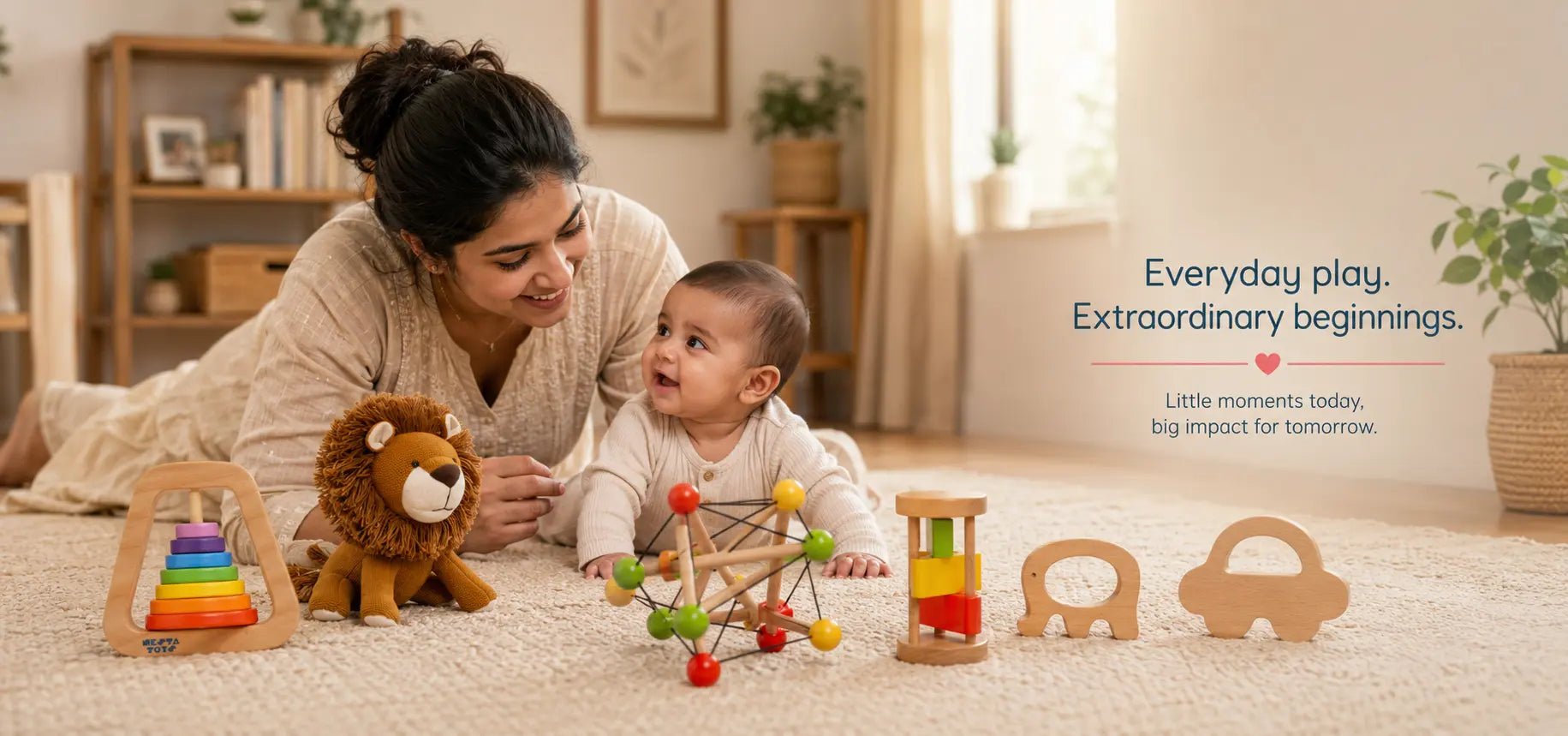
Somewhere around month two or three, a lot of new parents start asking the same question. Am I doing enough? You see another baby "hitting milestones," read one worrying post online, and suddenly the ordinary stuff you do all day, talking, singing, just being around your baby, starts to feel like it might not count.
It counts. Most of what actually shapes a baby's brain in this first year isn't expensive, planned, or even something you'd think to write down. It's the ordinary back and forth of a normal day.
Why the first year does so much of the work
A baby's brain grows faster in these twelve months than at any other point in life, and the reason is worth understanding, not just believing.
- Nearly all the brain cells your baby will ever have already exist at birth
- What's still being built are the connections between those cells, which is what eventually allows thinking, memory, and speech
- Every interaction, being held, hearing your voice, watching your expressions, strengthens those connections
- You can see the results just by comparing a newborn to a one-year-old: barely holding eye contact versus pointing, waving, and turning at their name
None of that shift happens because of one big moment. It happens through thousands of tiny, repeated ones.
Play is the actual learning, not a break from it
It's easy to picture play as downtime, something that happens between naps and feeds. For a baby, play is closer to the main event.
- Shaking a rattle is an early lesson in cause and effect
- Reaching for something just out of range builds patience and motor planning
- Copying your facial expressions is early social learning
- Babbling back and forth teaches your baby that talking is a two way exchange, not a performance
Child development researchers have a term for that last one, "serve and return." Baby babbles, you respond, baby tries again. It looks like nothing much. It's actually one of the strongest known drivers of early brain growth.
What this looks like in an average day
You don't need a plan or a checklist here. Most of it already fits into a day you're having anyway.
-
Talking through your day. Narrating what you're doing while dressing or feeding your baby feeds them language patterns long before they can use words themselves.
-
Singing. Repetition and rhythm are easier for a baby to follow than regular speech, which is part of why a bath time song often becomes something they start to expect.
-
Reading together. This doesn't need to be a full story at this age. Pointing at a picture and naming it out loud is enough, even if the book's main job right now is being chewed on.
-
Tummy time. A few minutes at a stretch, a few times a day, builds the neck and shoulder strength your baby will need to sit, crawl, and eventually walk.
-
Peekaboo and similar games. These teach anticipation, and the idea that something still exists even when your baby can't see it.
- Unstructured exploring. Letting your baby examine their own hands or bat at a toy without you narrating every second gives them room to work things out on their own terms.
Making it fit into a day that's already full
A common worry is that all of this needs dedicated time you don't have. It mostly doesn't.
- Talking and singing can happen during things you're already doing, dressing, feeding, driving, walking to the shop
- Tummy time can be split into short stretches rather than one long session, which often works better for younger babies anyway
- A five minute burst of undivided attention, no phone, just your face and voice, does more than an hour of half attention
- It's fine, and probably healthy, if some of the day has no structured "activity" at all
How to tell your baby is actually enjoying it
Babies communicate long before they have words, and reading their cues helps you know when to lean in and when to pause.
- Sustained eye contact and a relaxed, open expression usually mean they're engaged
- Kicking, waving arms, or vocalizing back at you are signs they want the interaction to continue
- Turning their head away, fussing, or going quiet can simply mean they've had enough stimulation for now, not that something's wrong
- Following their lead, stopping when they signal they're done, teaches them that their signals are being heard, which is its own kind of learning
You don't need expensive toys for any of this
If you've spent time browsing baby products, it's easy to feel like there's a "correct" set of toys you're somehow missing. The evidence doesn't really support that.
- A baby's brain responds most to relationships and repetition, your voice and face carry more weight than a toy's features ever will
- Simple objects often hold attention just as well as complicated ones, a wooden spoon and a steel bowl can be just as interesting as anything with buttons and lights
- What actually drives development is the exploring itself, not the object being explored
A few myths worth clearing up
Some ideas keep circulating that create more worry than they resolve.
-
"More stimulation is always better." Babies also need quiet, low input time to process what they've just experienced. Staring at the ceiling for a bit isn't wasted time.
-
"Educational apps help." Most pediatric guidance still recommends limiting screens in the first year, since babies learn best from real faces and real hands, not a screen.
-
"Every baby should hit milestones at the same time." There's a fairly wide range of what's normal. Comparing timelines with another baby usually adds stress without adding useful information.
- "You need expensive toys to support learning." As above, connection and repetition do far more of the actual work than product complexity does.
Where age-appropriate toys still have a place
None of this means toys don't matter at all. A well-chosen, age-appropriate toy, something that encourages grasping, stacking, or exploring different textures, can genuinely add to what your baby is exploring. The useful way to think about it is as one small addition alongside everyday interaction, not a stand-in for it.
When it's worth talking to your pediatrician
Babies develop at their own pace, and a fairly wide range of that pace is completely normal. Still, if something specific is genuinely worrying you, movement, hearing, vision, or anything else, your pediatrician is the right person to bring it to. They can look at your baby's full picture in a way no article, this one included, ever really can.
The short version
None of this needs a curriculum. It's the songs during bath time, the conversation while you're making dinner, the tummy time on the living room floor, the peekaboo game that gets the same laugh every single time. If you're already doing these things, you're already doing what your baby needs.
About the Expert Author
Dr. Tanya Gupta is a women’s health practitioner with a passion for women’s health, pregnancy, and maternal wellness. Alongside her medical practice, she is also a mother, an experience that has given her a deeper and more personal perspective on motherhood and baby care. Through her work, she shares practical, evidence-based, and relatable information to support women and fellow mothers in making informed decisions about their health and well-being.
FAQs
How does play affect a baby's brain development?
Play helps babies build neural connections through repeated experience, teaching them cause and effect, communication, and problem-solving through everyday interactions like talking, singing, and simple games.
What are the best activities for a baby's brain development in the first year?
Talking throughout the day, singing, reading together, tummy time, peekaboo, and safe independent exploration all support development. None require special equipment.
Do babies really need educational toys?
Not necessarily. Connection, conversation, and repetition matter more for brain development than the complexity of any toy. Simple, age-appropriate toys can complement everyday interaction without being essential to it.
Is talking to my baby before they can talk actually helpful?
Yes. Babies absorb language patterns, tone, and rhythm well before they can speak, and regular conversation supports later language development.
How much tummy time does my baby need for development?
Most guidance suggests starting with a few short sessions a day and gradually increasing as your baby builds strength and tolerance. Your pediatrician can advise on what's right for your baby specifically.
Can too much stimulation overwhelm a baby?
Yes. Babies also need quiet, low-stimulation periods to process what they've experienced. Constant activity isn't necessarily better for development.
When should I talk to my pediatrician about my baby's development?
If you have any specific concerns about your baby's development, whether related to movement, hearing, vision, or general milestones, it's always worth raising with your pediatrician, who can assess your baby individually.


