

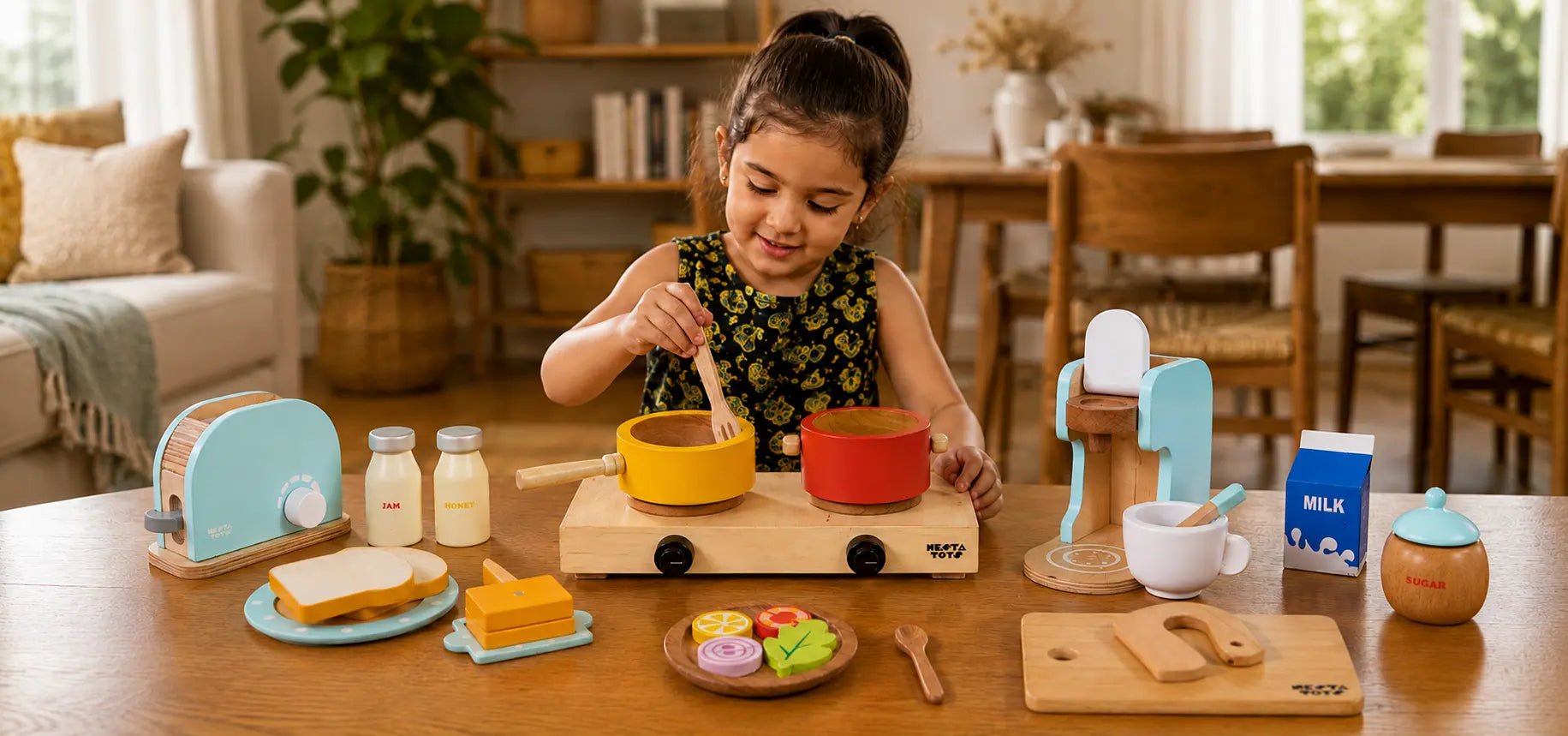
A parent stirs a pot on the stove. A minute later, their child is doing the exact same thing with an empty bowl and a spoon, deeply focused, completely serious about it. No one taught them to do this. They just watched, and then they copied.
This is where wooden kitchen toys actually earn their place, not because a toy is labeled educational, but because it gives a child somewhere safe to recreate what they've already been watching. This guide looks at what's really happening during kitchen pretend play, and how to think about choosing a toy kitchen that actually supports it.
What Counts as a Wooden Kitchen Toy
At its simplest, a wooden kitchen toy is a child-sized version of familiar kitchen activity, a stove, some cookware, pretend food, a few utensils, built for a child to handle and imagine with.
The educational value here has nothing to do with how many pieces come in the box. A child with three wooden utensils and an empty pot can build an entire imaginary restaurant. A child with forty accessories and no room to decide what any of it means often just moves pieces around without much happening underneath. What actually matters is whether the child gets to decide what the kitchen becomes.
Why Pretend Play Actually Matters
Pretend play isn't passive. Every few seconds, a child playing in a toy kitchen is quietly answering questions no one asked out loud. What am I making? What happens next? Who am I right now?
Picture a child turning their kitchen into a restaurant. Suddenly there's a menu to invent, a customer to serve, a decision about what's for sale today, and a small crisis when the restaurant "runs out" of plates. None of that was scripted. It came from one child, one kitchen, and about ninety seconds of imagination.
This is genuinely different from watching something happen on a screen. A screen decides what comes next. A kitchen doesn't, the child does. That distinction is really the whole point of pretend play, not that it's smarter or better, just that it asks something of the child that passive entertainment doesn't.
Worth being careful here too. Pretend play doesn't raise a child's IQ or guarantee anything about school performance, and it's worth being skeptical of anyone claiming otherwise. What it does offer is a genuine chance to think, decide, and imagine, repeatedly, in a low-stakes setting.
What Kids Actually Explore Through Kitchen Play
Language comes out almost by accident.
"I'm making soup. You have to wait, it's still cooking." That's one sentence from a three-year-old, and it's already doing a lot, naming an action, setting a scene, giving an instruction. Kitchen play tends to create a steady stream of small moments like this, opportunities to name, describe, and narrate, more than a guarantee of vocabulary growth on any fixed schedule.
The same kitchen never tells the same story twice.
One afternoon it's a bakery. The next, a busy café during the lunch rush. There's no single correct way to use it, which is really the definition of open-ended play. A kitchen doesn't get more creative because it has more pieces in the box. It gets more creative when the child has more room to decide what those pieces mean.
Playing kitchen with someone else changes the game entirely.
Sharing roles, waiting a turn to be the customer, negotiating who's cooking and who's eating, these are small, repeated practice runs at cooperating with another person. None of this happens automatically just because a kitchen set sits in the corner of a room. It tends to show up most when a sibling, friend, or parent actually joins in.
Stirring, pouring, and scooping are doing more than they look like.
Small, repeated hand movements, opening a lid, transferring a pretend ingredient from one bowl to another, "chopping" a pretend vegetable with something like a Montessori Chopping Board & Knife, all build the kind of fine motor control a child will eventually use for far less exciting tasks, like holding a pencil.
Every pretend meal comes with a dozen tiny decisions.
What ingredients do I need? What do I cook first? What happens if the restaurant runs out of plates? Kids solve these problems constantly during kitchen play, quietly and without anyone grading the outcome.
None of this replaces actually helping in a real kitchen.
A toy kitchen can build familiarity with sequences, prepare, serve, clean up, but it isn't a substitute for a child genuinely helping wash a bowl or set the table under supervision. The two work best alongside each other, not instead of one another.
| Area | How Kitchen Play Can Help | Example |
|---|---|---|
| Language | Gives children reasons to narrate, name, and describe | "I'm making soup, it needs more salt" |
| Imagination | Same setup, endless different stories | The kitchen becomes a bakery one day, a café the next |
| Social Play | Practice sharing roles and taking turns | One child cooks, another orders and waits |
| Fine Motor Practice | Small, controlled hand movements | Pouring, stirring, stacking plates |
| Problem-Solving | Small decisions made repeatedly | "What do I serve first if I only have one pot?" |
| Practical-Life Exploration | Builds familiarity with everyday sequences | Preparing, serving, then cleaning up after |
Does Wood Actually Make a Difference Here?
Not automatically, and it's worth being upfront about that. A poorly made wooden toy isn't better than a well-made toy in any other material, just because of what it's carved from.
That said, there are real characteristics parents tend to value in wood specifically. It holds up to being dropped, stacked, and handled roughly for years. It has a tactile, substantial feel in small hands. Simple wooden pieces tend to invite open-ended use rather than one obvious function.
Plastic has its own real advantages too, it's lighter for smaller hands, easier to wipe clean, and often comes in a wider range of shapes and colors, which sometimes suits specific play scenarios better. Neither material wins outright. What matters more is the actual toy in front of you, how it's built, how stable it is, whether the finish is smooth, whether it survives real play. For a fuller breakdown of what to check regardless of material, our buying guide covers this in more depth.
What Age Is a Kitchen Toy Actually For?
Toddlers usually start with simple imitation, stirring, transferring, naming things they recognize. Big, easy-to-grip utensils and close supervision matter more than complexity at this stage.
Preschoolers tend to build actual scenarios, a restaurant, a family dinner, a whole cooking story with characters. This is often where kitchen play gets genuinely elaborate.
Early school-age kids often push further still, running pretend businesses, hosting cooking shows, managing menus, sometimes with friends playing along.
The interesting part is that the same kitchen can serve all three stages. The toy doesn't need to change. The way a child plays with it does.
Choosing a Wooden Kitchen Toy Without Overthinking It
A few things genuinely matter more than the rest.
- Age suitability, matched to what your child can actually handle safely
- Stable construction, nothing that tips or wobbles during rough play
- Smooth, splinter-free finish
- A size that fits your actual space, not just what looks impressive in a photo
- Room for open-ended play, rather than one single obvious use
- Realistic enough to recognize, simple enough not to overwhelm
None of this means buying the biggest set on the shelf. A smaller, well-built kitchen with room to imagine usually outperforms a larger one crammed with single-use pieces. If you're not sure where to start, a stove and cooking set tends to be the most versatile first purchase, it covers the core actions, stirring, pouring, serving, that most kids gravitate to right away, like our Wooden Gas Stove and Cooking Set.
Simple Ways to Stretch the Play Further
A few easy prompts tend to open up new scenarios without much effort:
- A pretend restaurant, with a menu the child invents on the spot
- A family breakfast, cooked entirely by the child
- A grocery shopping game before the "cooking" begins
- A mini bakery morning, a Wooden Bread Pop-up Toaster Toy turns this into an easy five-minute setup
- A tea party or café afternoon, a Tea Set or Coffee Machine Toy works well here, especially with a sibling or parent playing customer
- Sorting pretend ingredients by type or color
- Setting the table properly before a pretend meal
- A chef-and-customer role reversal, letting the child order instead of cook
- A kitchen clean-up game once the "meal" is done
One question is often enough to keep things going. "What are you cooking today?" tends to do more than any amount of directing.
Where This Fits Into a Screen-Free Routine
Kitchen play doesn't replace screen time, and it's worth being honest about that rather than making a bigger claim than the evidence supports. What it does offer is an activity where a child is actively deciding, imagining, and talking, rather than watching something unfold. For families looking to build more screen-free time into a routine, pretend play is one genuinely useful piece of that picture, alongside whatever else already works for your household. Our research piece on screen time in early childhood goes deeper into what the actual research says, worth a look if that's a topic you're weighing.
A Few Things Worth Watching For
Buying far more accessories than a child needs, choosing a kitchen because it looks good rather than because a child would enjoy it, and picking the biggest set purely because it looks impressive are all common, understandable mistakes, not signs of doing anything wrong. The fix is usually simpler than it sounds, watch what your child actually gravitates toward before adding more, and resist the pull toward "more pieces equals more value."
One more worth naming, expecting the toy to do all the teaching on its own. A kitchen set doesn't develop anything by sitting in a room. It's the imitating, deciding, and talking that does the work, and that mostly happens when a child has room to lead their own play.
Quick Checklist Before You Buy
Age appropriate
- Stable and safe
- Durable, built to survive real play
- Smooth finish
- Genuinely encourages pretend play, not just one action
- Leaves room for open-ended use
- Matches what your child is actually drawn to
- Likely to still be relevant a year or two from now
- Easy to store and maintain
A wooden kitchen isn't valuable because the label says educational. It's valuable because it gives a child somewhere to recreate what they've already been watching, cooking, serving, cleaning up, and to make all of it their own along the way. NESTA TOYS builds its kitchen sets with that in mind, sturdy construction, careful finishing, and simple enough design to leave real room for a child's imagination to do the actual work.
For a starting point, browse the Wooden Kitchen Toys Collection, or see how kitchen play connects to Educational Toys and Montessori Toys more broadly if you're building out a wider collection at home.
About the Author
Neha Makdey is the Co-Founder & CEO of NESTA TOYS - India’s homegrown educational toy brand loved by over 3 lakh curious kids. NESTA Toys designs research-backed, hands-on learning toys for children aged 1–10, available on Amazon, Blinkit, Swiggy Instamart, and nestatoys.in. Follow NESTA TOYS on WhatsApp and Pinterest for free parenting resources and activity ideas.
FAQs
Are wooden kitchen toys actually educational?
They can create genuine learning opportunities, through language, imagination, motor skills, and problem-solving, but the value comes from how a child plays with it, not from the toy itself.
What do children actually learn from pretend kitchen play?
Common areas include language and storytelling, imaginative thinking, small hand-eye coordination movements, and everyday decision-making, all built through repeated, low-stakes pretend scenarios.
What age is right for a toy kitchen?
There's no strict cutoff. Toddlers often start with simple imitation, while preschoolers and early school-age kids build more elaborate scenarios using the exact same kitchen.
Are wooden kitchen toys better than plastic ones?
Not automatically. Wood tends to be more durable and tactile, plastic is lighter and easier to clean. Construction quality matters more than the material alone.
Do kitchen toys genuinely support pretend play, or is that just marketing?
A well-designed kitchen set does support it, mainly by giving a child a recognizable setting with enough openness to decide what happens next, rather than dictating one fixed activity.
Can boys and girls both play with kitchen toys?
Yes. Kitchen pretend play reflects an everyday activity every child observes, regardless of gender, and there's no meaningful reason to treat it as suited to one group over another.
Are wooden kitchen toys considered Montessori toys?
Some can be, if they're simple, realistic, and support independent, child-led play. Not every wooden kitchen set qualifies automatically, the same way not every wooden toy is Montessori by default.
How do I choose a safe wooden kitchen toy?
Look for stable construction, a smooth and splinter-free finish, and an appropriate size for your child's age. Our buying guide covers the full safety checklist in more detail.
Can kitchen toys help reduce screen time?
They don't replace screens outright, but they do offer an engaging, active alternative where a child is deciding and imagining rather than watching, useful as one part of a broader screen-free routine.
How can parents encourage kitchen pretend play without taking it over?
Simple prompts work best, "what are you cooking today?" is often enough. Stepping back and letting the child lead usually creates richer play than directing every step.


