

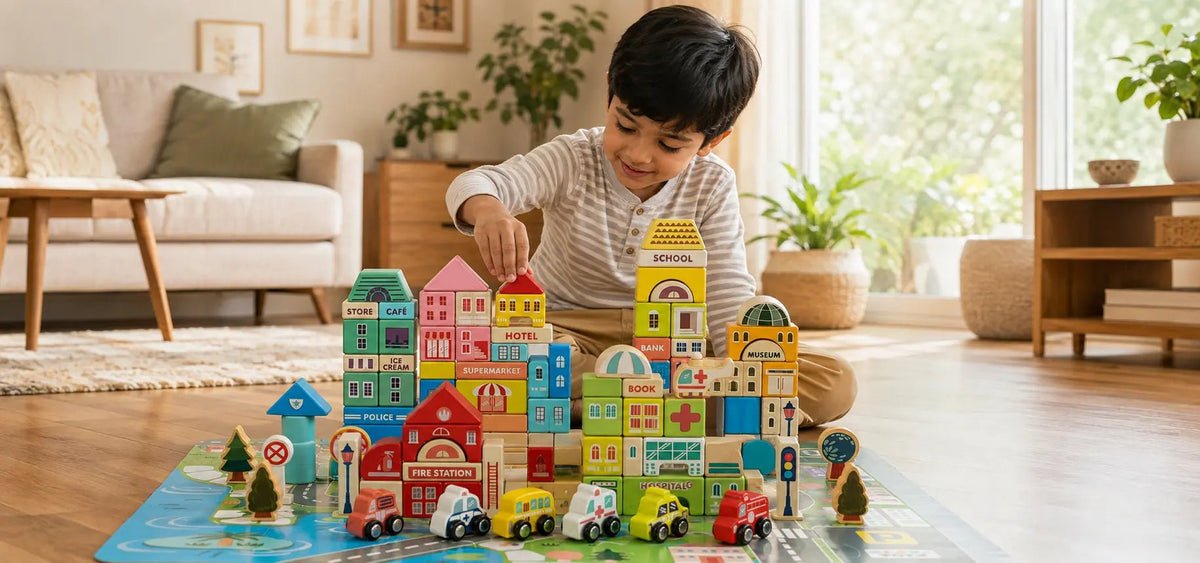
A two-year-old stacks three blocks, watches them fall, and immediately starts again. No one asked them to. They're not following a plan. They're just curious about what happens when you put one thing on top of another.
That's really where building blocks start earning their keep, not in the finished tower, but in everything that happens on the way there. This guide looks at what's actually going on during building play, and what to think about when choosing a set.
What Wooden Building Blocks Actually Are
A wooden building block set is exactly what it sounds like, individual pieces a child can stack, arrange, balance, and combine into something new. Different sets bring different shapes to the mix, arches, cylinders, triangles, simple rectangles, sometimes pieces built specifically for balancing.
More pieces doesn't automatically mean more value, though. A smaller, versatile set often gets used in more different ways than a huge box a child never fully explores.
Why Building Play Is Worth Taking Seriously
Every few minutes during block play, a child is quietly deciding things. What should I build? Why did it fall? Which piece goes underneath this time?
That's a meaningfully different experience than watching something happen. A child isn't observing here, they're the one making the calls. Build, notice, adjust, try again, that loop repeats constantly during a single session, without anyone directing it.
Worth being honest about the limits too. Building blocks don't raise a child's IQ or guarantee anything about school later on, and that's worth being skeptical of if you ever see it claimed. What they do offer is a genuine, repeated chance to experiment and adjust, in a setting with basically zero stakes.
What Kids Actually Practice While Building
A falling tower is a small problem, and small problems are useful.
Wider base, fewer blocks, different order, a totally different shape entirely, a child trying to fix a collapsed tower is testing possibilities, not following an answer key someone gave them.
Above, below, wider, balanced, these ideas show up long before the words do.
A child building a bridge has to figure out where the supports go and how much gap needs to stay between them. That's spatial thinking, worked out with hands rather than taught with vocabulary.
Picking up a block and setting it down carefully takes more coordination than it looks like.
Aligning pieces, adjusting a wobble, moving something without knocking over what's already built, all of it is quiet hand-eye coordination practice, repeated dozens of times an hour.
Nothing about the blocks changes between Monday and Friday. What changes is the idea.
Monday it's a house. Wednesday, a bridge. Friday, an entire city with roads running between buildings. Same set of blocks the whole week, completely different outcomes, because the child decided what they meant each time.
Building something taller usually means thinking one step ahead, even briefly.
"I need a wide base if I want this tall." No one needs to consciously plan like an adult here, the planning just shows up naturally the moment a structure gets ambitious enough to demand it.
A structure falling down isn't really a failure, it's part of how the play works.
Build, watch it fall, notice why, change something, rebuild. That loop is the actual mechanism, not a detour from it. Not every fallen tower needs rescuing.
A house built for a toy animal often turns into a whole story by accident.
A garage, a shop, a school, once building overlaps with pretend play, the structure stops being just a structure and starts being a setting. This connects naturally to pretend play more broadly, the two often blend without a child noticing the line between them.
| Area | How Building Play Can Help | Example |
|---|---|---|
| Problem-Solving | Gives a child a small, low-stakes problem to fix | Widening the base after a tower falls |
| Spatial Thinking | Builds a working sense of how objects relate physically | Figuring out gap width for a bridge |
| Fine Motor Practice | Repeated, controlled hand movements | Carefully placing a block without toppling the tower |
| Creativity | Same pieces, endless different outcomes | A house on Monday, a city by Friday |
| Planning | Thinking a step ahead as structures get ambitious | Widening a base before building tall |
| Persistence | Practice at trying again after something doesn't work | Rebuilding a collapsed tower differently |
Why "Open-Ended" Is the Whole Point
An open-ended toy has no single correct way to be used. Blocks are about as clear an example as toys get, since the child decides what to build, how, whether to follow any plan at all, and what the finished thing actually represents.
Here's the part worth sitting with. The same box of blocks becomes a completely different toy depending on who's holding it. A toddler stacks it. A preschooler builds a house with it.
A seven-year-old turns it into an entire city with roads connecting every building. The product never changed. Only the child using it did.
That's really the strongest argument for buying fewer, better pieces over a huge one-time haul, a good set keeps being useful for years, just in a different shape each time.
Does Wood Actually Matter Here?
Not automatically, and it's worth saying that plainly. Wooden blocks tend to have a sturdy, tactile feel and hold up to years of rough handling. Plastic blocks are usually lighter, easier to clean, and sometimes come with interlocking systems that let kids build more complex, stable shapes than loose wooden pieces easily allow.
Neither one wins outright. What actually matters is the specific toy in front of you, safety, construction, finish, how stable the pieces are, and whether it genuinely fits how your child plays. For the fuller breakdown of what to check regardless of material, our buying guide covers this in depth.
What Age Actually Fits Building Blocks
Toddlers usually stick to stacking, carrying, and the occasional dramatic knock-down, simple exploration more than construction. Big, safe pieces and a bit of supervision matter more than complexity here.
Preschoolers start building actual things, towers, houses, roads, often layered with a story on top. Early school-age kids push further still, planned cities, road networks, sometimes collaborative builds with a sibling or friend.
The genuinely useful part is that one good set can carry a child through all three stages. Nothing about the blocks needs to change. The child's approach does that work on its own.
Choosing Blocks Without Overthinking It
A few things matter more than the rest.
- Age-appropriate piece size, especially for younger kids
- Stable, consistent shapes that stack predictably
- Smooth, splinter-free finishing
- Enough variety to build more than one kind of thing
- A size that actually fits your home, not just an impressive photo
None of this means buying the biggest set available. Piece consistency and finish matter more day to day than sheer quantity, since a child handles, drops, and stacks these constantly, worn or uneven pieces get frustrating fast. For the fuller quality checklist that applies across any wooden toy, our buying guide covers it in detail. If you're not sure where to start, a versatile mixed-shape set, like the Wooden City Building Blocks (115 Pieces), tends to cover the widest range of builds without needing a second purchase right away.
Building Blocks and the Montessori Connection
Blocks fit comfortably into Montessori-inspired homes, hands-on, open-ended, and genuinely independent once a child gets going. That said, being wooden doesn't automatically make a set Montessori, the same way it doesn't for any other wooden toy. Montessori is a broader philosophy, not a material. If you want the fuller explanation, our Montessori guide covers exactly what does and doesn't count.
Simple Ways to Stretch the Play Further
- Build the tallest tower that survives one more block on top
- Build a bridge a toy car can actually drive under
- Build a small city, one building at a time
- Build a shelter for a favorite toy animal
- Rebuild the exact same structure twice, differently each time
- Build together with a parent or sibling, no instructions given
A challenge works better than an instruction. "Can you build something that stays up even with one more block?" leaves the child solving it their own way, rather than copying yours.
Where This Fits Into Screen-Free Time
Block play doesn't replace screens, and it's not trying to. What it offers is something screens generally don't, active decisions, physical hands-on effort, a structure that only exists because the child built it. For families working more screen-free time into a routine, building play is one genuinely useful piece of that, alongside whatever else already works. Our research piece on screen time in early childhood goes deeper into the actual evidence, worth reading if that's a topic on your mind.
A Few Things Worth Watching For
Buying based purely on piece count, expecting a child to copy an adult's design, or rebuilding a fallen structure for them before they've had a chance to try, all common, all fixable. The general fix is the same one, hold back a little, and let the child solve the small problem in front of them, even if it takes three attempts.
One more worth naming. Assuming a pricier set is automatically the better one. Sometimes it is. Often the real difference is piece consistency and finish, not the number printed on the box.
Quick Checklist Before You Buy
- Age appropriate
- Safe, smoothly finished pieces
- Sturdy, consistent shapes
- Enough variety for more than one kind of build
- Genuinely open-ended, not single-purpose
- Fits your child's current interests
- Likely to hold up for years, not months
The real value in a set of blocks was never really in the finished tower. It's in everything that happened building it, the guessing, the failing, the small adjustment that finally worked. A good set of blocks can carry a child from their first wobbly stack all the way to an entire imagined city, all with the exact same pieces. NESTA TOYS builds its block sets with that stretch in mind, sturdy construction, consistent shapes, and finishing meant to survive years of actual use, not just a season.
To browse a starting set, the Wooden Building Blocks Collection is worth a look, and for how building connects to pretend play and open-ended learning more broadly, Wooden Kitchen Toys and Educational Toys are natural next reads.
About the Author
Neha Makdey is the Co-Founder & CEO of NESTA TOYS - India’s homegrown educational toy brand loved by over 3 lakh curious kids. NESTA Toys designs research-backed, hands-on learning toys for children aged 1–10, available on Amazon, Blinkit, Swiggy Instamart, and nestatoys.in. Follow NESTA TOYS on WhatsApp and Pinterest for free parenting resources and activity ideas.
FAQs
Are wooden building blocks actually educational?
They can create genuine opportunities to practice problem-solving, spatial thinking, and creativity, but the value comes from how a child plays with them, not from the blocks themselves.
What skills do children actually practice with building blocks?
Commonly, spatial thinking, fine motor coordination, early problem-solving, and creative thinking, all built through repeated, low-stakes experimenting rather than instruction.
What age can kids start with building blocks?
Many children begin simple stacking around 12 months. The same set typically stays relevant for years, since how a child uses it changes long before the blocks need replacing.
Are wooden blocks better than plastic ones?
Not automatically. Wood tends to feel sturdier and more tactile, plastic is lighter and sometimes allows more complex interlocking builds. Construction quality matters more than material alone.
How do building blocks encourage creativity?
The same set can become a house, a bridge, or a city depending entirely on what the child decides. That open-endedness is what drives the creative part, not any single feature of the toy.
Do building blocks genuinely help with problem-solving?
They give children small, repeated problems to work through, like a collapsing tower, which they solve through trial and adjustment rather than being told the answer.
Are wooden building blocks Montessori toys?
Some fit comfortably into Montessori-inspired play, since they're hands-on and open-ended, but wood alone doesn't make a toy Montessori. The philosophy behind it does.
How many blocks does a child actually need?
Fewer than most people assume. A well-chosen, varied set often gets used more creatively than a huge collection a child never fully explores.
How can parents encourage building play without taking over?
A simple challenge works better than instructions, asking "can you build something that survives one more block?" rather than showing a specific design to copy.
Are building blocks good for screen-free play?
Yes, as one part of a broader routine. They don't replace screens, but they do offer active, hands-on decision-making that passive screen time generally doesn't.


