

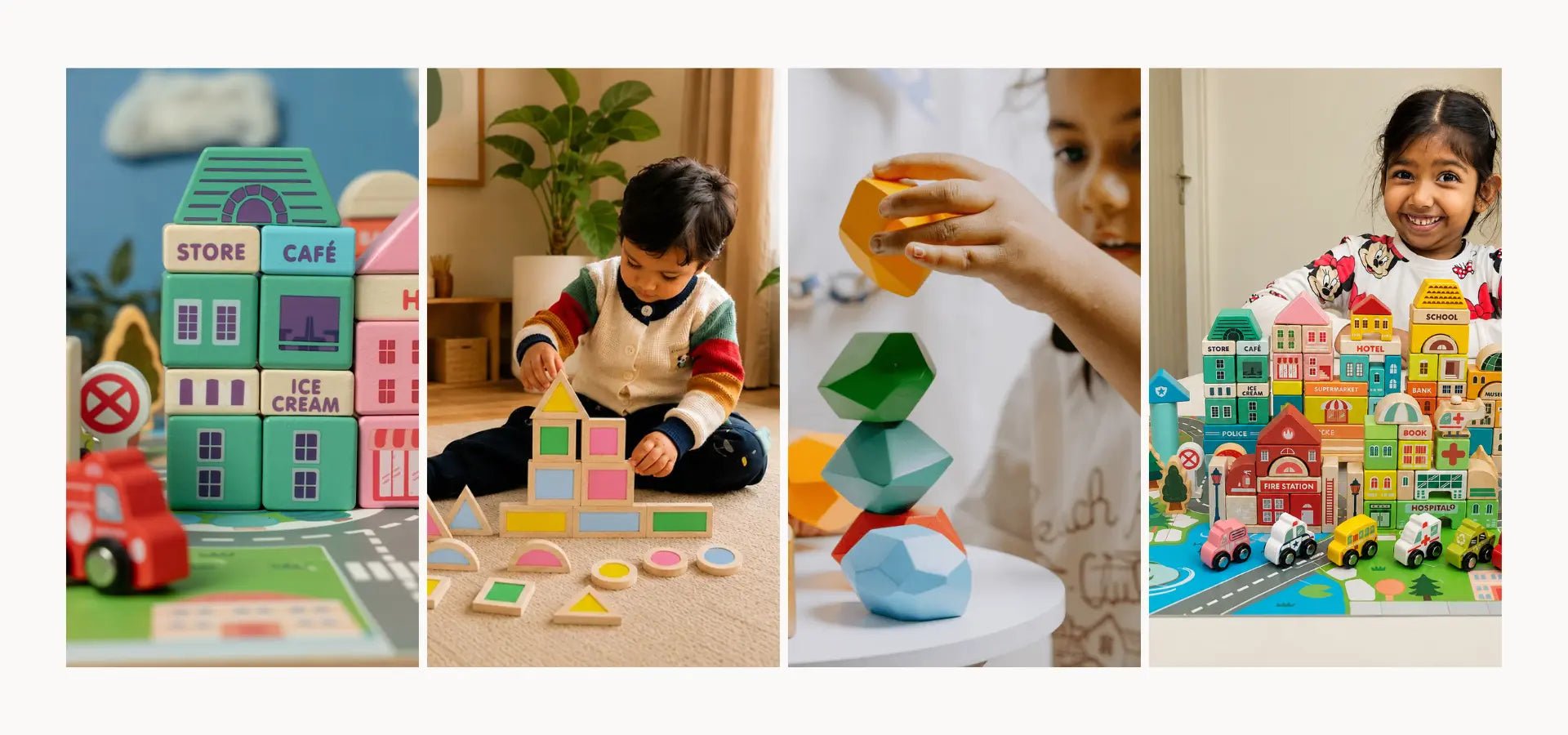
Wooden, plastic, giant sets, tiny sets, loose blocks, interlocking systems, a hundred pieces or twelve, the options genuinely start to blur together after a few minutes of scrolling. And the biggest, most expensive box on the page isn't automatically the right pick.
This is really a decision guide, not a shopping list. Age matters, sure, but so does your child's actual ability, what they're drawn to, the size of the pieces, the material, how much variety is in the box, and whether the whole thing is built to survive real use. Here's how to think through all of it without getting overwhelmed.
What Actually Matters When You're Choosing
Piece count is the number most sets lead with, and it's honestly one of the least useful ones. Age fit, safety, material, shape variety, how well it's finished, whether it genuinely allows open-ended building, all of that tells you more than a number printed on the box.
A few things worth weighing before anything else:
- Age and current ability, not just the birthday
- Piece size, big enough to handle safely, small enough not to feel clunky
- Material, wood or plastic, each with real tradeoffs
- Enough shape variety to build more than one kind of thing
- How it's finished, smooth edges, no obvious weak points
- Whether storage is realistic in your actual home
- Long-term use, will this still make sense in two years
Piece count can genuinely mislead. A hundred identical pieces is often less useful than forty pieces in eight different shapes, since the second box just opens up more ways to build.
Piece count can genuinely mislead.
A hundred identical pieces is often less useful than forty pieces in eight different shapes, since the second box just opens up more ways to build.
Choosing by Age, Loosely
Age ranges help, but treat them as a rough starting point, not a rule written in stone.
Toddlers
Larger, easy-to-grip pieces work best. Mostly picking up, carrying, stacking, and the occasional dramatic knock-down. Safety and ease of handling matter more than variety here.
Preschoolers
More shapes and pieces once stacking feels too easy. Small houses, simple roads, combining shapes on purpose rather than by accident.
Early School-Age
Bigger, more deliberate builds, bridges, towers, entire miniature cities, sometimes built with a sibling or friend rather than solo.
Older Children
Genuine challenge, complex, multi-step designs, sometimes blending building with a story or a specific problem they've set for themselves.
Worth repeating across all four of these: interest and ability matter as much as age, sometimes more. A cautious five-year-old and a confident five-year-old can need genuinely different sets.
Wood, Plastic, or Something in Between
Wood tends to feel sturdier, heavier in the hand, more tactile, and it usually leans open-ended, loose pieces with no fixed way to connect. Plastic is generally lighter, sometimes easier to clean, and often comes with interlocking systems that let kids build taller, more stable structures than loose wooden pieces easily manage.
Neither one wins outright, and it's worth being skeptical of anyone who tells you otherwise. What actually matters is the specific set in front of you, how well it's made, whether it fits your child's style of play, whether the pieces feel safe and solid in hand. Material is one input among several, not the deciding factor on its own.
A Few Buying Myths Worth Clearing Up
Myth: More pieces always means better value.
Fact: A smaller set with real shape variety usually gets used more creatively than a huge box of near-identical pieces a child can't realistically manage.
Myth: Wood is always the higher-quality choice.
Fact: Material is one input among several. A well-made plastic set can outlast a poorly finished wooden one. Construction quality matters more than the label.
Myth: A bigger, pricier set is automatically the better gift.
Fact: A toy only earns its cost if the specific child actually wants to use it. The set your child keeps returning to beats the one that looked most impressive in the box.
How Many Blocks Does a Kid Actually Need
Short answer: fewer than the marketing suggests. More pieces doesn't automatically mean more play.
A smaller set with genuinely varied shapes, cubes, arches, cylinders, triangles, often gets used more creatively than a huge box of near-identical pieces a child can't realistically manage. Storage matters too, a set that's a hassle to put away tends to get played with less, however good the pieces themselves are.
Before buying more, it's worth watching how your child uses what they already have. If they're consistently building taller, wider, or more ambitious structures than the current set allows, that's a real signal for more variety, not just more volume.
Why Shape Variety Changes What Gets Built
Different shapes open different possibilities, and it's fairly intuitive once you see it play out. A long rectangular block works as a wall. An arch creates an opening a toy car can drive through. A triangular piece becomes a roof. A cylinder turns into a column holding something up.
None of this is about one shape being smarter than another. It's simply that more variety means more combinations, and more combinations means a set stays interesting for longer instead of running out of ideas after the first afternoon.
Open-Ended Play Is the Real Value Here
Open-ended play just means the child decides what gets built and how, rather than being steered toward one fixed outcome. A tower one day, a bridge the next, an entire imagined city by the weekend, all from the same pieces. Our guide to why building play matters goes deeper into the developmental side of this, worth reading if that's what you're after. For choosing a set, the practical takeaway is simpler: the more open the pieces are to different uses, the longer they'll stay genuinely interesting.
Why Quality Actually Affects the Play Itself
Blocks get stacked, dropped, carried, knocked over, and rebuilt constantly, sometimes dozens of times in a single sitting. That kind of handling puts real demands on construction. Smooth, consistent pieces, sturdy material, and solid finishing aren't cosmetic details, they directly affect how frustrating or satisfying the play actually feels.
A set with pieces that don't stack evenly turns into a source of frustration fast, however good the shapes are on paper. Expensive doesn't automatically mean well made, and wooden doesn't automatically mean high quality either, the actual construction is what to check, not the price tag or the material label alone.
A Practical Safety Checklist
- Check the manufacturer's recommended age range as a starting point
- Watch piece size carefully for younger children, choking risk is real
- Look for smooth, splinter-free surfaces with no obvious cracks or damage
- Check that no small components can detach unexpectedly
- Follow the stated material and finish guidance where it's provided
- Supervise more closely with younger or less experienced builders
None of this guarantees zero risk, nothing fully does, but it meaningfully lowers it.
Signs Your Child Is Ready for More
Age alone won't tell you this. Watch instead for a few concrete signs, repeatedly rebuilding the same structure with small changes, mixing shapes that weren't obviously meant to go together, testing balance on purpose rather than by accident, asking for more pieces, inventing stories around what they've built, or getting genuinely curious about bridges, roads, or bigger, more elaborate builds.
Any of these suggest a child might be ready for more variety or complexity, not necessarily more volume.
| Feature | What to Look For | Why It Matters |
|---|---|---|
| Age & Ability | Match current skill, not just birthday | Too advanced frustrates, too simple bores |
| Piece Size | Safe for the child's age, manageable in hand | Directly affects safety and ease of play |
| Material | Wood or plastic, based on play style | Each has real, different tradeoffs |
| Shape Variety | More than one or two repeated shapes | More combinations, longer-lasting interest |
| Number of Pieces | Enough to build something real, not overwhelming | More isn't automatically better |
| Safety | Smooth finish, no loose or detachable parts | Reduces real, everyday risk |
| Quality & Finish | Consistent, sturdy, well-made pieces | Affects how satisfying the play actually feels |
| Open-Ended Play | No single fixed way to use it | Keeps the set relevant for years, not months |
| Storage | Realistic for your actual space | Hard-to-store sets get used less often |
A Simple Buying Checklist
☐ Age and ability appropriate
☐ Safe, easy-to-handle piece size
☐ Material that fits how your child plays
☐ Smooth, well-made finish
☐ Genuine shape variety
☐ Enough pieces to build more than one thing
☐ Genuinely open-ended, not single-use
☐ Durable enough for repeated, rough handling
☐ Room to grow into as skills develop
☐ Not needlessly complicated for where your child is right now
So, Are Wooden Building Blocks Worth It
If your child genuinely enjoys building, the set is well constructed, and it offers enough variety to stay useful beyond one type of structure, yes, generally. A set like the Wooden City Building Blocks (115 Pieces) is a reasonable example of a mixed-shape wooden set built with that range in mind, not because it's the only option, but because it illustrates what genuine variety looks like in practice.
That said, worth is really about fit, not price or material. A toy only earns its cost if the specific child in front of you actually wants to use it. The most elaborate, most expensive set on the shelf isn't automatically the right one, the set your child keeps returning to is.
Choosing well here was never really about finding the "best" set in the abstract. It's about matching pieces, size, and complexity to the kid who'll actually be building with them, and picking something solid enough to survive the years of stacking, dropping, and rebuilding that's about to happen.
About the Author
Neha Makdey is the Co-Founder & CEO of NESTA TOYS - India’s homegrown educational toy brand loved by over 3 lakh curious kids. NESTA Toys designs research-backed, hands-on learning toys for children aged 1–10, available on Amazon, Blinkit, Swiggy Instamart, and nestatoys.in. Follow NESTA TOYS on WhatsApp and Pinterest for free parenting resources and activity ideas.
Frequently Asked Questions About Choosing Building Blocks
How do I choose building blocks for my child?
Start with age and current ability rather than the number of pieces. Then check piece size, material, shape variety, and build quality, all of it matters more than a big number on the box.
What age is best for building blocks?
There's no single right age. Many children start simple stacking around 12 months, and a good set stays relevant for years since the way a child uses it changes long before the blocks need replacing.
Are wooden building blocks good for toddlers?
Often yes, provided the pieces are large enough to handle safely and the set is simple enough not to overwhelm. Toddlers generally do best with fewer, bigger pieces rather than a large, varied set.
How many building blocks should a child have?
Fewer than most marketing suggests. A smaller set with genuine shape variety tends to get used more creatively than a large box of repetitive pieces.
Are wooden blocks better than plastic blocks?
Not universally. Wood tends to feel sturdier and more open-ended, plastic is often lighter and allows more complex interlocking builds. The specific set's construction matters more than the material alone.
What should I look for in high-quality wooden blocks?
Smooth, splinter-free finishing, consistent piece sizes that stack predictably, and sturdy construction that holds up to being dropped and handled repeatedly.
Are building blocks open-ended toys?
Generally yes, especially loose, unconnected sets. The child decides what to build and how, rather than following one fixed design, which is what makes them useful across a wide age range.
How can I choose building blocks that grow with my child?
Favor open-ended, varied-shape sets over single-purpose ones. A well-made, versatile set can go from simple stacking to complex, planned construction using the exact same pieces.


