

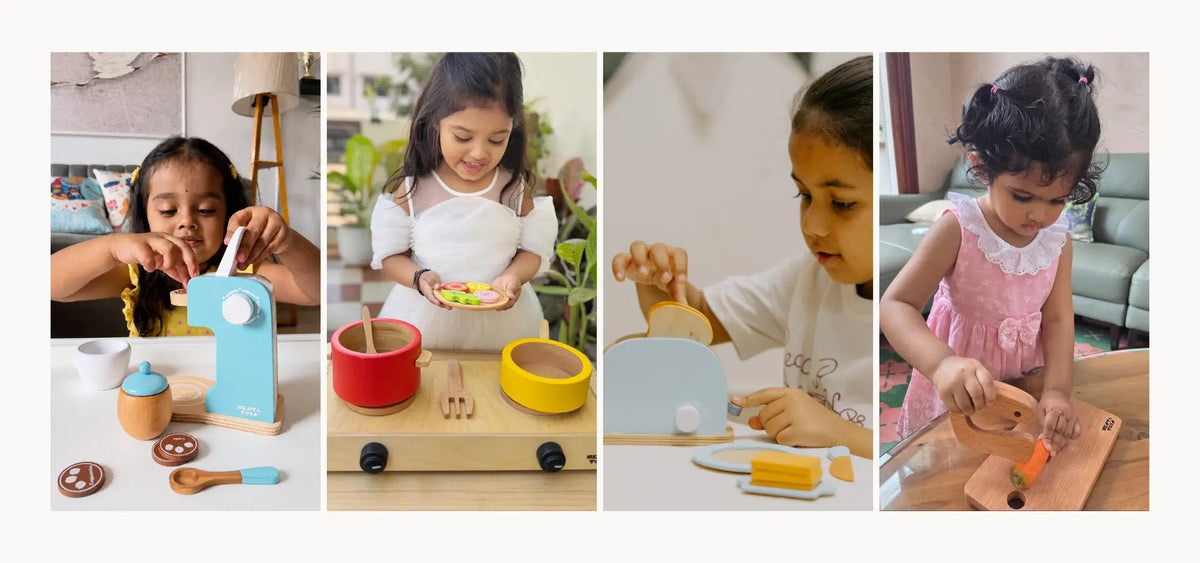
Scroll through kitchen toy listings for more than a minute and the range gets a bit absurd, three loose utensils on one end, a full multi-shelf kitchen station with forty accessories on the other, and everything in between claiming to be the right fit for your child. Somewhere in that spread is the right choice, and it's rarely the biggest option on the page.
Age is part of the answer, but only part. What actually matters is whether your child can comfortably handle the pieces, how much space you realistically have at home, whether they'll be playing alone or with a sibling, and what kind of pretend play they already gravitate toward on their own. Our guide to how pretend play through kitchen toys supports learning covers the why. This one's about the how, working through size, complexity, and setup so you end up with something that actually gets used, not something that looks good in a photo and then sits untouched after week one.
What to Actually Weigh Before Buying
A big set with dozens of accessories looks impressive in a listing photo. Whether it's actually the right buy depends on something the photo can't show you, can your child handle it comfortably, and will they keep coming back to it after the first few days of novelty wear off.
Worth checking before anything else:
- Age appropriateness, as a starting point, not the deciding factor
- Piece size, easy enough to grip without being fiddly
- Overall complexity, matched to what your child can manage right now
- How many accessories genuinely add new play possibilities versus just adding clutter
- Whether it invites open-ended use or locks into one script
- Storage and the space you actually have at home
- Build quality and how it'll hold up to being handled constantly
That last point tends to get overlooked in the moment of buying, but it matters more than it seems. A set that looks charming in photos but wobbles or sheds small parts within a month isn't actually a good buy, whatever the price tag says. And accessory count deserves a second look too, ten pieces that each open up a genuinely different kind of play beat forty pieces that all do roughly the same thing.
A bigger set isn't automatically the better buy.
A large kitchen with dozens of accessories can genuinely overwhelm a child who's just starting pretend play. A few well-chosen pieces they can actually handle often gets used far more often.
Choosing by Age, as a Starting Point
1 to 2 Years
Large, easy-to-grip pieces work best here. A toddler who enjoys pretending to stir or serve often gets more out of a few big pieces than a set with dozens of small accessories. Supervision matters more than complexity.
2 to 3 Years
This is often when a child starts connecting steps, food into a pot, stir, onto a plate, serve. Larger utensils and simple food pieces tend to fit naturally into this kind of sequencing.
3 to 4 Years
Some children are ready for fuller pretend-kitchen setups here, more accessories, real cooking scenarios, parent or sibling roleplay. Others are still perfectly happy with something simpler. Both are normal.
4 to 6+ Years
Longer, multi-step scenarios tend to show up now, restaurant, café, grocery shop, entire cooking stories. But individual interest still matters more than the number on the box.
Age gets you into the right range. It doesn't guarantee the right fit. Two three-year-olds can be worlds apart, one might be running a full pretend restaurant with a menu and a waiting list, the other might still be happily banging a wooden spoon against a pot and calling it soup. Neither is behind. They're just genuinely different kids, and the toy that suits one won't necessarily suit the other.
Full Kitchen or Smaller Pieces First?
Neither approach is universally right, and it's worth resisting the pull to assume bigger automatically means better value for money.
| Approach | Where It Works Well |
|---|---|
| Smaller kitchen toys | Less space, easier storage, lower commitment, a good way to test interest before going bigger |
| Full kitchen set | More immersive roleplay, room for siblings to join, works well once interest is already established |
If a child rarely engages in kitchen pretend play at all, a smaller set usually offers more practical value than committing to a full station right away. It's much easier to expand a collection later, adding a stove, then a sink, then a fuller set of cookware, than it is to walk back an oversized purchase that's mostly gathering dust in the corner of a room. Starting small also gives you real information. If a simple set gets picked up daily for weeks, that's a genuine signal a bigger setup would get used too, not just a guess based on age.
What's Actually Worth Including in a Starter Set
Not every accessory pulls its weight. Before adding more pieces to a cart, it helps to separate what genuinely expands play from what just adds bulk to the box.
Pieces that tend to earn their place:
- A pot or pan, since stirring and cooking motions come up constantly in kitchen play
- A few pieces of pretend food, ideally ones that can be "cut," stacked, or combined in different ways
- Basic serving pieces, a plate and cup or two, enough for the give-and-take of serving someone else
- One or two utensils, a spoon and a knife cover most of what a young child actually reaches for
Pieces that are easy to overspend on:
- Extremely specific, single-use food items that only work in one scenario
- A large number of near-identical accessories in slightly different colors
- Decorative elements that look nice on a shelf but don't actually get picked up during play
A smaller, well-chosen starter set built around genuine essentials often outperforms a bigger box stuffed with filler, and it's a lot easier to add to later than to sort through and remove.
Choosing by What Your Child Actually Enjoys, Not by Assumption
Kitchen play isn't one single activity, it actually splits into several different interests, and none of them belong to one gender over another.
Myth: Kitchen toys are mainly for girls.
Fact: Kitchen play covers cooking, serving, organizing, shopping, storytelling, and social roleplay. None of these interests are gender-specific, a child drawn to any of them benefits the same way regardless.
A few ways this actually breaks down in practice:
- A child who enjoys cooking imitation does well with a basic kitchen set
- A child who likes serving others gravitates toward cups, plates, and serving pieces
- A child drawn to shopping extends the scenario with pretend groceries
- A child who loves building can combine kitchen play with construction pieces
- A child who's into storytelling turns the kitchen into an ongoing narrative
- A child who likes organizing naturally starts sorting food and accessories
- A child who's socially inclined does best with a setup big enough for others to join
The easiest way to figure out which of these fits your own child is simply to watch what they already do with ordinary household objects. A kid who constantly "cooks" with real spoons and bowls in the kitchen, uninvited, is telling you plenty, arguably more than any age chart could.
Independent Play or Play With Others
This is worth thinking through before buying, since it genuinely changes what "right" looks like. A child who mostly plays kitchen alone does fine with a compact setup they can manage entirely on their own, nothing so large or elaborate that it needs another person to make it interesting.
A child who regularly plays with a sibling or friend often benefits from a bit more scale, enough plates and utensils that nobody's left waiting, and enough space around the kitchen for two kids to actually stand there together without bumping elbows. Neither setup is objectively better. It really comes down to how your child plays day to day, not some ideal version of kitchen play that may not match your household at all.
Why Build Quality Still Matters Here
Kitchen pieces get picked up, moved, stacked, and rearranged constantly, arguably more than most other toy categories, since so much of the play involves handling multiple pieces at once in quick succession. Sturdy construction, smooth finishing, and consistent build quality directly affect how long a set stays enjoyable rather than turning into a source of frustration.
Price isn't a reliable shortcut either way, a higher price doesn't guarantee better quality, and a lower price doesn't automatically mean it's poorly made. What actually matters is the specific piece in front of you, how solid the joints feel, whether the finish is smooth, whether the paint or coating looks like it'll survive being handled by small, enthusiastic hands for months. NESTA TOYS follows these same principles when developing its wooden kitchen and pretend-play products, sturdy pieces built to survive constant handling rather than just looking good on a shelf for the first week.
A Practical Safety Checklist
- Check the manufacturer's stated age guidance as a starting point
- Watch piece size closely for younger children, choking risk is real
- Look for smooth, well-finished surfaces with no obvious damage
- Check regularly for loose or detached components
- Follow the stated material and finish information where it's provided
- Supervise more closely with younger or less experienced players
- Store smaller accessories properly when they're not in use
How to Know If a Kitchen Toy Is Actually Right for Your Child
The right kitchen toy matches what your child can comfortably handle, the kind of play they already enjoy, and the level of complexity they're ready for, not the age printed on the box.
A Quick Decision Framework
☐ Is it suitable for my child's current age and ability?
☐ Can they handle the pieces comfortably on their own?
☐ Does it match what they're already drawn to?
☐ Is the complexity right for where they are now?
☐ Can they use it independently, at least some of the time?
☐ Can a parent or sibling join in naturally?
☐ Is it durable enough for repeated, everyday play?
☐ Does it allow more than one type of pretend scenario?
☐ Do you actually have the space for it?
☐ Will your child realistically use it, based on what they already play with?
Can the Same Kitchen Toy Grow With Your Child?
Often, yes, and this matters more than most parents realize when they're standing in a store weighing whether to spend more upfront. A younger child mostly handles, names, and imitates. An older child cooks, serves, and role-plays with actual narrative behind it. An older preschooler or school-age kid turns the exact same set into a restaurant, café, or full family-meal scenario, sometimes with an actual menu they've invented themselves.
The toy itself often doesn't need to change. What changes is how the child chooses to use it, which is really the strongest argument for buying one well-made set instead of upgrading every year as interests shift. A set that was a simple stirring activity at eighteen months can become the backdrop for an elaborate pretend café two or three years later, with no new purchase required in between.
Choosing a wooden kitchen toy was never really about matching a number on a box. It comes down to size, complexity, and setup that fits the specific child playing with it, not the child the packaging assumes exists. Get that part right, and one good set can carry a kid through several genuinely different stages of play, quietly earning its keep the whole way through. You can explore our collection of wooden kitchen toys to find a setup that fits your child's current interests and stage of play.
About the Author
Neha Makdey is the Co-Founder & CEO of NESTA TOYS - India’s homegrown educational toy brand loved by over 3 lakh curious kids. NESTA Toys designs research-backed, hands-on learning toys for children aged 1–10, available on Amazon, Blinkit, Swiggy Instamart, and nestatoys.in. Follow NESTA TOYS on WhatsApp and Pinterest for free parenting resources and activity ideas.
FAQs About Wooden Kitchen Toys by Age
What age is best for wooden kitchen toys?
There's no single right age. Younger children often start with a few large, simple pieces, while older preschoolers can typically handle more detailed sets for longer pretend scenarios.
Are wooden kitchen toys suitable for toddlers?
Yes, provided the pieces are large and easy to grip. A toddler often gets more value from a handful of manageable pieces than a set with dozens of small accessories.
What kitchen toys are good for a 2-year-old?
Larger utensils and simple food pieces work well, especially once a child starts connecting steps, stirring, then serving, into a simple sequence.
Should I buy a toy kitchen or a smaller kitchen set?
Depends on interest and space. If your child rarely engages in kitchen pretend play, a smaller set usually offers more practical value than a full station.
Are wooden kitchen toys good for pretend play?
Generally, yes, they tend to invite open-ended use rather than one fixed script, which supports richer, more varied pretend scenarios over time.
What should I look for in a high-quality wooden kitchen toy?
Sturdy construction, smooth finishing, and consistent build quality that holds up to being picked up, moved, and rearranged constantly during play.
Can boys and girls both play with kitchen toys?
Yes. Kitchen play covers cooking, organizing, serving, and storytelling, none of which are gender-specific interests.
How do I choose kitchen toys based on my child's age?
Use age as a starting point, then check piece size, complexity, and whether it matches what your child already enjoys, ability and interest matter as much as the number on the box.


