

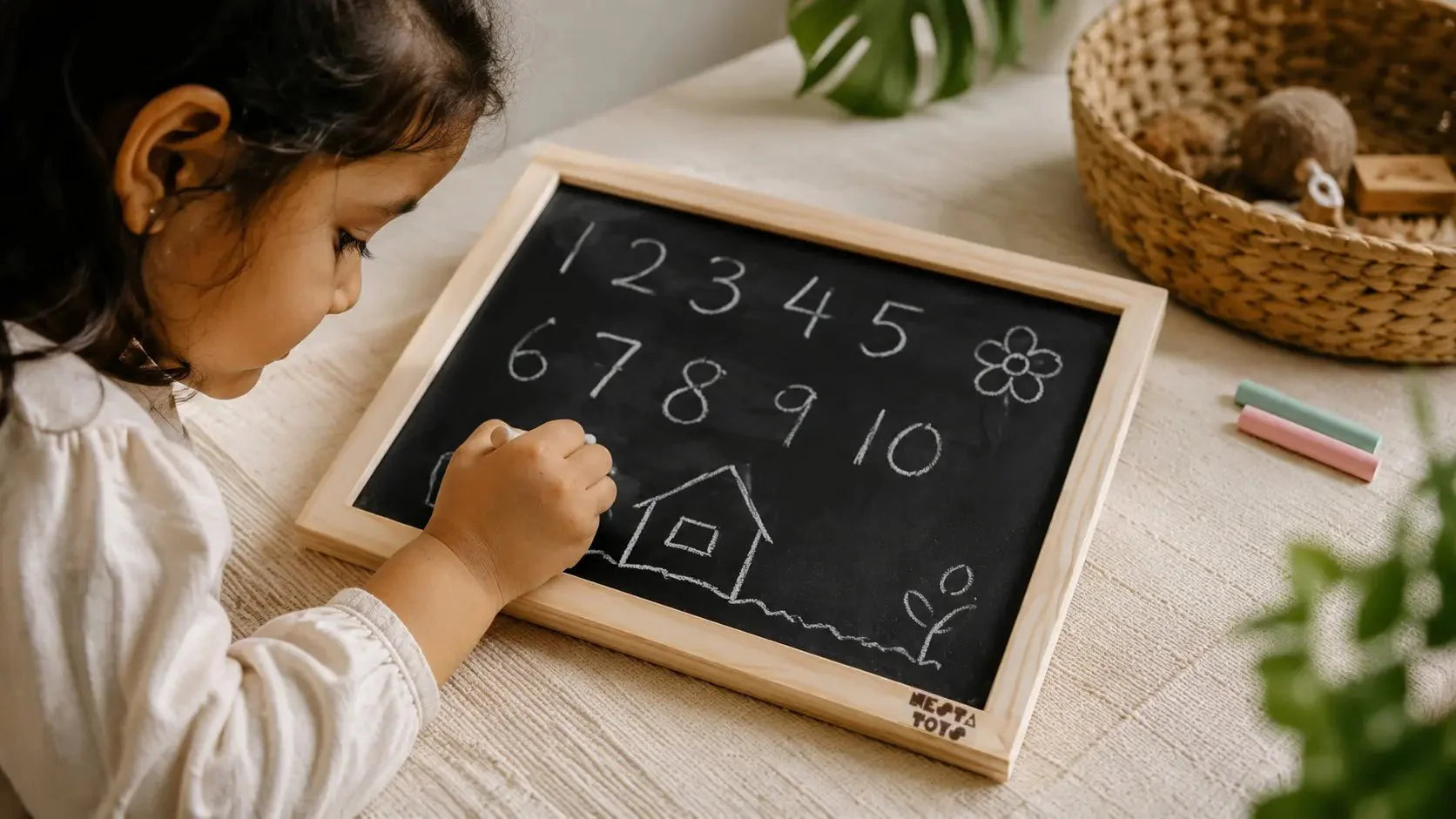
Most parents do not connect everyday play with handwriting development because the two things look completely unrelated from the outside. A child sitting with crayons, glue, paper scraps, and building blocks usually just looks messy and busy. But during those simple moments, the brain is quietly developing hand stability, finger coordination, pressure control, and movement precision. These are the same skills children later need for neat handwriting, spacing, and writing fluency.
Writing development actually begins long before children start writing full sentences in notebooks. When children colour inside shapes, cut paper with scissors, squeeze glue carefully, or fold craft paper, the brain keeps learning how to guide hand movement with better control. These repeated actions slowly strengthen the systems responsible for pencil grip, line alignment, writing rhythm, and hand endurance.
What makes hands-on play especially effective is that children feel relaxed while doing it. The moment handwriting becomes a “task,” many children become conscious about mistakes, neatness, or speed. But during art and craft activities, the pressure disappears. The hands move more naturally because the child feels emotionally engaged instead of judged. Honestly, this is why many children practise movement control longer during play than during formal writing exercises.
Why Writing Skills Begin With Movement Before Letters
One of the biggest misconceptions about handwriting is believing children improve mainly through worksheets. In reality, writing is physical before it becomes academic. A child may know exactly what they want to say but still struggle to write comfortably because the hand muscles and movement systems are still developing.
Fine motor development involves much more than simply holding a pencil properly. It includes finger strength, wrist stability, posture balance, visual tracking, and pressure control working together at the same time. Even colouring inside a small boundary requires controlled movement and coordination. Adults do these actions automatically, but children build these skills slowly through repeated hands-on experiences.
This is why activities involving painting, folding, sticking, tearing, arranging, and assembling become so valuable during childhood. These actions strengthen small muscles naturally without making children feel like they are “practising handwriting.” Many educators working in handwriting development now focus heavily on movement-based preparation because children with weak hand control often struggle with spacing, writing rhythm, and pencil stability later in school.
At Younglabs, educators working closely with handwriting readiness often observe that children who regularly participate in creative hand-based activities usually develop stronger writing comfort over time. The improvement rarely happens overnight, but the hands slowly become more stable, controlled, and coordinated because the child is repeatedly engaging in purposeful movement without emotional pressure attached to performance.
The Everyday Activities Quietly Strengthening Hand Control
The beautiful thing about fine motor development is that children do not always need expensive tools or highly structured exercises to improve it. Some of the strongest developmental experiences happen during ordinary play situations that most adults barely notice at first. What appears “simple” from the outside is often extremely valuable for the nervous system because the child is constantly learning how to guide movement more efficiently.
Creative Activities That Naturally Build Writing Readiness
- Colouring and painting activities help children improve directional control because they continuously practise staying within visual boundaries while adjusting pressure and wrist movement. Over time, this supports better handwriting alignment and smoother pencil flow during classroom work.
- Craft activities involving glue, paper folding, and ice cream stick models strengthen bilateral coordination since both hands must work together carefully. Even simple craft work teaches children patience, hand stability, and controlled placement movements.
- Clay work and dough activities strengthen finger muscles deeply because squeezing, rolling, flattening, and shaping require repeated resistance-based movement. Many children struggling with writing fatigue benefit significantly from these types of sensory hand activities.
- Cutting with scissors improves hand separation skills and movement coordination because one hand stabilizes while the other performs controlled action. This directly supports notebook handling and writing balance later.
- Bead threading, sticker placement, and small object sorting games improve eye-hand coordination and visual precision, especially for younger children still developing movement accuracy.
The important thing parents should understand is that improvement usually appears gradually rather than dramatically. Children rarely wake up one morning with suddenly perfect handwriting. Instead, small developmental changes begin showing first. The child starts colouring more patiently. Pencil grip becomes slightly less stiff. Craft activities begin looking more organized. The child stops tearing paper accidentally while writing. Homework frustration reduces little by little. These small signs often indicate that the underlying movement system is becoming stronger.
Why Emotional Comfort Changes Learning Completely
One thing many adults unintentionally overlook is how strongly emotions influence physical learning. Children do not perform movements the same way under stress compared to when they feel relaxed. The body literally changes its movement quality depending on emotional comfort. When children constantly hear corrections like “write neatly,” “fix your spacing,” “stay on the line,” or “slow down,” some of them slowly begin associating writing with pressure rather than expression.
This is where creative play changes everything quietly.
During art and craft activities, children focus more on creating something meaningful than avoiding mistakes. A child painting a sunset or making a handmade birthday card is emotionally engaged in the process itself. They are experimenting freely, repeating movements naturally, and staying focused for longer periods because the activity feels enjoyable instead of performance-driven. The hands relax differently in that environment. Relaxed hands usually develop smoother movement patterns because tension reduces.
Honestly, this is why some children who resist handwriting worksheets completely can still spend forty-five minutes deeply focused while painting, cutting paper shapes, or building random craft projects at home.
Parents sometimes unknowingly interfere with this natural developmental process by trying to correct every tiny detail during creative work. They straighten craft placement, fix colouring mistakes, or compare artwork with siblings. But children often develop more confidence through independent imperfect work than through perfectly corrected work managed mostly by adults. Fine motor growth depends heavily on repetition, experimentation, and emotional safety.
Why Modern Childhood Is Quietly Affecting Writing Readiness
Childhood today looks very different compared to earlier generations. Many children now spend more time tapping screens than physically manipulating objects. Swiping a finger across a tablet requires very little resistance or coordinated hand effort compared to painting with brushes, folding paper, squeezing glue carefully, or assembling detailed craft materials. That difference matters because hand muscles develop through varied physical movement experiences over time.
This does not mean technology itself is harmful. The issue is imbalance. When children lose regular opportunities for physical creative work, educators increasingly notice weaker grip strength, lower writing stamina, and greater hand fatigue during classroom tasks. Some children become mentally advanced but physically uncomfortable during writing-heavy activities because the small muscles supporting handwriting have not received enough strengthening opportunities.
Parents often misinterpret this discomfort as laziness or lack of focus, when in reality the child may simply be struggling physically. A child whose hands tire quickly may avoid writing not because they dislike learning, but because the movement itself feels exhausting. This becomes especially visible during homework sessions where handwriting quality starts neatly and slowly deteriorates after only a few lines.
Creative play helps rebuild these missing movement experiences naturally because the child is actively using the hands in meaningful ways rather than passively interacting with screens.
What Parents Can Do Without Turning Creativity Into “Homework”
One mistake many well-meaning parents make is over-structuring every developmental activity. The moment creativity begins feeling like another monitored task, emotional resistance usually increases. Fine motor growth happens most naturally when children experience movement through curiosity, experimentation, and enjoyable repetition rather than constant evaluation.
Simple Ways Parents Can Support Fine Motor Development Naturally
- Keep art supplies easily accessible instead of treating them like special-event materials. Children engage more freely when creativity feels like a normal part of everyday life.
- Allow children enough time to complete detailed activities slowly because rushing often reduces movement quality and increases frustration.
- Include children in practical household tasks involving controlled hand movement such as folding clothes, decorating cards, arranging stationery, or handling small kitchen activities safely.
- Encourage effort and movement awareness instead of perfection. Comments focused on control and patience build confidence more effectively than appearance-based praise alone.
- Observe posture, paper positioning, and hand comfort gently during activities because body stability strongly influences writing rhythm and endurance later.
The goal is not producing “perfect” artists or exceptionally neat children overnight. The real goal is helping children build movement confidence gradually so writing eventually feels physically manageable rather than emotionally stressful.
Why Hands-On Play Supports Confidence Beyond Handwriting
One overlooked benefit of creative physical play is that children begin trusting their own abilities more through independent creation. They build things. They solve problems physically. They experiment, fail, retry, and eventually complete projects using their own hands. That confidence quietly transfers into academic situations too.
Children who feel physically capable usually approach writing tasks differently from children constantly worried about mistakes. Confident hands move more freely. The child becomes more willing to practise naturally because the activity no longer feels threatening. This emotional shift is often just as important as the physical skill development itself.
And honestly, this is why meaningful learning during childhood cannot always be measured immediately through worksheets or grades alone. Some of the most important developmental progress happens quietly while children are painting messy pictures, building uneven cardboard projects, mixing colours incorrectly, or proudly showing adults something imperfect they created completely on their own.
Conclusion
Strong writing skills are not built only through repeated handwriting pages or constant correction. They are built slowly through years of movement experiences that strengthen coordination, stability, pressure control, and hand confidence underneath the surface. Every time children paint, cut, fold, squeeze, colour, stick, build, or create something using their hands, the brain is quietly refining the same systems later needed for comfortable writing.
Sometimes the most meaningful developmental progress does not happen during formal practice sessions at all. Sometimes it happens quietly at the dining table while a child proudly tries to finish a messy little craft project with complete concentration written all over their face.
About the Author
Neha Makdey is the Founder & CEO of NESTA TOYS - India’s homegrown educational toy brand loved by over 1 lakh curious kids. NESTA Toys designs research-backed, hands-on learning toys for children aged 1–10, available on Amazon, Blinkit, Swiggy Instamart, and nestatoys.in. Follow NESTA TOYS on WhatsApp and Pinterest for free parenting resources and activity ideas.
FAQs
1. Can hands-on play really improve handwriting skills?
Yes, very naturally. Activities involving painting, clay work, paper crafts, cutting, threading, and colouring strengthen the same muscles and coordination systems children use while writing. Over time, this improves hand stability, pencil control, and writing endurance.
2. What age is most important for developing fine motor skills?
Fine motor development begins very early, but ages 4–10 are especially important because children start handling more detailed classroom writing tasks during these years. Consistent creative movement experiences during this period can make writing adaptation much smoother later.
3. My child dislikes colouring and craft work. Should I force it?
Not necessarily. Some children avoid these activities because they already find hand control physically tiring. Instead of forcing perfection, start with simpler enjoyable activities involving movement and creativity. Confidence usually develops gradually once pressure reduces.
4. How much hands-on play is enough for children?
There is no perfect number, but even 20-30 minutes of meaningful creative play several times a week can support noticeable improvement over time. Consistency matters more than intensity.
5. Are handwriting worksheets enough to improve writing control?
Worksheets help to some extent, but strong handwriting development usually requires broader movement experiences as well. Children need opportunities to strengthen finger muscles, posture control, wrist movement, and coordination through varied physical activities, not only repetitive writing practice.


