

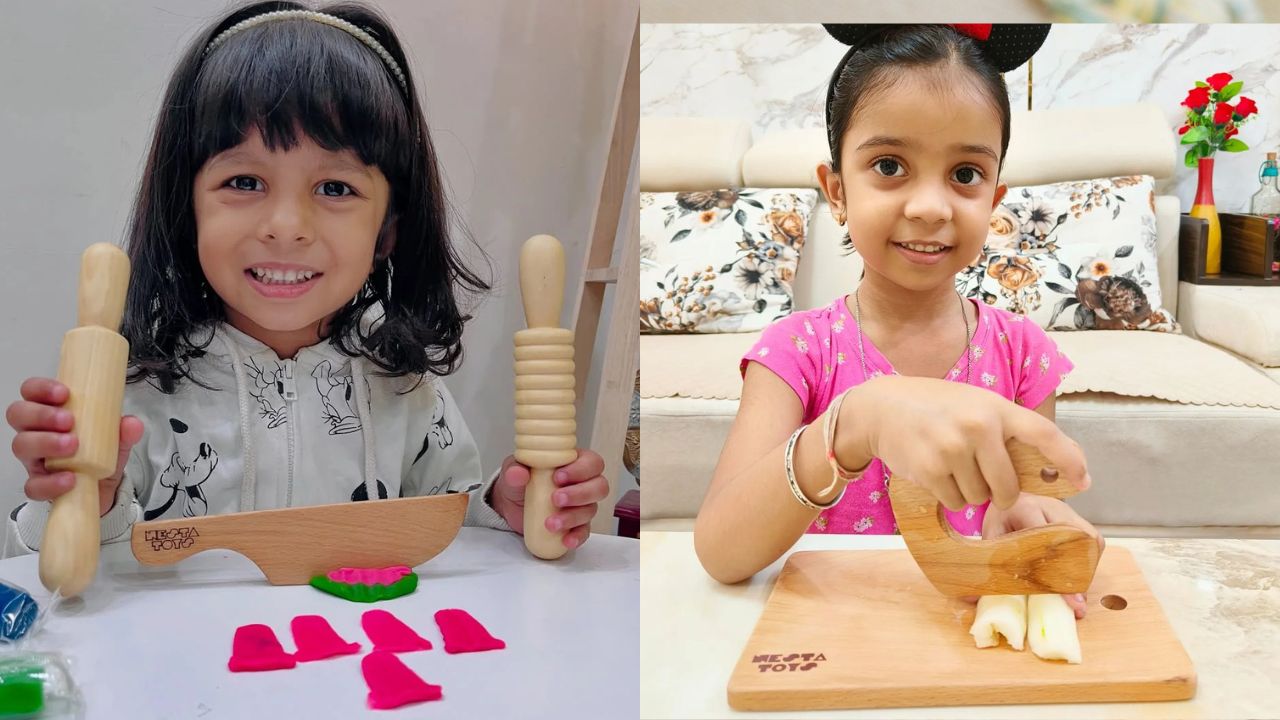
There is a moment every parent notices. Your toddler stops watching you cook and starts reaching for the counter. They want to hold the spoon, touch the dough, and be part of whatever you are doing.
This is not just curiosity. It is your child's natural drive to learn through doing.
Giving them the right tools to act on that instinct is one of the most powerful developmental choices you can make as a parent. And two of the simplest, most effective tools to start with are a Montessori chopping board and a play dough tool set.
Together, they cover some of the most important early childhood skills, from hand strength and coordination to focus, independence, and confidence.
What Are Montessori Kitchen Tools and Why Do They Matter?
Montessori learning is built around real-life activities with a clear purpose and a visible outcome. Instead of passive play, children become active participants in everyday routines.
A Montessori kitchen set fits directly into this approach. When a toddler uses tools designed for their size and ability, they are not pretending to cook. They are learning how to do real things, which builds a completely different kind of confidence.
The right tools are safe, natural, and sized for small hands. They allow children to explore independently without constant supervision or restriction, and that freedom is where real learning happens.
Why Wooden Tools Are Better Than Plastic Toy Sets?
Most toy kitchen sets are designed around pretend play. Bright colors, sound effects, and exaggerated features keep children entertained but do not fully satisfy their desire to do real things.
Plastic materials also lack the natural sensory quality that toddlers respond to. Children at this age explore through touch, and the feel of a material matters more than most parents realize.
Wooden tools offer a completely different experience. They feel solid and real in small hands. They are durable enough for daily use. And they do not overstimulate, which means children can focus more deeply on the task in front of them.
This is why wooden kitchen tools for toddlers are a central part of Montessori practical life learning.
How to Use a Montessori Chopping Board With Your Toddler?
A child-safe chopping board with a wooden knife is often one of the first real kitchen tools a toddler can use independently. It looks simple, but the learning it supports is significant.
Cutting Soft Fruits and Vegetables
Start with soft foods like bananas, strawberries, boiled potatoes, or cooked carrots. Show your child how to place the fruit on the board, hold it steady with one hand, and press down gently with the other.
This activity builds hand-eye coordination, controlled movement, and confidence. The moment a toddler successfully cuts something on their own, their face says everything. They feel capable, and that feeling matters.

Butter Spreading
Place a slice of bread on the chopping board and let your child spread butter or cream cheese using the wooden knife. This teaches fine motor control and gentle pressure in a way that feels genuinely useful.
It is also one of the most satisfying activities for toddlers because they can immediately eat what they made.
Transferring and Arranging
Use the chopping board as a workspace for transferring ingredients from one bowl to another, arranging fruit slices, or assembling simple snacks. These activities develop focus, precision, and a sense of order that directly connects to Montessori practical life principles.
Meet the Nesta Toys Montessori Chopping Board and Knife
The Nesta Toys Montessori Chopping Board and Knife is a child-safe cutting tool designed specifically for toddlers. It gives children a real sense of participation in kitchen activities while keeping safety at the center of every detail.
The wooden knife is sized perfectly for small hands, and the board provides a stable, comfortable surface for early cutting practice. Together they make one of the most purposeful additions to any toddler's learning environment.
👉 Shop Now : Montessori Chopping Board and Knife
How to Use a Play Dough Tool Set as a Montessori Learning Activity
A play dough tool set is one of the most underrated learning tools in early childhood. When paired with a chopping board, it becomes a complete Montessori activity that children can return to again and again.
Rolling Dough
Place a ball of play dough on the chopping board and hand your toddler the rolling pin. Let them press and roll freely at first before showing them how to use both hands together and apply even pressure.
The back and forth motion of rolling is deeply satisfying for toddlers and naturally holds their attention for longer than most activities. It builds bilateral coordination, strength, and focus all at once.
The patterned rolling pin adds an extra layer of excitement as children discover the textures and prints it leaves behind in the dough, encouraging them to roll more, experiment more, and stay engaged longer.

Cutting Play Dough
Once the dough is rolled flat, let your child use the wooden knife to cut it into pieces. This connects directly to the chopping board skills they are developing and reinforces the same careful, controlled movement.
Because play dough is soft and forgiving, there is no pressure to get it right. Children can try, reshape, and try again without frustration, which is exactly the kind of low-stakes practice that builds genuine skill.
Using Moulds and Shapes
Press the dough into small bowls or shape it by hand into fruits and vegetables. This encourages imagination, problem solving, and fine motor development all at the same time.
It also naturally connects to real cooking. Your child begins to understand how dough behaves, how pressure changes its shape, and how repetition leads to better results.
Meet the Nesta Toys Play Dough Tool Set
The Nesta Toys Play Dough Tool Set includes everything a toddler needs to explore dough play with real purpose. The kit comes with one smooth wooden rolling pin, one patterned wooden rolling pin for texture and creative patterns, and one child-safe wooden knife for cutting and shaping.
Each tool is crafted from high-quality wood with a smooth, non-toxic finish that is durable, easy to clean, and completely safe for children aged 2 and above. The tools are sized perfectly for small hands, making them easy to grip and control from the very first use.
It is a perfect gift for birthdays or any occasion where you want to give something genuinely useful and developmental, not just entertaining.
👉 Shop Now : Play Dough Tool Set
What Skills Do These Kitchen Tools Build Together?
Both the Montessori chopping board and the play dough tool set work on the same core developmental areas, which is why they complement each other so well.
- Fine motor skills develop through every squeeze, cut, roll, and spread. These small hand movements directly prepare children for writing, drawing, and self-care tasks.
- Hand strength grows with repeated use of tools. Pressing, rolling, and cutting all require effort, and that effort builds the muscle control toddlers need as they grow.
- Coordination improves as children learn to use both hands together and control their movements with increasing precision.
- Focus deepens when children are given purposeful tasks with visible outcomes. Unlike passive entertainment, these activities require attention and reward it.
- Independence grows with every task completed successfully. When children are trusted with real tools and real work, they begin to see themselves as capable individuals. That confidence extends well beyond the kitchen.
How to Bring These Activities Into Your Daily Routine?
You do not need to set aside special time for this. The best Montessori learning happens inside everyday moments.
Slow down your cooking routine occasionally and invite your child to join. Let them roll dough while you prepare a meal. Give them soft fruit to cut while you chop vegetables. Allow them to spread butter on their own toast in the morning.
Keep their tools accessible. When children can reach their kitchen tools independently, they are far more likely to engage without being prompted. A low shelf or a dedicated basket works well.
Focus on the process, not the result. Dough will be overworked. Cuts will be uneven. Butter will go on thick. None of that matters. What matters is that your child is doing, trying, and learning with every single attempt.
Frequently Asked Questions
1. At what age can a toddler start using a Montessori chopping board?
Most children are ready to use a child-safe chopping board from around 18 months to 2 years. Start with very soft foods like bananas and build up gradually as their coordination and confidence grow.
2. Is play dough safe for toddlers aged 2 and above?
Yes, play dough is safe and highly recommended for toddlers aged 2 and above. Always supervise younger children and use non-toxic, child-safe dough to ensure a safe experience.
3. Can these tools be used every day?
Absolutely. In fact, daily use is what makes Montessori tools so effective. Repetition builds skill, and the more often your child uses these tools, the more confident and capable they become.
4. What is the difference between a smooth and a patterned rolling pin?
A smooth rolling pin is ideal for basic rolling and flattening dough. A patterned rolling pin adds texture and prints to the dough surface, which makes the activity more visually stimulating and encourages children to keep exploring.
5. Are wooden kitchen tools better than plastic ones for toddlers?
Yes. Wooden tools feel more natural and solid in small hands, do not overstimulate, and are more durable for daily use. They also align better with Montessori principles of using real, purposeful materials for learning.
6. Where to Get the Best Kitchen Tool Set for Toddlers in India?
If you are looking for safe, Montessori-aligned kitchen tools for your toddler, we have got you covered. At Nesta Toys, we offer the Montessori Chopping Board and Knife and the Play Dough Tool Set, both crafted from high-quality wood with a non-toxic finish and designed specifically for children aged 2 and above.
Final Thoughts
Toddlers do not need more toys. They need more opportunities to feel capable.
A Montessori chopping board and a play dough tool set are two of the simplest, most effective tools you can give your child. Used together, they cover a wide range of developmental skills while keeping your toddler genuinely engaged in purposeful, hands-on activity.
The kitchen is already where your family comes together. Invite your little one into it, give them the right tools, and watch what they are truly capable of.
About the Author
Neha Makdey is the Co-Founder & CEO of NESTA TOYS - India’s homegrown educational toy brand loved by over 1 lakh curious kids. NESTA Toys designs research-backed, hands-on learning toys for children aged 1–10, available on Amazon, Blinkit, Swiggy Instamart, and nestatoys.in. Follow NESTA TOYS on WhatsApp and Pinterest for free parenting resources and activity ideas.


