

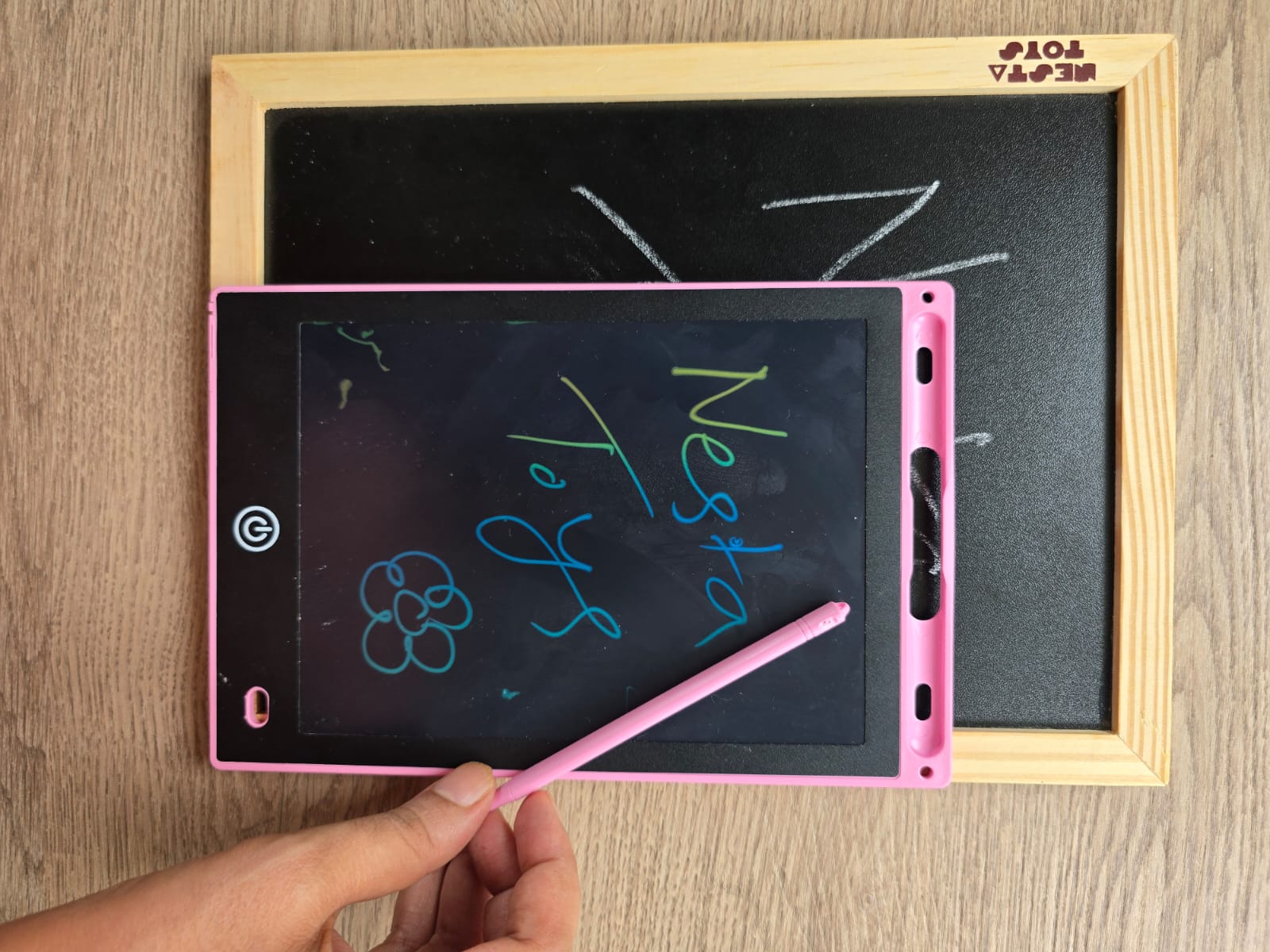
When parents search for the best writing board for kids, they often come across two popular options: the traditional wooden slate and the modern LCD writing tablet.
At first glance, both seem to serve the same purpose—drawing, writing, and practicing letters without wasting paper. But once you look beyond the surface, the differences become much more significant.
As a team that spends months researching and designing educational toys, we compared both products from a child's perspective rather than just a parent's budget.
Here's what we found.
1. Grip and Pencil Control: The Foundation of Writing Skills
One of the biggest challenges for toddlers is developing the correct pencil grip.
Most LCD writing tablets come with a thin plastic stylus that is fixed in size. While it may work for older children, many toddlers struggle to hold it comfortably.
A wooden slate offers much more flexibility.
-
Start with jumbo chalks that are thick and easy for little hands to grasp.
-
As your child develops better control, switch to standard chalk.
-
The writing tool evolves with your child's motor development instead of forcing them into a one-size-fits-all solution.
Winner: Wooden Slate ✅

2. Durability and Build Quality
Children don't use toys gently.
They drop them, stack them, carry them around the house, and sometimes even sit on them.
A well-crafted wooden slate offers:
-
A sturdy frame
-
Better resistance to everyday wear
-
A premium feel
-
Long-term durability
Many budget LCD writing tablets use lightweight plastic that can crack or feel flimsy after repeated use.
Winner: Wooden Slate ✅
3. A Better Sensory Learning Experience
Writing isn't only about seeing letters appear.
Children learn through touch, sound, movement, and repetition.
With a wooden slate, they experience:
-
The texture of chalk
-
The gentle resistance while writing
-
The sound of chalk against the board
-
The action of wiping and starting over
These small sensory cues make learning more engaging and memorable.
LCD tablets provide convenience but remove much of this tactile feedback.
Winner: Wooden Slate ✅
4. Freedom to Adapt as Your Child Grows
A digital tablet limits you to the stylus that comes with it.
A wooden slate gives parents choices.
You can:
-
Use jumbo chalks for beginners
-
Switch to thinner chalks later
-
Experiment with different grip sizes
-
Replace chalks easily without depending on proprietary accessories
That flexibility supports children through multiple developmental stages.
Winner: Wooden Slate ✅
5. Writing Space Matters
Many LCD writing tablets have relatively compact active areas.
A larger wooden slate encourages:
-
Bigger arm movements
-
Better letter formation
-
Comfortable drawing
-
Creative storytelling
-
Collaborative play with siblings
When children aren't worried about running out of space, they tend to express themselves more freely.
Winner: Wooden Slate ✅
6. Sustainability and Eco-Friendliness
Parents today are increasingly conscious about the materials their children interact with.
Wood is:
-
Renewable
-
Durable
-
Timeless
-
Naturally appealing
A wooden slate can last for years and often becomes something that can be passed on to younger siblings.
Budget plastic products, on the other hand, are more likely to be discarded once damaged.
Winner: Wooden Slate ✅
7. Screen-Free Learning That Feels Intentional
Although LCD writing tablets don't emit the same type of light as phones or tablets, they still resemble electronic devices.
A wooden slate creates a completely different environment.
Children associate it with creativity, handwriting practice, and open-ended exploration rather than gadgets.
For many families trying to build screen-free habits, this distinction matters.
Winner: Wooden Slate ✅
Side-by-Side Comparison
| Feature | Wooden Slate | LCD Writing Tablet |
|---|---|---|
| Grip options | ✅ Jumbo or regular chalk | ❌ Fixed stylus |
| Toddler-friendly | ✅ Excellent | ⚠️ Stylus may be too thin |
| Sensory development | ✅ Rich tactile experience | ❌ Limited tactile feedback |
| Durability | ✅ Strong wooden frame | ⚠️ Depends on plastic quality |
| Sustainability | ✅ Eco-friendly materials | ❌ Mostly plastic construction |
| Writing experience | ✅ Natural and engaging | ✅ Convenient but less tactile |
| Long-term adaptability | ✅ Grows with the child | ❌ Limited customization |
Does That Mean LCD Writing Tablets Are Bad?
Not at all.
They're lightweight, reusable, and convenient for travel or quick doodling.
But if your goal is to help a young child build writing confidence, improve fine motor skills, and enjoy a richer hands-on learning experience, a thoughtfully designed wooden slate offers advantages that go beyond convenience.
Why We Chose Wood at Nesta Toys
When we designed our wooden slate, we didn't ask:
"How can we make this cheaper?"
We asked:
"How can we make this better for a child?"
That meant choosing sturdier materials, allowing parents to use different chalk sizes, creating a larger writing surface, and focusing on an experience that supports real learning rather than just imitation.
Sometimes, the best educational toy isn't the one with the newest technology.
Sometimes, it's the one that has quietly worked for generations—refined with thoughtful design and built to help children learn with confidence.
Frequently Asked Questions
Is a wooden slate better than an LCD writing tablet for toddlers?
For many toddlers, yes. A wooden slate allows parents to use thicker jumbo chalks that are easier to grip and provides a more tactile writing experience that supports fine motor development.
Can children learn writing skills better with a wooden slate?
A wooden slate encourages natural hand movements, pressure control, and sensory feedback, all of which contribute to early writing practice and coordination.
Are LCD writing tablets useful?
Absolutely. They're convenient, reusable, and portable. However, they offer less flexibility in grip options and may not provide the same sensory engagement as traditional writing tools.
Which is more eco-friendly?
A durable wooden slate made from responsibly sourced materials can be a more sustainable long-term choice than inexpensive plastic alternatives, especially when designed to last for years.
Final Thoughts
Technology has its place, but not every innovation replaces a classic.
When choosing between a wooden slate and an LCD writing tablet, the decision isn't just about price or convenience—it's about the kind of learning experience you want your child to have.
For families who value creativity, fine motor development, durability, and sustainability, a wooden slate remains one of the simplest and most effective educational tools available.


